
Table of Contents
- Introduction: Mindfulness in the Modern Therapy Room
- Why Mindfulness Matters for Therapists in 2025
- The Five Most Effective Mindfulness Techniques (According to Research)
- How to Integrate Mindfulness Into Trauma Therapy
- Recent Research, News, and Conferences (2025)
- Best Trainings and Resources for Therapists
- Conclusion: Elevate Your Practice With Mindfulness Mastery
Introduction: Mindfulness in the Modern Therapy Room
As a long-time meditator and mental wellbeing advocate who also supports thousands of therapists on their professional growth journey, I’ve watched mindfulness evolve from a buzzword to a core pillar of evidence-based clinical work (not to mention self-care!). In 2025, mindfulness techniques for therapists are no longer optional—they’re vital for addressing trauma, anxiety, dissociation, and burnout.
In this post, we’ll dive into the most effective, research-backed mindfulness skills every advanced therapist should master, and highlight new trainings and resources to keep your practice at the cutting edge. If you’re ready to jump right in to applying mindfulness in your therapeutic work, healing the fragmented selves of trauma survivors is a free introductory training in the TIST method, which integrates mindfulness with trauma work at the highest level.
I thought it would be helpful to share this video here, too – an overview of TIST training straight from TIST founder Janina Fisher, PhD.
Now, on to the nuts of bolts truths about the importance of the mindfulness aspects of successful therapy interventions…
The demand for mindfulness in clinical practice is higher than ever. According to recent American Mindfulness Research Association research reports, mindfulness-based interventions are now a top-requested specialty in therapist directories and are being rapidly integrated into telehealth platforms. The 2025 APA Mindfulness Outlook notes mindfulness’s unique value for addressing trauma responses, somatic symptoms, and even vicarious trauma in clinicians themselves.
1. Interoceptive Awareness
Mindfulness isn’t just about “being present”—it’s about tracking the subtle cues in the body. Interoceptive awareness helps clients recognize early signs of anxiety, dissociation, or emotional flooding (Cleveland Clinic). For therapists, modeling this skill can also help prevent burnout.
Mindfulness HowTo Practice tip 1: Guide clients to develop a practice of noticing sensations in their chest, gut, or limbs before labeling emotions.
2. Mindful Self-Compassion
Rooted in Kristin Neff’s work, mindful self-compassion is a cornerstone in trauma recovery. Therapists who model (and teach) self-compassion—especially in moments of shame or self-criticism—see better outcomes and client engagement (Mindful.org).
Mindfulness HowTo Practice tip 2: Use brief self-compassion breaks in session to help regulate both therapist and client nervous systems.
Example: Self-Compassion Break for Therapists and Clients
“Let’s pause for a moment. Place your hand gently over your heart or another comforting spot. Take a slow breath and silently say to yourself,
‘This is a moment of difficulty.
Difficult moments are part of being human.
May I be kind to myself right now.’
We can take as long as we need. Notice any warmth, softness, or ease that arises, even if just for a second.”
This 30-second practice can be used whenever you or your client notice stress, shame, or overwhelm, helping to co-regulate and re-center both therapist and client. Here´s a more elaborate self-compassion script from Bob Gillespie.
3. Grounding With the Senses
Research shows that multi-sensory grounding (focusing on sight, sound, touch, smell, taste) is among the fastest ways to interrupt flashbacks or dissociation.
Mindfulness HowTo Practice tip 3: Invite clients to use the 54321 technique: name five things right now that they can see, four they can touch, three they can hear, two they can smell, and one they can taste.
4. Urge Surfing and Impulse Awareness
Originally developed for addiction, urge surfing is now used for trauma, eating disorders, and emotional dysregulation. It helps clients “ride out” distressing sensations or impulses without acting on them (Goff, For Trauma Survivors).
Mindfulness HowTo Practice tip 4: Teach clients to visualize urges like waves—rising, cresting, and eventually falling away. It is helpful to notice that an urge is a desire, not a need. One can have an urge and choose not to act, and every urge dissipates in time.
5. Mindful Parts Work
As Janina Fisher’s model (TIST) illustrates, mindfulness can be applied to recognizing and relating to internal “parts” without judgment. This technique, especially when combined with somatic tracking, builds safety and self-awareness for clients with complex trauma.
“Integrating the disowned parts of ourselves is the cornerstone of trauma recovery.”
—Janina Fisher, as taught in Healing the Fragmented Selves of Trauma Survivors (JaninaFisher.com)
How to Integrate Mindfulness Into Trauma Therapy
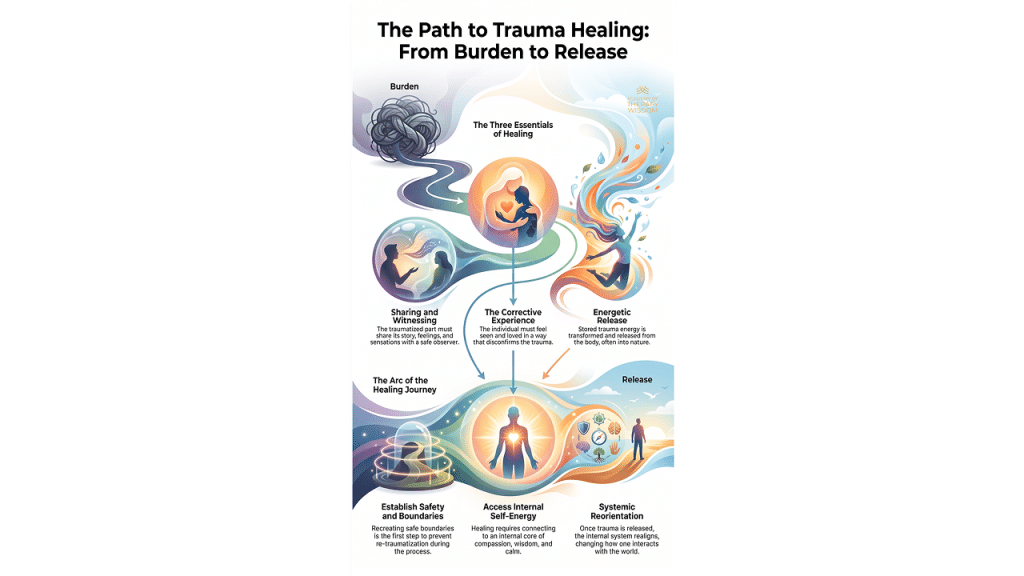
At Therapy Wisdom, our psychotherapy training students consistently report that they see the best results when mindfulness is woven into every phase of trauma treatment—not just as a “calming tool,” but as a means to deepen internal safety, relational presence, and somatic awareness. In TIST, mindfulness is used to notice protective parts, track dissociative shifts, and anchor both therapist and client in the present moment—a process that reduces therapist stress and improves outcomes for clients, especially those with complex PTSD.
Advanced Mindfulness-Based Integration Tip: Practicing Dual Awareness
Research and clinical wisdom from leaders like Janina Fisher, Pat Ogden, and Bessel van der Kolk emphasize the importance of “dual awareness” in trauma therapy. This practice helps clients remain anchored in the safety of the present while gently exploring difficult internal experiences, thus reducing the risk of overwhelm or retraumatization.
“Dual awareness—being aware of both the past and the present simultaneously—enables clients to process traumatic memories without becoming overwhelmed by them.”
—Janina Fisher, Healing the Fragmented Selves of Trauma Survivors
Pat Ogden, developer of Sensorimotor Psychotherapy, similarly highlights this technique:
“The therapist helps the client maintain dual awareness—attention to internal experience and to the safety of the present moment.”
—Pat Ogden, Sensorimotor Psychotherapy: Interventions for Trauma and Attachment
Example: Practicing Dual Awareness in Session
“Let’s try something together. As you begin to notice a difficult memory or emotion, see if you can also bring awareness to the feeling of the chair supporting your body, the sound of my voice, or the light in the room. If what’s happening inside feels intense, gently shift your attention to your surroundings—your feet on the floor, the temperature of the air—then return to your inner experience when you feel steadier.
This gentle back-and-forth between your internal sensations and the safety of the present moment is called ‘dual awareness.’ It helps you stay grounded and regulated while we work with challenging material.”
(Adapted from Fisher, 2017; Ogden, 2015; van der Kolk, 2014)
This approach is foundational in TIST and other advanced trauma therapies, and is supported by a broad base of trauma research and clinical consensus. By teaching and modeling dual awareness, therapists empower clients to process trauma safely and effectively, while also strengthening their own clinical resilience.
Recent Research
- American Mindfulness Research Association: 2025 Research News
- JAMA Psychiatry: Mindfulness and Brain Connectivity
- Multi-sensory therapyin psychiatric care (Baillon, van Diepen & Prettyman)
Best Mindfulness Trainings and Resources for Therapists
- TIST Certification Training – integrates advanced mindfulness and parts work for trauma.
- Treating Attachment Trauma with Deirdre Fay – blends attachment theory, mindfulness, and somatic interventions, and offers a strong peer support network for therapists
- Mindful Self-Compassion Resources for Beginners – for clinicians seeking deeper self-compassion practice.
- Nervous System Regulation Therapy (Linda Thai) integrates trauma-informed mindfulness with polyvagal theory and somatic resourcing.
- Mindfulness-Based Stress Reduction (MBSR) Online at Brown University
- Trauma Resource Institute: Community Resiliency Model – body-based mindfulness for at-risk populations.
Naturally, I recommend you explore Therapy Wisdom’s diverse mental health CE online trainings which offer additional options for integrating mindfulness with advanced clinical skills.

Join Dr. Janina Fisher for a FREE webinar
Healing the Fragmented Selves of Trauma Survivors
In this free webinar, Dr. Janina Fisher will help you:
How to identify and work with fragmented selves in trauma survivors.
How to stabilize chronically at-risk clients using TIST principles.
How to address self-alienation and dissociation to foster self-acceptance.
How to navigate therapeutic gridlock and work effectively with resistant, stuck, or emotionally overwhelmed clients.
Conclusion: Elevate Your Practice With Mindfulness Mastery
As I reflect on 2025’s most effective mindfulness techniques for therapists, it’s clear that mastery goes far beyond the basics. Advanced, research-backed skills like interoceptive awareness, mindful parts work, and urge surfing can transform your clinical impact and prevent burnout. If you’re ready to deepen your expertise and join a global community of trauma-informed, mindfulness-savvy clinicians, healing the fragmented selves of trauma survivors is your next step.
Here’s to elevating your practice for the clients who need you most! See you soon.
Warm regards,
Heather