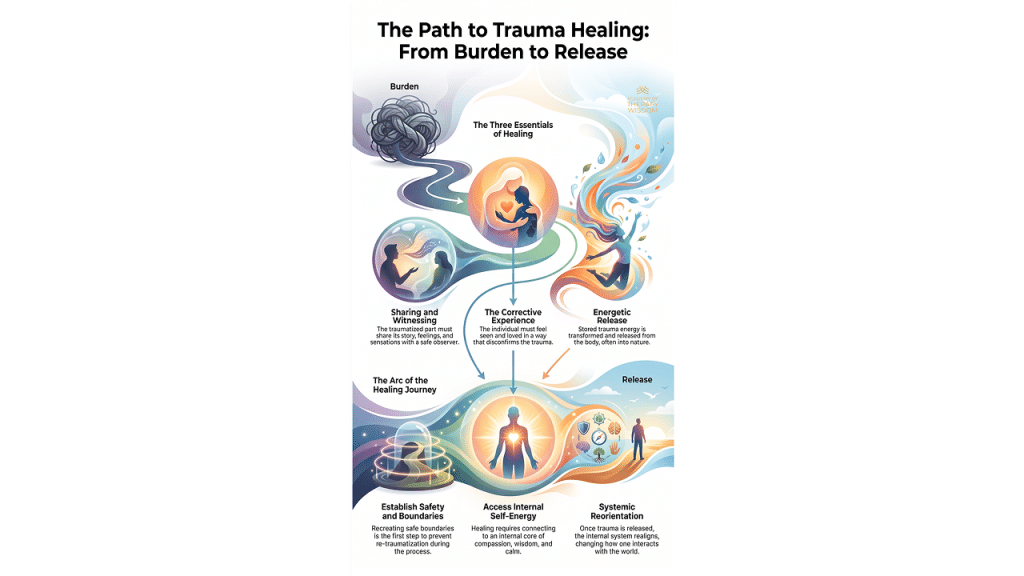

One of the key elements of the spirituality in psychology training approach to trauma healing taught by Frank Anderson is providing an introduction to IFS (Internal Family Systems) and “parts.” IFS for trauma, combined with neuroscience and spirituality in psychotherapy, can offer an incredibly effective approach to wellbeing for your therapy clients.
In our new online therapist training with Frank Anderson, you’ll learn a way of bringing spiritual energy into therapeutic healing spaces that is informed by the IFS model. Spiritual Therapy Techniques: Intuition in Clinical Practice with Frank Anderson is the perfect place to explore how spirituality and energy directly affects our human experience and the healing process.
In the course, Frank will give you an important introduction to IFS which provides the foundation for the rest of the course. Here, we’ve pulled from the therapist training course transcript to offer you a taste of how the training starts and to give you some of the key principles to understand about IFS in psychotherapy.
Frank Anderson IFS Introduction Part 1
Five Key Principles of Internal Family Systems for Therapists
IFS Principle #1: We all have “parts”
One of the things that’s important in IFS is the concept that everybody has different parts of us. Internal Family Systems is a mulplicity of the mind. The presence of parts is not seen as pathology, but rather parts are considered normal, important aspects of our personality.
IFS Principle #2: Parts are organized around systems
All of these different parts of our personality are organized around different systems. Each system is a collection of parts. Each system or collection of parts tends to be organized around overwhelming life experiences, or trauma, as we’ve been talking about.
IFS Principle #3: All parts have good intentions
This is something that kind of throws people, that all parts have good intenons. Yes, suicidal parts. Yes, depressed parts. Yes, parts that show up as a panic attack or anxiety. The parts that cut. The parts that drink. The parts that shoot heroine. From the perspective of IFS trauma therapy, we believe that all parts have a positive intention.
IFS Principle #4: Focus on the intentions, not the effects
What we’re looking at when we’re looking at these different aspects of the personality is the intention behind the part, not the effect it has on the body, on your partner, or at work. This is because when you focus on the effect, “Suicide is bad,” or “Drinking causes trouble at work and destroys relationships,” you shame those parts. Those parts feel bad when you point out the effect that they have. This undermines our efforts to help our clients feel safe, confident, and open to heal those parts.
IFS Principle #5: Parts, not diagnosis
Parts are trying to protect us from deeper pain. Parts can show up as symptoms, but we don’t think about diagnoses. We don’t talk about symptoms in IFS, we talk about parts. As therapists, and certainly within IFS and the IFS-informed approach taught in Spiritual Therapy Techniques: Intuition in Clinical Practice with Frank Anderson, we’re going to be helping you find a different way to get that protection.
In Part 2 of this IFS for counseling introduction, we’ll share how Frank considers and teaches the categories of parts – which is unique from the way the original Internal Family Systems model positions the parts. Frank uses different language and helps us to stay focused on seeing parts categories as opportunities for recognizing intention and providing a safe space for our clients to relax. We’ll post a link here as soon as part two is published.

JOIN a FREE WEBINAR TRAINING with Frank Anderson
Spiritual Therapy Techniques: Intuition in Clinical Practice
In this training, We will explore:
How to access your intuition in the therapy room so you can use it
How to differentiate what’s coming from your mind’s eye from what you are receiving from ‘beyond’
How to talk about Spirituality so your clients don’t feel like you’re imposing your personal beliefs on them.
How to incorporate your intuitive sense with non-spiritual clients
Frank Anderson, MD, completed his residency and was a clinical instructor in psychiatry at Harvard Medical School. He is both a psychiatrist and psychotherapist. He specializes in the treatment of trauma and dissociation and is passionate about teaching brain-based psychotherapy and integrating current neuroscience knowledge with the IFS model of therapy.
Dr. Anderson is a Lead Trainer at the IFS Institute with Richard Schwartz and maintains a long affiliation with, and trains for, Bessel van der Kolk’s Trauma Center. He serves as an advisor to the International Association of Trauma Professionals (IATP) and was the former chair and director of the Foundation for Self Leadership.
Dr. Anderson has lectured extensively on the Neurobiology of PTSD and Dissociation and wrote the chapter “Who’s Taking What” Connecting Neuroscience, Psychopharmacology and Internal Family Systems for Trauma in Internal Family Systems Therapy-New Dimensions. He co-authored a chapter on “What IFS Brings to Trauma Treatment in Innovations and Elaborations in Internal Family Systems Therapy” and recently co-authored Internal Family Systems Skills Training Manual.
His most recent book, entitled “Transcending Trauma: Healing Complex PTSD with Internal Family Systems” was released on May 19, 2021. Dr. Anderson maintains a private practice in Concord, MA.