

At Academy of Wisdom Therapy, we have the privilege each year to receive, read, and be changed by the essays and artwork submitted from our wider community of therapists for our annual Wise Therapy Spotlight publication. While we prepare this year´s publication, we are remain grateful for those past submissions whose reflections ring true as much today as they did then.
Below, we share an excerpt from the December 2020 issue of Wise Therapy Spotlight and one of its stand-out essays submitted by Keenan Mosley, NCC, LCMHC. Enjoy!
From the editors Brian Spielmann & Ian McPherson:
…Fundamentally, psychotherapy is working with compassion, whether that is being modeled through transference or taught in practical skills. Compassion opens our eyes to our own suffering, which can then expand and radiate to other beings. Working with compassion is deeply spiritual work. Similarly, social change originates with caring about other people, and becoming alive to the suffering of others. The world religions all point to examining our own actions and results such that they cause no harm. Self love provides the seeds for compassion.
When we invited our community to join in this conversation, we were not sure what to expect. We know that we are passionate about the intersection between psychotherapy, spirituality and social change, but it felt vulnerable to ask others why it mattered to them.
Specifically, we asked:
- Why does the intersection between psychotherapy, spirituality, and social change matter to you?
- How do you see the field of psychotherapy being influenced by spirituality and social change, especially in light of the dramatic events of 2020?
- How has the intersection between those three shown up in your office?
We have been delighted by the response. The essays, stories, and heartfelt reflections in the pages that follow are by turns provocative, hopeful, critical, simple, beautiful and full of nuggets of wisdom…
A Reflection on Empowerment, Community, and Spirituality
by Keenan Mosley
Why does the intersection between psychotherapy, spirituality, and social change matter to you?
I think it is a holistic approach that empowers us to see our lives f rom a broader perspective. It’s empowering to learn that our lives are not just shaped by our personal experiences or causation, but also our lives are impacted in an environmental context. When I learned as an African American female how the systemic issues of racism shaped my life, it helped to relieve some of the burdens I carried as to why do I see some of the same recurring issues in my life, my family’s life, and many other African Americans. It is because racism has impacted us and has inflicted pain. Being able to “externalize myself” from the problem and helping others to do so as a clinician, affirms I knew that I (that we) deserved better than this!
I work with a lot of African American students and families. As a clinician, hearing their stories and exploring the psychosocial context of their situation has been an empowering exchange. I’ve seen clients discover their voice and decide how they want to move forward with using it – in the classroom, in meetings, and with goal setting.
Advocating for equal rights and equity to promote social change in conjunction with applying faith is empowering. I’m advocating for myself, my children, for youth & their families; and the unifying power of that social movement in direct relation to knowing God is on our side is an immediate source of strength. I draw inner strength from being spiritually grounded as a Christian, even after being aware of the years of unjust, unacceptable, repeated cycles of social injustice and how it has caused trauma to many African Americans.
How do you see the field of psychotherapy being influenced by spirituality and social change, especially in light of the dramatic events of 2020?
I formed a women’s support team, a circle of sisters called The Ladies Room. It’s a platform to express ourselves as a group of women. Our theme: We love to discuss topics that uplift us personally & professionally. We promote faith in God and perseverance as black women in today’s society. Our purpose is to push positivity.
My approach is to formulate topics and develop questions infused with psychoeducation. For example, we had a teen talk discussion on My Black is Beautiful. The young ladies addressed their strengths, scriptures were incorporated from a faith-based perspective to affirm their worth. We addressed why it’s important to emphasize My Black is Beautiful. Their responses addressed social stigmas and racial stereotypes. They expressed how black intelligence is beautiful, their hair is beautiful. They processed the struggles and challenges they encountered as black females. All of them addressed the racial indifferences that they experienced in the public school system. They also addressed safe places, where they feel celebrated.
The Ladies Room has discussed how to deal with COVID-19, setting boundaries, relationship challenges, how we describe or define ourselves. Each session addressed psychoeducation, spirituality, and how we are impacted as black women in today’s society.
Another example is when one of the ladies shared how the story in the bible of Joseph reminds her of black males and their exoneration from wrongful prison sentences. She shared how resilient black people are and how many embraced Christianity even though some of the scriptures were misused to justify slavery. She addressed how trauma has impacted us but resilience has been our strong suit.
I see psychotherapy being a guiding source to help those who want clarity, information, and specific skills and strategies to address the social climate. Many want to process their life, their spiritual values and hear from others about what is working well for them in light of the dramatic events of 2020. The Ladies Room is one example of how people are gathering, processing, and sorting out the details of their lives to be intentional about a positive lifestyle in 2020.
I see how psychotherapy is being used outside of the traditional format of setting an appointment and meeting the therapist in their office. The dialogue has moved to social media with informative ways to support the need to cope, embrace spiritual and cultural values to promote mental health during these unprecedented times.
How has the intersection between those three shown up in your office?
I have worked with clients and their families who wanted to share how they were angry with God due to tragedies and traumatic events. Some wanted to grow in their faith and talk about their relationship with God. And some due to the situations that they dealt with no longer believed in a higher power.
In my work, most often the intersection of these three has shown up in regards to advocating for equity for students and families in the school system. Advocating for and addressing the impact of trauma, historical trauma, and the importance of alternative solutions to adultizing and over disciplining African American youth. I have partnered with community agencies and spiritual leaders who are actively involved in addressing the systemic issues that stagnate youth. I have been asked to speak at a church conference and I addressed how trauma and mental health issues often need clinical attention as well as spiritual application. Most often, I find myself out of the office and out in the field.
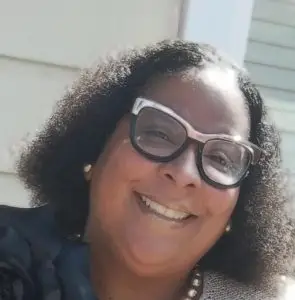
Keenan Jackson Mosley graduated from UNCA with a B.A. in Sociology. In 2001, she earned a Master’s in Religion from Memphis Theological Seminary. After living in Memphis, TN for about 18 years she moved back to Asheville, NC, and in 2017 graduated with a Master’s in Clinical Mental Health Counseling from Lenior-Rhyne University. She has worked as a school-based therapist, a school counselor, and currently is the District Mental Health Liaison for Asheville City Schools. She is a licensed evangelist-missionary and works in the ministry with her husband Pastor Ricky Mosley. She is the mother of 3 children Zion, Eden, and Israel.
At Academy of Therapy Wisdom, we are committed to offering ongoing training that educates and supports therapists in the important work of social justice, implicit bias, and racial trauma. You can register for one of our leading-edge anti-racism courses here:
Embodied Anti-Racism: A Mindfulness Way for Therapists and Helping Professionals with Francesca Marguerite Maximé A Five-Week Course for Examining Our Inner World So We Can Help Our Outer World
Relational Privilege and Systemic Trauma: Liberation Psychology Training with Akilah Riley-Richardson, MSW, CCTP
Trauma Informed Stabilization Treatment (TIST) Introductory Webinar led by Janina Fisher.