
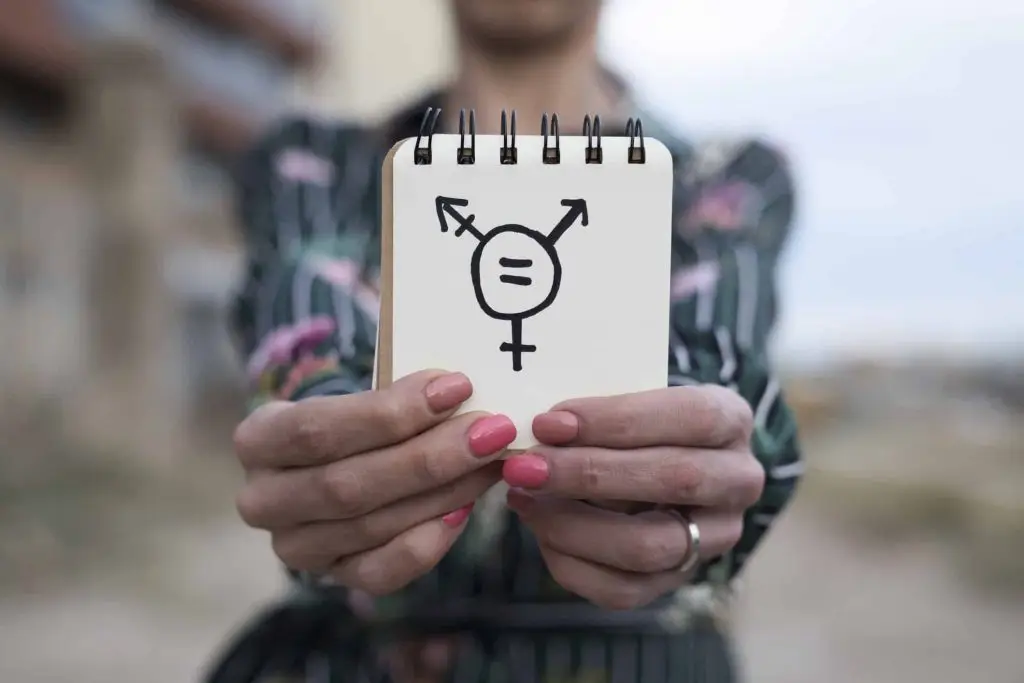
So how do you know your gender? When talking about gender diversity for therapists, we aren’t just talking about the folks that we might meet within our office, potential clients, or our kids’ friends. It’s about you also. I want you to think, “How did I come to know my gender? What is it that makes my gender mine?”
What is gender?
If you were in my women’s studies classes back in the day, I would have said to you gender is a social construct. It’s something we made up. While technically somewhat correct, there’s more to it than that. So gender, the category, is necessarily posited in a culture in a space in time. What gender looks like here in the United States does not look the same in Asia.
But there are other parts to gender. Gender identity is something that’s internal. So we’ve left the realm of social construct and now we’re in a very individual place.
Then there’s gender expression, or sort of how we bring ourselves to the table and convey our gender to others. I actually think these concepts are more complicated than they sound. What I’d like to show you is that gender as a social category is indeed culturally relative. Gender as an umbrella, the way we think of masculinity, femininity, who we are as people, and the way we define that, varies very necessarily on where we’re located, even our family of origin and what we’re taught.
Gender is pervasive.
What it means to be feminine in my hometown in Denver, Colorado, is different than what it means to be feminine in Tokyo, or further, in Leningrad. So it matters where I am, but generally speaking, every culture has some sense of what it means to be feminine, masculine, androgynous. There’s something about this category that’s pervasive.
Basically, gender identity is a psychological sense of self. In other words, it’s internal. It’s something I feel inside myself. It’s not immediately visible, it’s not something that you can know unless I tell you.
Gender expression is the way that I perform to you who I am. It might be in the way I move, my speech, my cadence, my intonation, my hairstyle, whether I’m wearing makeup or not, even the things that I do. So this can also include the roles that I perform in my day to day life. Am I a homemaker? Do I go out and work? Am I the one who drives the car? Even the things that I’m interested in.
Gender expression is what I call “social gender currency”.
We all know “the rules”, and that’s where gender expression and social currency comes into play. Here’s an example: If I say, “Okay, I want you to imagine an individual who’s dressed in the most glorious ballgown, okay, head to toe sparkles, really, really feminine. This person’s got some nice high-heeled shoes, bangles, some earrings, really elaborate makeup…” we might be like, oh, that person’s way overdressed. I’ll give you one more thing: This person has a thick, very long, very curly, very dark bushy beard.
My question to you is, what does your brain tell you, when you visualize this person – again, ballgown, really feminine, big bushy beard – what does your brain tell you about what the gender may be?
About now, there are some people that may say, “Well, Sarah, you already told me that gender identity is something that I can’t possibly know unless somebody tells me.” So, I’m going to tell you to shut down your higher order brain for a moment and just tell me what your brain barfs up, your first thought when I say ballgown, beard.
Now I’ll demystify this. The answer that’s most common is that this person is a male. This person is a male in a really fancy dress. The reason why we go there, even though I gave you a bunch of different things of masculine and feminine gender expression, is because some things have more value in the way we read gender. A secondary sex characteristic like facial hair has a greater value to your brain than what somebody’s clothing might look like. So this is an example of gender currency.
Now, how does this all come into play?
Well, right at the intersection of these things is what I call the gendered self. In other words, none of us do gender in a vacuum. Just because my identity may be something known to me, doesn’t mean it’s known to you. But, you’re going to assume some things about it, and I’m going to know that you’re assuming things about it. So I have a gender, it’s in a cultural context of where I live and what’s happening in my world, how old I am. I know myself inside how I feel, which may or may not correspond to what I give you or perform, my gender expression.
Confused yet? Okay, so to just really hammer home that things vary by culture, I want to add the fact that third genders or genders outside of just masculine, feminine, or male, female exist the whole world round, and they have for some time. This isn’t something that’s new. It just so happens that some of our cultures are coming into this a little late. North America, we’re a little late, especially our dominant culture. It´s only quite recently that we’ve been noticing, and now it’s time for us to catch up.

Join FREE video of Sarah Burgamy, Psy.D.
When Your Client is Non-binary: Gender Diversity for Therapists
In this webinar, you will learn about:
What pronoun do you use for a non-binary person? Understand the significance behind each choice and the validation it offers.
Non-binary therapy strategies that cater specifically to non-binary clients, ensuring their experiences are validated and their needs addressed.
Nonbinary client psychotherapy with real-world examples, offering therapists tangible solutions and techniques.
The Gender Regime
The system I’m introducing you is what we call the “gender regime”. It’s a binary system predicated on the immutable assumption of gender. This is from an individual named Riki Anne Wilchins. This is not a new concept, it’s not my concept, but the idea is that something’s happening that we all participate in and that none of us really remembers choosing.
A regime, according to the dictionary, is “a regular pattern of occurrence of action.” It is something that we know happens seasonally, regularly, all the time. It could be a “characteristic behavior or orderly procedure” or a “natural phenomenon or process.” It can be a “mode of rule or management.” It can be “a form of government.” I think that’s where most people start thinking of dictators. It can be “a government in power in a period of rule.” This is Merriam-Webster’s version of a regime. Some of the language that you get from this is that there´s something compulsory, something that has a power dynamic in it.
There’s something that tells us that this system doesn’t come from our own just decision making day to day, there’s something about compliance. So building a system of gender, basically the regime consists of these things: There’s two boxes, everyone goes in one, there’s no middle ground, no one chooses and no one changes.
It sounds a little stifling. But, what are the boxes? What’s the difference? Well, we’ve got male and female, boy and girl, man and woman. There are two boxes. Most of us are pretty used to this system, so much so that we probably don’t think about it.
Now, what if we called these cages instead of boxes?
Why is this necessary as therapists?
The reason why this is so necessary, as clinicians, as people that are healers, as people trying to help other folks manage and erase distress in their lives and live a better life, is that when you get placed in your gender box, if it doesn’t fit, it’s not a matter of just being pushed up against the boundaries of something like a cardboard box, something kind of soft. It’s about being up against the bars. It’s painful.
If you don’t fit and you’re trying to get where you feel your most authentic self lives, it hurts if you are in this regime, and I’d offer to you that we’re all in it. Everybody has a cage.
The Cage For the Bars
Now, I’m telling you you’re in a cage, but I’m not telling you you’re up against the bars. That’s just the thing about cages. Just because there’s a system doesn’t mean we always notice it. Why not? Well, if I’m squarely standing in the middle of my cage and I’m like, “You know what, this fits pretty well,” I probably have a lot of room. I probably have a lot of room to move. I feel pretty good in my cage. I can probably pace around in the middle and be like, “You know what? I don’t feel bars. I don’t even see bars, they’re so far away.”
But for the person for whom it doesn’t fit, they were placed in an identity, they were told that’s who they are, and they can feel it. They’re inside screaming out, “That’s not me!” They feel the pain of the bars.
We need to help these people navigate gender land, especially young people and their families.
Because our education did not prepare us to competently work with gender diverse clients, therapists have shied away from clients like these, and where possible, referred them to “specialists”.
However, unlike specialization areas such as eating disorders or PTSD, gender identity is too much a part of the core human identity for therapists to not know how to work with it.
You need to feel competent and confident when working with your clients to address this sensitive, universal part of being human.
Sarah Burgamy, Psy.D., is the founder of a private practice in Denver, Colorado, PhoenixRISE, with specialty offerings in identity development (considering intersections of target and non-target status identities), sexual minority competency, as well as transgender and gender diverse issues with adults, adolescents, and children. Dr. Burgamy has previously worked as a founding integrated psychologist in the TRUE Center for Gender Diversity at Children’s Hospital Colorado (2017-2020). Dr. Burgamy previously served as the Colorado Representative to the American Psychological Association (APA) Council of Representatives (2014-2019) and as a member, and 2019 chair, of the APA Committee on Sexual Orientation and Gender Diversity (2017-2019). She is a Past-President of Colorado Psychological Association and has previously served as the diversity division chair of CPA. Dr. Burgamy currently serves on the Advisory Committee for the Leadership Institute for Women in Psychology at APA. She appears in the Academy of Therapy Wisdom program Everything You Wanted To Know about Gender-Competence But Were Afraid to Ask!.