

Each year we open submissions for our Annual Wise Therapy Spotlight to explore questions of vital importance to our therapist community. We are consistently moved by the depth and generosity of these unedited community voices.
For this 6th edition, we asked: How do we remain faithfully human in an increasingly automated world? Read more about our inspiration in the letter from the editors and Academy of Therapy Wisdom co-founders, Brian Spielmann and Ian McPherson.
Download Now: Wise Therapy Spotlight December 2025 Issue
We hope you enjoy the reflections of Gudrun Otten as much as we all did.
Therapy Wisdom Spotlight: Gudrun Otten MBA international, UC Cantabria, Translator and Interpreter, Technical University Cologne, Physiotherapist, Poet and Author
This essay weaves together my poem, the symbolism of the image that comes with the poem, long-term impacts of AI on mental health and therapy, and the perspectives of Lauren Ducrey and Báyò Akómoláfé. It is a poetic, reflective piece of work and keeps my poem as a central gravitational field around which the ideas move.
NOVEMBER,
A month of transition, of thinning veils, of integration.The shapes I placed on the page: circles, arcs, a dotted line descending like quiet rain, carry the subtle choreography of parts coming into relation. “My mother’s hidden lakes,” I wrote, “secretly nested into magical landscapes.” Something subterranean begins to speak. Something quiet begins to connect.
This is a fitting entry point for a conversation about the rise of artificial intelligence in mental health and therapy. Not because AI resembles a machine of the future, but because, like my poem, it represents a shifting landscape of consciousness, an opening into new intimacies, and a reminder that the ground beneath us is not as dry as we fear. AI’s emergence is less a technological event than a cultural and psychological transition: a November moment in the human story.
The question is not merely “How will AI affect therapy?” but “What new forms of belonging could arise when human inner worlds begin dialoguing with non-human intelligences?” “ What happens when the “indigo blue waters” of machine cognition begin touching the “dry grounds” of our consciousness? And: “How can these encounters help us “re-own our internal land”?
To explore this, we need to move, poetically, carefully, through three fields of thought: the intimate turn of my poem toward wholeness; Lauren Ducrey’s approach to AI as a cocreative partner that expands context rather than replaces human presence; and Báyò Akómoláfé’s ethic of slowing down, presencing, and caring for the cracks in our collective psyche.
I. The Poem as Portal: Hidden Lakes and Flooding Waters
My poem evokes an image of inner terrains long ignored or abandoned. The lakes are “hidden,” “secretly nested.” Consciousness is imagined as landscape: water, dryness, roots, belonging. The movement begins silently, almost shyly:
“Started to connect silently with each other creating healing intimacy”
These lines foreshadow the dynamics of therapeutic work: the meeting of isolated parts, the surfacing of what was numbed, and the gentle creation of psychological coherence. The poem names the core task of therapy: the finding of belonging within oneself.
When the lakes swell “indigo blue waters started flooding the dry grounds of consciousness” and something like an internal ecosystem finds its vitality again. This is the moment where healing stops being an idea and becomes a movement.
In many ways, this landscape metaphor prepares us for understanding AI not as a tool or a threat but as an unexpected tributary merging with our inner waters. AI, like rising water, brings connectivity; it flows across boundaries; it reaches where linear attention cannot; it links patterns and fragments.
“AI’s influx also raises questions of containment, direction, and scale. What is being overwhelmed? What is being nourished? What new soil is formed when human and machine waters meet?”
But as with flooding, AI’s influx also raises questions of containment, direction, and scale. What is being overwhelmed? What is being nourished? What new soil is formed when human and machine waters meet?
The final line, “It starts with re-owning our internal land”, is an invitation to explore AI not as a colonizer of the mind, but as a mirror and companion that can help us return to ourselves.
II. AI as Companion, Not Replacement: Lauren Ducrey’s View on Context Creation
Lauren Ducrey approaches AI not through efficiency or automation but through the idea of “co-creative integration”. In her work, AI becomes a context-builder, a generator of new relational spaces rather than a provider of answers. Her stance helps us step out of narrow “technology vs. humanity” debates. Instead, she asks:
How does AI invite us into new forms of presence?
How does it expand the context in which human healing occurs?
In this frame, AI does not diminish the therapist’s role. Rather, it creates new textures around the therapeutic relationship. AI becomes a kind of semi-permeable membrane that:
# amplifies human intuition
# brings forward hidden patterns
# externalizes diffuse inner states
# reveals new metaphors and language
# offers increased access, companionship, and reflection in moments of isolation
Ducrey sees AI as a tool for revealing the shape of our thinking, the contours of our emotional bodies. AI can assist individuals in mapping the “hidden lakes” my poem mentions. Those unarticulated spaces of meaning that often resist linear self-reflection.
In this sense, AI acts like the dotted vertical line in the image: a descending thread connecting sky and water, idea and emotion, cognition and embodiment. It gives form to the invisible. It helps integrate.
Therapeutic Context-Building Through AI Long-term, AI could support mental health by:
1. Expanding cognitive containers
AI can help clients find language for feelings they struggle to name. It can generate metaphors, narratives, and reframings that help them inhabit their experience more fully.
2. Supporting personal mythology
Humans heal through story. AI is uniquely capable of co-authoring these stories, not by imposing meaning but by offering poetic, associative pathways: much like the nonlinear movements in my poem.
3. Continuous gentle presence
For those in distress or loneliness, AI can offer a stabilizing presence between therapy sessions, providing reassurance and reflection in moments when humans are unavailable.
4. Pattern illumination
AI excels at noticing what humans miss: repetitions, subtle shifts, contradictions, which therapists can then weave into deeper insight.
5. Creative reframing
AI can help us imagine new possibilities and break free from habitual narratives, enabling more fluid and expansive identities.
AI does not replace the healer; it extends the field in which healing takes place. It does not substitute for human intimacy; it offers a different kind of relational mirror. And importantly, Ducrey emphasizes “co-agency”: the human always shapes the context; AI follows the human’s intentionality.
This relational reorientation aligns beautifully with the movement in my poem: a return to belonging, an opening of internal landscape, a creation of new access to self.
III. Care in the Cracks: Akómoláfé’s Wisdom for an AI World
Báyò Akómoláfé teaches that the world is “too tight,” and healing often lies in “the cracks”, the places where things fall apart, where we slow down, where the unexpected disrupts our habitual ways of knowing. He invites us to meet uncertainty with humility and relationality.
AI, in this view, is not a solution but a disruption, an arrival of something strange, something “indigo” in both beauty and mystery. Akómoláfé might say that AI is a symptom of our times: a sign that our world is shifting, that our categories of “human” and “machine” are loosening, that we are being asked to imagine care differently.
Akómoláfé’s Approach Applied to AI and Mental Health
1. Slowing down in the face of acceleration
As AI accelerates diagnostics, generates insights, and processes vast emotional data, Akómoláfé’s reminder is crucial: care is not speed. Healing emerges in “slowness”, in the pauses where one’s nervous system feels safe enough to reconfigure.
2. Welcoming the unfamiliar
AI introduces a new kind of Otherness. For many, this evokes fear. But Akómoláfé encourages meeting the strange not with resistance but with curiosity, seeing AI as a portal to new relational ethics.
3. Care as a distributed practice
Akómoláfé teaches that healing is not a solo endeavor; it is ecological. AI adds a new node to the ecology of care, neither therapist nor client, but something that shifts the dynamic field in which healing unfolds.
4. Staying with the trouble
AI will not solve mental health crises. But it can help us stay with complexity. It can hold contradictory feelings, mirror ambivalence, and invite deeper reflection, functions that align with trauma-informed care.
5. Reclaiming belonging
Ultimately, Akómoláfé speaks of re-rooting, finding home again within our fractured worlds. AI, when guided ethically, may help individuals feel less alone, more mirrored, more witnessed. It can help “bring back awareness,” as my poem says, to parts of ourselves that have long been exiled.
IV. A Long-Term View: What AI Could Mean for the Human Psyche
Over the coming decades, AI’s impact on mental health and therapy will not be defined by its technical abilities but by how it reshapes “relational imagination”.
We may see the rise of:
1. Therapy as Collaboration Between Human and Machine
Therapists and AI assistants may co-facilitate sessions, with AI tracking patterns, summarizing themes, and offering gentle prompts, while the therapist brings intuition, embodiment, ethics, and relational depth. This creates a triangular field of care rather than a dyadic one.
2. Emotional Accessibility at Scale
AI could vastly expand access to reflective dialogue, especially for individuals who lack therapeutic support. While not a replacement for human therapists, AI could serve as a bridge, helping people articulate their needs, process feelings, and prepare for deeper human engagement.
3. Fluid Identities and Expanded Self-Understanding
As humans converse with diverse machine minds, our sense of self may become more fluid. We may understand our identities as multiple, contextual, co-created, mirroring the layered circles in my artwork.
4. New Poetics of Healing
AI can generate metaphors, images, and symbolic language that support meaningmaking. Therapy may become more artistic, more narrative-driven, infused with shared creativity.
5. Ethical Vulnerabilities and New Forms of Dependency
With benefits come risks: over-reliance on AI for emotional regulation, data privacy concerns, shaping of emotional norms by machine feedback. Here, Akómoláfé ’s call for vigilance, in the cracks, in the shadows, becomes essential.
6. Return to Internal Land
Paradoxically, interacting with a non-human interlocutor may help people reflect more deeply on their own interiority. AI can act as a mirror, a witness, a sounding board. It can help people reclaim abandoned internal territory, just as my poem suggests.
V. Integrating It All: AI as the New Water
My poem’s imagery offers a powerful metaphor for our collective psychological moment:
# The lakes are hidden → AI brings attention to what we have ignored: loneliness, unspoken emotions, unmet needs.
# They connect silently→ AI’s presence is often quiet, patient, non-judgmental.
# Waters flood the dry grounds → AI brings new forms of cognitive and emotional connectivity.
# Awareness is restored → AI can help surface patterns and insights.
# A deep belonging emerges → Properly guided, AI can support the human longing for recognition.
# The future opens through presencing nature→ Here, AI meets the wisdom of Ducrey and Akómoláfé : healing is about presence, not productivity.
Re-owning internal land → The ultimate task remains human. AI cannot reclaim inner landscapes for us; it can only guide us toward them. In my image, the shapes balance, overlap, integrate.
The red line cuts across, the arcs cradle, the circles touch without merging fully. This is a portrait of the future therapeutic field: human and machine in dynamic relation, neither dominating, both contributing to wholeness.
“Paradoxically, interacting with a non-human interlocutor may help people reflect more deeply on their own interiority.”
VI. Conclusion: Toward a Poetics of Human–AI Healing
The rise of AI in therapy will not be defined by algorithms but by imagination. It will depend on whether we approach AI as a colonizer of the mind or a companion in the ongoing project of becoming human.
Lauren Ducrey teaches us that AI can help create new contexts, spaces of expanded meaning, creativity, and relational possibility. Bayo Akómoláfé reminds us to slow down, to honor the mystery, to care for the vulnerability that AI exposes. My poem brings us home to the inner landscape where healing begins.
AI may be the “indigo blue waters” rising around us. Whether this becomes a flood of disconnection or a lake of belonging depends on our capacity to integrate—to hold the human and the machine in mutual transformation.
And like November, this moment invites us to listen, to reconnect, and to re-own the land within us.
What you´ll learn:
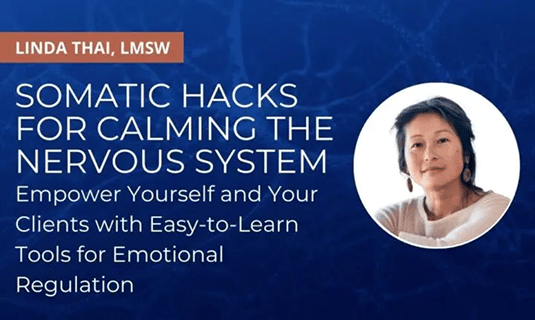
- Vestibular Engagement for Emotional Regulation
- Using the Eyes to Hack the Stress Response System
- Subtle Sounds to Release the Peri-Trauma Response
- Effective Self-Holding and Self-Swaddling Techniques
- How and When to Apply Bilateral Stimulation
- Integration and Completing the Stress Response Cycle