

Dear friends,
I am not a therapist. I am not a clinician.
I grew up as a translator, not just of words but emotions, opposing realities. I grew up in the in– between. Between my parents’ Spanish and the banker’s English. Between what my family felt but couldn’t name, and what I later learned to describe in textbooks.
I learned to say things so others could understand; defending my immigrant parents throughout childhood, noticing the stares, softening conversations. For a long time, I thought my ability to fluently code-switch and make others comfortable was my strength. And it is. But it’s taken me time to realize that it has come with a cost, a quiet erasure of my own voice.
There’s a kind of loneliness that comes with that. The more I worked to smooth out others’ reactions to my family, their language, their skin, the more I left pieces of myself behind… beckoning a slow fading of self that happens when belonging depends on how well you can shape-shift.
These days, I’m learning to let all my languages live together, the expected and the broken, the inherited and the improvised. They all belong.
I think many of those in the helping professions know that feeling of the in-between.
Holding space for clients’ complexities while quietly searching for your own language. Navigating between theory and intuition, between what’s professional and what’s deeply human. You create spaces where complexity is welcome and keep learning, not just to learn the newest thing or modality, but to help your clients live in the in-between. You work to help them find language for every version of themselves that fought to survive.
Thank you for showing up again and again with your full humanity, even when you’re still finding your own path.
If you’ve ever felt caught between worlds and identities, between knowing and not knowing, I hope you know that you’re not alone. Finding that language is sacred work. Your in-betweeness is wisdom.
Wherever you are this week, may you find a moment to listen to your own voice and honor its strength.
With warmth,
Mónica Quiñones-Hernández
Mònica is one of our small but mighty team of dedicated contributors committed to continually bringing you wisdom and insight from the world´s therapy and wisdom traditions through our online CE counseling courses for therapists. We look forward to sharing perspectives from across our team and hope these insights inspire you in new ways each week.
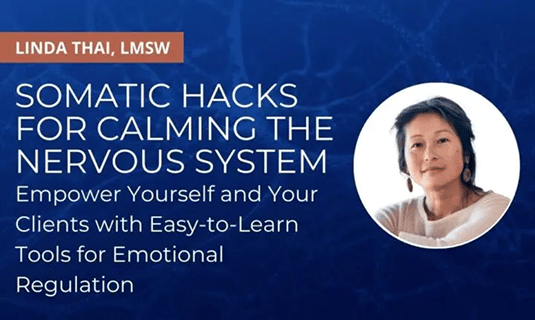
What you´ll learn:
- Vestibular Engagement for Emotional Regulation
- Using the Eyes to Hack the Stress Response System
- Subtle Sounds to Release the Peri-Trauma Response
- Effective Self-Holding and Self-Swaddling Techniques
- How and When to Apply Bilateral Stimulation
- Integration and Completing the Stress Response Cycle