

Table of Contents
- Intro: Why Therapists Worry About AI
- AI vs Human: Surprising Research
- Limits of AI in Therapy
- Staying Human: Practice & Integration
- Quotes from Faculty
- Deliberate Practice in Action
- Essential 2025 Resources
- Video: Jules Shore & Tori Olds
- Take Action: Thrive as a Human Therapist
- Conclusion: Brave, Human Future
Introduction: Why Therapists Worry About AI—and Why Human Therapy Still Matters
I have to admit it. I´m a little nervous about AI, AI agents, certainly “AI Therapy“, and what seems to be happening with our own good sense as human beings in relation to the rise of machine learning. AI is facilitating some indisputable and beneficial advances in science and industry, but there are some questionable uses, too. The uncertainty about how machines are shaping our not-so-distant future is probably giving us all little flicks into our sympathetic nervous systems. I think the background anxiety is affecting us all.
“AI Chatbots Outperform Novice Therapists on Basic Empathy Tasks—But Clients Still Prefer Humans.”
—New York Times
We’re been seeing headlines like this that play on our anxieties about “ChatGPT Therapists”, but also expose a truth.
Can a machine really replace the deeply relational, creative, and healing work you do? The answer, as we see it in 2025 (and likely forever!), is a clear no… and there are real reasons to pay attention.
At Academy of Therapy Wisdom, we’ve been having real, sometimes tough conversations about AI therapy and the AI tools we use to support you and our faculty. The rise of AI chatbots and “virtual therapists” is everywhere in the media, and it stirs up worry for many of us, because we care so much about our professional therapist community, your clients, and all of our futures.
How AI Affects Therapists, Affects Us
As a team, we’ve been reflecting on what the rise of therapist-like chatbots means not just for your job security (and ours), but for the future of mental health care, and for society at large. We want therapists to not only survive, but thrive, staying independent, knowing their value, and deeply connected to their calling. I know you want to keep growing and serving at your highest level. Since our team is focused on helping you become even more irreplaceable, I’d be remiss not to share a few incredible resources that can support you.
Quick Free Therapist Resources
Allow me to point you towards some powerful integrative and experiential therapy methods taught by the incomparable Juliane (Jules) Taylor Shore, our “resident” neurobiology and integrative therapy expert. I get more into how experiential and integrative therapy approaches can make a difference in your practice here is this article, but please do take us up on our free experiential therapy techniques training with Jules. She´s incredible!
Now, let´s continue discussing whether or not AI therapy can replace a human therapist, shall we?
AI Therapy, Surprising Research, and the Human Edge
The APA Monitor and recent reporting in The Guardian have highlighted a reality that’s both sobering and empowering.
Not really suprising, researchers found that while AI therapy bots can deliver “textbook empathy” in controlled environments, clients overwhelmingly choose real, present therapists when it comes to trust, safety, and making real changes in their lives.
The University of Rochester Medical Center points out that, even for kids, AI chatbots miss the mark on empathy, can’t track life context, and often fail to address deeper inequities or risks. If this is true for children, it’s just as relevant for adults.
And there’s an economic ripple too. As AI displaces more of the workforce, fewer people may have resources to invest in meaningful therapy. This makes it essential that we get better at offering something no bot can, not just as a “competitive edge”, but also to be better at helping more people ride this wave of great and historical transition.
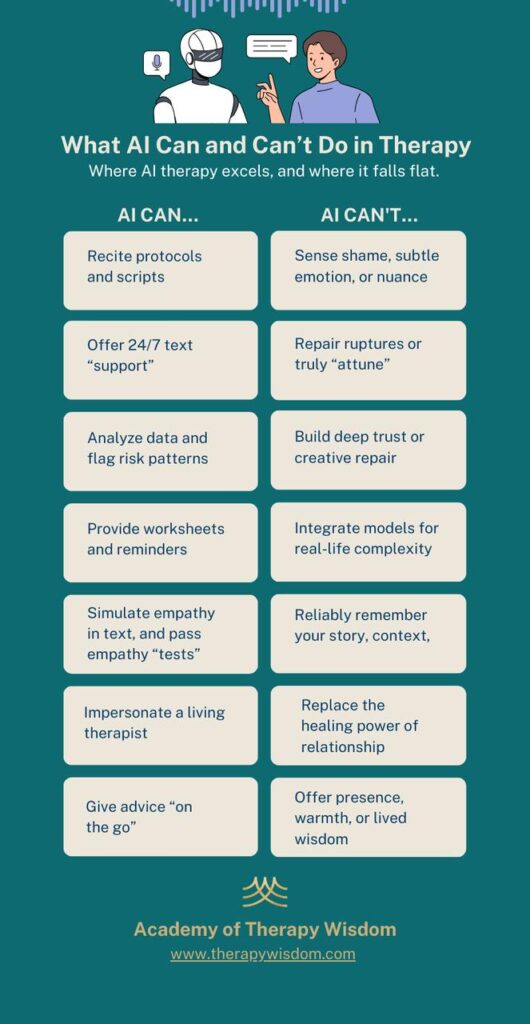
AI hype is everywhere, sure. But the reality is, bots can hallucinate, forget a client’s story, mix up details, or offer conflicting guidance. They’re not accountable for outcomes, and can’t create the safe, sacred space needed for deep healing. And let´s not forget about a critical and necessary part of relating and healing: touch.
“AI misses the heart of therapy: the presence, warmth, and safe space that only a real person can give.”
—URMC Rochester, 2025
Why Deliberate Practice and Integrative Therapy Keep Us Human—and Needed
If you feel anxious about AI therapy, you’re not alone. But I have hope and feel confident that great, real, human therapists will always matter. Let´s consider how integrative therapy and deliberate practice make an impact.
- Integrative therapy is a mindset and a skillset. It’s about drawing from somatic, cognitive, attachment, and experiential models to meet clients where they are, in real time. It is about being responsive, agile, and above all, human.
- Integrative therapy allows us to respond creatively and compassionately to every client’s complexity. AI can’t improvise in the moment or bring the warmth of human presence.
- Deliberate practice is the path to mastery. It’s not about clocking hours, but about focused, feedback-driven improvement on the micro-skills that make therapy extraordinary, improvements that help clients heal more deeply – improvements that no anonymous chat bot with a soft “voice” can replicate.
When you bring these together, you create real impact; you offer healing that goes beyond scripts or checklists, healing that changes lives one relationship at a time.
“The real healing happens not through protocol, but in the relationship—the safe, warm, attuned space you create together.”
—Janina Fisher, PhD, creator of Trauma-informed Stabilization Treatment (TIST)
“It’s the humility to keep learning, and the courage to be with clients in their pain, that sets real therapists apart.”
—Linda Thai, LMSW, Nervous System Regulation and Trauma Therapy Expert
“We need to be more visible, not just to attract clients, but to advocate for real human care in a world that’s getting noisier and more disconnected.”
—Tori Olds, PhD, Expert Psychotherapy Trainer and Deliberate Practice Specialist
Deliberate Practice in Action: Gentle Self-Assessment and Framework
Let’s make this real. Here’s a quick self-assessment to help you reflect on where you are, and where you might grow next.
Gentle Self-Assessment Quiz
How often do you…
- Set aside time to practice specific therapy skills outside of sessions (not just reading, but role-play or feedback)?
- Ask for honest feedback from supervisors, peers, or clients?
- Blend techniques and models in session, rather than sticking with one approach?
- Reflect on sessions to notice what worked, what didn’t, and why?
- Invite and repair rupture or challenge in the relationship, instead of avoiding it?
- Stay curious and humble, even when you feel competent or experienced?
If you answered “rarely” or “sometimes” to any of these:
Try picking one skill or practice this month to focus on.
Consider asking a trusted colleague for feedback, or attending a supervision group.
Remember, growth is about steady, real-world improvement, not perfection.
A Framework for Deliberate, Integrative Practice
- Choose a micro-skill to work on (for example, “Inviting feedback after a rupture”).
- Practice it with intention (role-play, record, or reflect after real sessions).
- Seek feedback from someone you trust.
- Reflect, adjust, and repeat. Growth happens in the doing, not just the knowing.
- Integrate across models. Ask yourself, “How would I approach this with TIST? With IFS? With somatic tracking?”
Journaling Prompts
- What is one moment in the past month where my presence made a difference for a client?
- Where do I feel most “stuck” in my work? How might deliberate practice help?
- What does being an integrative therapist mean to me, beyond using multiple models?

Join Juliane Taylor Shore for a FREE 90-minute webinar
Experiential Therapy Techniques: A Neurobiological Approach to Self-Compassion Therapy
During the webinar, you will learn:
A practice to increase self-compassion towards yourself as you do your work so you can both embody and benefit from self-acceptance.
The neurobiological difference between empathy and compassion so you keep use them judiciously in practice.
How to set up experiential practices so clients can discover and experience self-compassion.
Spotlight: The Essential Integrative Therapy Resources for 2025
The world of integrative therapy is growing fast. Here are some of the most helpful resources to deepen your skills and community:
- Society for the Exploration of Psychotherapy Integration (SEPI)
- International Integrative Psychotherapy Association
- Jules Shore: experiential therapy training
- Handbook of Psychotherapy Integration (Norcross & Goldfried)
- An integrative Psychotherapeutic Approach to Treating Complex PTSD (U.S. NIH)
Mark your calendar for the 2025 Integrative Psychotherapy Conference for workshops and community.
Jules Shore and Tori Olds: Video, Transcript & Key Lessons
Watch the conversation:
Key Lessons from the Video:
- Deliberate practice isn’t just hours. Tori Olds explains that research shows therapists can actually get less effective over time without intentional practice.
- State-dependent learning matters. Practicing in emotionally real contexts—role-play, video review—helps new skills stick.
- Integrative mastery is more than loyalty to a single model. Jules and Tori emphasize that great therapy is about combining, adapting, and improvising.
- Humility is essential. The best therapists are endlessly curious and willing to be learners, no matter how seasoned they are.
- Feedback is growth. Honest input from diverse sources helps you keep improving and avoid getting stuck.
Full Transcript:
Tori Olds:
Deliberate practice is not specific to psychotherapy. It’s a general way of training—one that research shows reliably produces expertise across domains.
Jules Taylor Shore:
We do know, no matter how you’re doing it, practice makes a difference, and hopefully we learn more and more about how to make it better.
Tori:
On average, most therapists actually get slightly worse with more years of experience.
Jules:
Can I have a moment of wanting to do a thing and then stop myself? Just being able to have that skill is so helpful to have in your back pocket when you’re doing therapy.
Tori:
It’s really nice if we can practice it, either in a role play or with video of actors pretending to throw challenging things at us, or using tape of our own clients. Where we’re actually pretending, where we’re in our therapist mode—we’re trying, we’re practicing.
Jules:
If we commit to deep practice, it changes how we can serve our people.
You all, we are so lucky because Tori Olds is here.
Tori:
Sweet, Jules.
Jules:
Tori, you’re one of my very, very favorite trainers on the planet. And I want to be really specific about why I was like, “Tori, can you come and do this?” It’s because of the depth of thinking you’ve devoted to helping helpers help people better. And specifically, your commitment to: How do we learn to do experiential therapy incredibly well?
Tori:
Right.
Jules:
It’s actually required. And you’re a fan of deliberate practice, and I’m a fan of deliberate practice. You teach so wonderfully about deliberate practice. So I thought, let’s have Tori come in and tell people why we’re excited about this thing that’s been around for a long time, that’s now infusing into therapy training.
Tori:
Okay, great. Maybe I’ll just start with describing it a little bit, and then you guide me. I may just keep going, but we’ll talk about it. So, I’ll kind of assume people don’t know much. Deliberate practice is not specific to psychotherapy—it’s a general way of training. The term was developed by Anders Ericsson, who Malcolm Gladwell popularized with his book and the 10,000-hour rule.
But Ericsson is the actual researcher. You can think of him as an expert on expertise—an expert on how to become an expert. He studied peak performance, or expert-level performance, in many different arenas. He found that what people do when they become expert, what they’ve put in hours and hours, is something he termed “deliberate practice.”
Practice in general, especially deliberate practice, is usually in solitude where you really have a clear, specific skill or objective, or a piece you’re trying to focus on improving. It’s like one thing at a time. It’s repetitive, it’s very focused, and it’s at your right level of challenge. These are some things we’ll get more into.
But it’s really, really important, because just doing the whole thing, rather than one skill at a time, doesn’t— and this is true for therapists but also other fields—just doing the whole thing, that’s called “performance.”
Jules:
Yeah, you’re doing it exactly…
What You Can Do: Growing, Thriving, and Leading as a Human Therapist
If you’re feeling uncertain about AI therapy, you’re not alone. Here’s how you can make a difference for yourself, your clients, and the field:
- Commit to your own growth. Choose one new skill or area of integration to practice this month.
- Get visible in your community. Share your story and expertise—clients need to know that real therapy is out there, and it matters.
- Keep learning, keep connecting. Supervision, peer support, and ongoing training keep you sharp and resilient.
- Advocate for real therapy. Talk with clients, colleagues, and the public about what makes real, relational therapy unique and essential, especially in the age of AI.
- Practice self-compassion. The world is changing fast, but the value of your presence, wisdom, and care hasn’t gone anywhere.
Conclusion: The Future of Therapy Is Human, Integrative, and Brave
We’re living through a time of deep change, and sometimes, real uncertainty. But what’s always been true stays true. No bot, however well-trained, can replace the healing power of a relationship with a real human being—especially one who is committed to learning, integrating, and leading with heart.
If you’re ready to meet this moment, not just with skill but with courage and connection, sign up for Jules Shore’s experiential therapy training.
Our clients, our profession, and our world need you, now more than ever.
Warmly,
Heather