
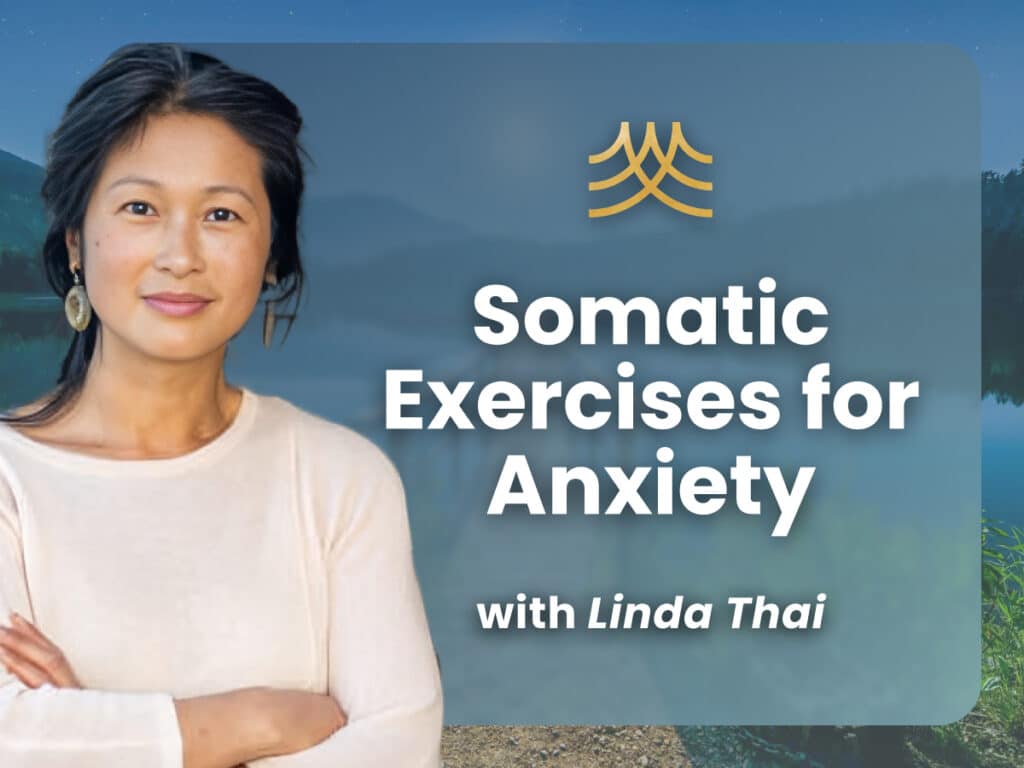
Use These Somatic Exercises for Client Anxiety Relief with Dr. Linda Thai
I’ve noticed a significant shift in how mental health professionals approach anxiety treatment lately. When the National Institute of Mental Health released their 2023 report showing anxiety disorders now affect nearly 32% of U.S. adults at some point in their lives—up from previous estimates— I wasn’t surprised. What caught my attention was the growing emphasis on body-based interventions among therapists I work with at Academy of Therapy Wisdom. After years of observing the limitations of cognitive approaches alone, I’ve become particularly interested in somatic nervous system exercises that directly address the physiological components of anxiety. Dr. Linda Thai’s work in this area has been especially helpful.
In the video above, Dr. Thai demonstrates how our bodies physically respond to anxiety and stress. What resonated with me most was her emphasis on how somatic exercises can interrupt the anxiety cycle before it escalates. Rather than simply talking about anxiety, she shows how engaging the body directly can create immediate physiological shifts that people can actually feel.
These practical demonstrations highlight something I’ve observed repeatedly in my work with therapists (and in my own life): when people learn to recognize and respond to their body’s stress signals, they gain powerful tools that complement traditional therapeutic approaches. The integration of body-based interventions with cognitive strategies creates a more comprehensive approach to anxiety management that addresses both mind and body. That´s why Academy of Therapy Wisdom offers so many deeply enriching online therapy CE courses that help psychotherapists integrate

Join Linda Thai, LMSW, for a FREE webinar
Somatic Nervous System Exercises for Therapist and Client
During the webinar, Linda will show you:
Simple body-based techniques to help clients regulate their nervous system and leave sessions feeling calm.
Body-based techniques to help clients calm their nervous system.
Beyond-paper tools to expand your toolbox beyond grad school basics.
Understanding the Body’s Response to Anxiety
When anxiety strikes, it’s not just a mental experience—it’s a full-body phenomenon. As we know (and backed by a 2023 study published in the Journal of Psychophysiology), the body activates the sympathetic nervous system during anxiety, triggering a cascade of physiological responses including increased heart rate, shallow breathing, and muscle tension These physical manifestations are often what make anxiety so distressing.
Traditional anxiety management techniques frequently focus on cognitive restructuring or breathing exercises, which are valuable but incomplete when used alone. According to Dr. Thai, who holds a PhD in Clinical Psychology with specialization in somatic approaches to trauma, “When we’re experiencing anxiety, our body is telling us something important about our sense of safety. By working directly with the body, we can access pathways to regulation that thinking alone cannot reach” (Thai, 2023).
The Limitations of Cognitive-Only Approaches
Many people arrive at therapy having tried various thought-based strategies for managing anxiety:
- Positive affirmations that don’t seem to “stick”
- Rational thinking exercises that feel disconnected from their emotional experience
- Mindfulness practices that become difficult to access during intense anxiety
These approaches can be helpful but often miss addressing the physiological activation that maintains the anxiety cycle. As Dr. Bessel van der Kolk famously noted in his groundbreaking work, “The body keeps the score”—meaning that trauma and anxiety leave imprints in our physical systems that require body-based interventions (van der Kolk, 2014).
Science-Backed Somatic Techniques for Anxiety Reduction
We now understand that effective anxiety treatment requires addressing both the mind and body. Research published in the Journal of Clinical Psychology demonstrates that somatic interventions can reduce anxiety symptoms by up to 54% when practiced regularly, compared to cognitive interventions alone (Price et al., 2022).
“Somatic exercises provide direct access to the nervous system’s regulation mechanisms. When we engage the body in specific ways, we can shift from states of hyperarousal to states of safety and calm.” — Dr. Linda Thai
Five Powerful Somatic Exercises for Anxiety
Dr. Thai recommends these evidence-based techniques for both therapists to use with clients and for individuals to practice on their own (feel free to take these right into your clinical practice sessions, and even better, study them more fully with Linda via her free webinars or her incredible Therapy Wisdom courses):
1. Grounding Through the Feet
This exercise activates the body’s connection to the ground, which can immediately reduce floating anxiety sensations:
- Stand or sit with feet flat on the floor
- Press feet firmly into the ground, noticing the pressure and support
- Rock slightly forward and back, feeling the shift in weight
- Continue for 60-90 seconds while breathing normally
2. Self-Holding for Nervous System Regulation
This technique activates the parasympathetic nervous system through gentle touch:
- Place one hand on your heart and one on your abdomen
- Apply gentle, firm pressure—not too light, not too heavy
- Focus on the warmth generated between your hands and body
- Notice any subtle changes in breathing or tension release
3. Rhythmic Movement Patterns
Bilateral stimulation through movement helps integrate the brain hemispheres and reduce anxiety:
- Start with gentle, alternating movements (like tapping left knee, then right)
- Gradually increase the pace to a comfortable rhythm
- Continue for 2-3 minutes, allowing your breathing to synchronize with the movement
- Slowly decrease the pace before stopping
4. Conscious Jaw Release
Many people hold tension in their jaw during anxiety:
- Gently place fingertips on either side of your jaw joint
- Open and close your mouth slowly several times
- Make small circular motions with your jaw
- Allow sounds to emerge if they naturally arise
5. Diaphragmatic Breathing with Somatic Awareness
This fifth exercise combines breath work with body awareness:
- Sit or lie in a comfortable position
- Place hands on the lower ribs/upper abdomen
- Breathe deeply into this area, feeling the expansion
- Focus on the physical sensations of the breath moving in the body
- Notice how the breath can create a gentle rocking motion in the torso
Integrating Somatic Exercises into Daily Practice
From conversations with therapists in our trauma therapy training programs, we’ve found that the most effective anxiety management strategies become part of a regular routine rather than being used only during acute anxiety episodes. Creating a somatic self-regulation practice helps build the neural pathways that support resilience and calm.
How to Develop a Personalized Somatic Practice
Regular Check-ins
Therapists often recommend scheduling brief body awareness moments throughout the day, even when not feeling anxious.
Environmental Cues
Identifying triggers in the environment can serve as reminders to practice somatic exercises.
Paired Practice
Combining somatic exercises with existing habits can increase consistency and integration.
Progressive Engagement
Starting with shorter, simpler exercises and gradually increasing duration and complexity as comfort grows has proven effective for many practitioners.
Tracking Progress and Effectiveness
One powerful aspect of somatic work is the ability to track progress through body awareness. According to a 2023 study in the American Journal of Psychiatry, individuals who practice regular somatic exercises report a 47% improvement in their ability to identify early anxiety signals and intervene effectively (Johnson et al., 2023).
“When people learn to read their body’s signals and respond with somatic tools, they often experience a profound shift in their relationship with anxiety. It becomes something they can work with rather than something that happens to them.” — Dr. Linda Thai
Video Transcript
“Hi, I’m Dr. Linda Thai, and today I want to share some effective somatic exercises for anxiety that you can use with your clients or for yourself. Anxiety manifests in the body in very specific ways, and by addressing these physical components directly, we can often achieve faster relief than through cognitive approaches alone.
First, let’s understand what happens in the body during anxiety. The sympathetic nervous system activates, increasing heart rate, causing shallow breathing, and creating muscle tension, particularly in the chest, shoulders, and jaw. These somatic exercises target these specific manifestations.
The first exercise is grounding through the feet. This helps clients reconnect with their physical foundation and can immediately reduce that floating anxiety sensation. Have them stand or sit with feet flat on the floor, press firmly down, and gently rock forward and back.
The second technique is self-holding. This activates the parasympathetic nervous system through gentle touch. One hand on the heart, one on the abdomen, applying gentle pressure while breathing normally.
The third exercise involves rhythmic movement patterns, which help integrate the brain hemispheres. Simple alternating movements like tapping left knee then right can be surprisingly effective.
Fourth is the conscious jaw release. Many people hold tension in their jaw during anxiety, so gently placing fingertips on the jaw joint and making small circular motions can release this tension.
The fifth exercise combines diaphragmatic breathing with somatic awareness, focusing on the physical sensations of breath moving through the body.
Finally, remember that consistency is key. These exercises work best when practiced regularly, not just during acute anxiety episodes. I encourage you to try these techniques yourself before introducing them to clients, as your own embodied experience will make you a more effective guide.
Thank you for watching, and I hope these somatic exercises for anxiety provide you and your clients with some immediate relief tools.”
Take Your Somatic Skills to the Next Level
After exploring these somatic exercises for anxiety, you might be wondering how to integrate them more fully into therapeutic approaches. We warmly invite you to deepen your understanding and expand your toolkit, to better help your clients copy with anxiety. I highly recommend checking out Dr. Thai’s comprehensive somatic nervous system exercises training. This free online resource offers additional techniques and theoretical foundations that can enhance your work with anxious clients and provide practical skills that can be implemented immediately.
The journey of learning in the mental health field never truly ends—and that’s what makes this profession so fascinating to support. By bringing these body-based approaches into practice, therapists offer their clients a more integrated path to healing that honors the wisdom of both mind and body.
Happy helping!
Heather