
Alongside our enriching trainings for therapists, we proudly presented the much-anticipated annual 2023 Wise Therapy Spotlight publication -a compilation of profound essays and captivating artwork from our esteemed psychotherapy training community. We extend our sincere gratitude to all contributors who shared their insights and talents, making this publication a true testament to the brilliance within our community.
A special congratulations to our featured authors! Your responses to the pivotal question, “How, as a community, do we repair a sick world when it is anguished with mental suffering?” have left us inspired.
If you’re interested in downloading the full Wise Therapy Spotlight December 2023 Issue, Click to Download the PDF now.

Karly Randolph Pitman, Psychoeducator, group facilitator, and writer
Being ground for one another
As a mother, as a woman on her own healing journey, and as a facilitator who supports women in recovery from eating disorders, there’s a truth that comes to teach me, over and over: that healing rests on our capacity to accept where we are. This is what helps me as I face a world in anguish with mental suffering.
Nature is my best teacher of this. During the pandemic, my husband and I tore up most of our small, suburban backyard to build raised garden beds and grow vegetables. Three years later, we’ve fed countless birds, insects, squirrels and our dog Bailey, who loves to eat the cherry tomatoes just as they ripen. Sometimes we feed ourselves.
Growing food fills me with awe. Growing food also reminds me that much of life is out of my control: too much moisture or too little, too much sun, or too much cold all have their way with the soil into which I pour my seeds, sweat, and good intentions.
I long to be an able gardener to hold the seeds that yearn to grow; to notice when they might need some water, a bit more sun, more shade, or even a tomato cage or two. And I long to be a humble gardener where I’m a midwife to growth, not its enforcer or producer.
This perspective soothes the part of me that feels over-responsible and that can be worried about achieving outcomes as a mother, writer, teacher and healer. And this perspective helps me when I feel overwhelmed by the suffering in the world and I feel so helpless.
Gardening and healing both ask me to look again, to look at what I might call a ‘failed’ crop or an ‘unthriving garden’ and ask, Is that so? They teach me patience. They give me courage. They teach me endurance, what my friend Catharine calls gentle persistence and persistent gentleness.
To me, this seeing is where psychology and contemplation meet: where our understanding of trauma, relational neuroscience, attachment theory, Carl Rogers’ unconditional positive regard and our spiritual traditions intersect. When we behold the life in front of us with respect to look again we esteem rather than criticize the scraggly roots of ourselves.
Respect asks me to face, see, and accept what’s here: bugs, invading pests, dry soil, rot, new flowers. Triggers, anxiety, collapse, frozenness, soothing in food or too much Netflix. The horrors of war and famine, the loss of species, the heartbreak of our collective world. Then it asks me to look again. And again.
 A Sufi teacher once told me that we’re here to be the earth for each other to be a solid place of ground, a place of strength and support. If I want to be somewhere other than where I am or if I want another to be somewhere other than where they are then there’s no stable place for us to stand. Instead, we’re off balance, reaching and striving to be at the place where we think we ‘should’ be.
This reminds me of watching a master teacher or coach at work in fact, I’m in awe of them! They’re able to temper their frustration, impatience, and worries so they can support their students and athletes. They know how to step in with just the right touch the advice, support, suggestions, or correction to help them grow. My vulnerabilities and unhealed wounds, the vulnerabilities and unhealed wounds of my loved ones, and the vulnerabilities and unhealed wounds of the people I support bring me back to earth, over and over, inviting me to meet the life that’s here rather than the life I wish were here.
Coming back to earth is not easy or comfortable for me. It means bearing the guilt, shame, frustration, impatience, worry, fear, anxiety, discomfort, judgment, annoyance, irritability, fatigue and more that can arise in the face of my wounds, in the face of other’s wounds, and in the face of my loved ones’ wounds.
The most painful wounds for me to bear are those of my loved ones, my children, husband, and family, especially when I had a part to play in those wounds. My guilt and shame can drive me to want to step in and hustle their healing along. But love asks me to pause, breathe, and open to trust that they’re loved and cared for, to trust that I’m loved and cared for, and to trust that the soil of our shared garden is alive and fecund, fed by the rich compost of our mistakes.
My mind’s ideas of ‘harvest,’ growth and healing are thrown out the window, over and over, as I kneel on the ground and look to see what’s actually here. And how many times has the compost of our lives born something surprising, something wondrous, even? So that is my labor as a mother, a teacher, a space holder, and as the companion to my own recovery: to attend the birth that’s coming, to tend the life that wants holding, to hold my ear close and watch, and listen.
As the poet Rumi wrote so beautifully, may we be ground, be crumbled, so wildflowers can grow where we are.
I’ll close with a poem that I wrote this fall after harvesting our first sweet potato crop. As I beheld the small pink potatoes, I couldn’t help but think of the harvests of our being. I hope we behold all our harvests with wonder.
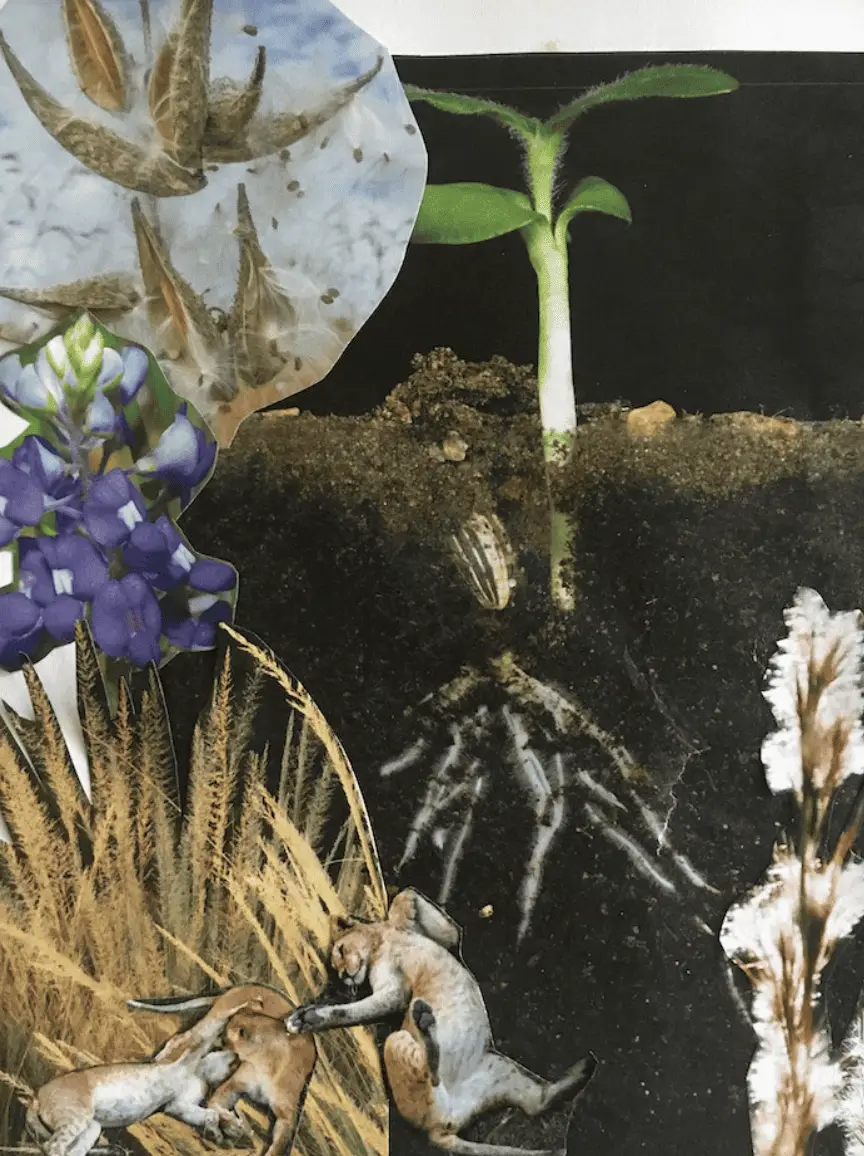 Growing Sweet Potatoes
It was the first time we’d planted sweet potatoes
slips of flesh with eyes and fingers, tiny beings of promise.
We planted and prayed for just enough sun, just enough wet,
just enough goo and microbe to sprout our seeds into harvest.
It rained and then it stopped for one hundred days.
The sun baked the earth brown.
It stayed hot and became hotter.
The plants wilted and I dreamt they cried for rain.
We decided: what do we let die?
What do we save?
We knew if the potatoes didn’t grow we could drive
to the store and buy more.
But I wanted the potatoes to thrive.
I wanted to tend something, cover new life in shit and rot
and create something useful and good, something as sturdy as a potato.
So I prayed for rain.
I sang to the vines.
And months later, when it finally rained, I stood in my yard with the plants
and let the water pour down my face and into my skin planted like the potato,
watered like the vine, open in my thirst.
Last week we dug into the warm earth
searching for pink orbs.
We found five perfect potatoes and dozens of silvery roots
no thicker than a pencil.
I can’t bear to throw any of them away.
Six months of toil and six months of hope that I can’t let go to waste.
Who am I to say the harvest is a failure?
That more should have grown in dusty soil?
Who am I to say that I, sweet potato vine, rain and soil, humus and hot sun,
should be any more than I am now?
If you would like to be inspired by more of the essays and artwork published in the Wise Therapy Spotlight December 2023 Issue, Click to Download the PDF now.