

As we lay some groundwork for spiritual trauma healing with Frank Anderson we’ve been sharing notes from his introduction to Spiritual Therapy Techniques: Intuition in Clinical Practice.
In the first and second posts from this series, we’ve learned five key principles of Internal Family Systems as taught by Frank in his new spirituality in psychology training New Dimensions of Trauma Healing: Energy, Neuroscience, and Spirituality and gone into some detail on some of those principles. Here is a very brief recap:
Internal Family Systems with Frank Anderson: Five Key Principles
- We all have “parts”
- Parts are organized around systems
- All parts have good intentions
- Focus on the intentions, not the effects
- Parts, not diagnosis
As we continue here in Part 2 of Frank’s introduction taken directly from the first part of his online course for therapists, we learn about the different types of parts and how these categories support the IFS trauma healing process.
We looked at how, according to Frank and the IFS model, our different psychological “parts” can be broken down into two categories – the protectors and wounds/trauma carriers. We also learned how there are two types of protectors:
IFS Informed Therapy for Spiritual Trauma Healing: Protector Types
1.Preventative protectors
According to Frank, these preventative protectors in the IFS Trauma Model “often help us to maintain our sense of safety and security, but can become destructive when we rely on them too much.”
2. Reactive, extreme protectors
These are the ones that Frank explains as “the parts of ourselves that respond to perceived threats… they can be very intense. It can be very helpful to have them on hand during a crisis, but… they can be problematic.
IFS Trauma Training for Spiritual Healing with Frank Anderson
Part 3: Wounded Parts, aka “Trauma Carriers”
Frank shares about wounded parts:
Okay, and then there are the parts that carry pain, the parts that carry wound, the parts that carry the trauma. Those protective parts work really, really hard. This is the positive intention in protecting the pain that we carry from our trauma.
How IFS Trauma Therapy Works, In a Nutshell
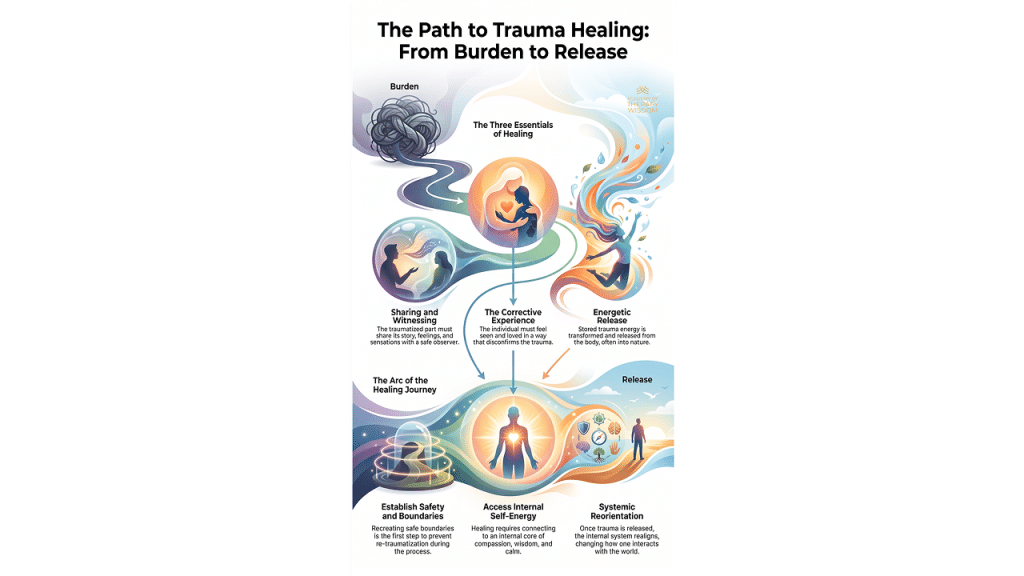
…The overall goal in internal family systems (IFS) is that we get permission from the protective parts to access the parts that carry the pain. Remember, trauma blocks love, love heals trauma. That’s what we’re talking about. Trauma blocks love. Those protective parts block, prevent, and protect the pain. We’re going to help access that through permission. We’re going to get access from protective parts to access the wound and the pain, and we’re going to use something called “self energy” as healing energy.
That’s the overall way internal family systems works. Dick Schwartz, who’s the founder of the internal family systems model, 35 years or so ago called these preventive parts the managers, and he called the extreme reactive parts firefighters. He called those wounded parts exiles.
We can have wounds at any stage of our life. Working with people who have relational trauma, or what we call complex PTSD, we see that those wounds are typically young. And they are held in all different places in our bodies, in our emotions, sometimes in our thoughts and our distorted beliefs. This looks like believing we’re unlovable or no good, having overwhelming emotion when we’re carrying something as a result of being traumatized, or holding something physically in the body as Bessel Van Der Kolk says, “The body keeps the score.”
So wounded parts can be in any area within our body. They can also be pre-verbal, believe it or not, that they don’t have words. This is especially true if somebody has been through something overwhelming before they have language, which is typically before two years of age when the hippocampus isn’t even developed yet, and can’t put words to their experience.
Interestingly enough, I’m working with somebody right now, who’s working on intrauterine trauma. His birth mom was in a domestically abusive relationship. And he was hit in utero. And he’s got so many physical problems. He never knew what they were related to. But as we explore what’s going on within his body, he has all of these visual memories and somatic memories about being hit in utero.
So we can hold trauma even before we have words.
We’ll continue to share notes and excerpts from the Frank Anderson online therapist course in future editions. We invite you to read all about the online therapist training with Frank and the supportive bonus material included, and look forward to seeing you there soon!
JOIN a FREE WEBINAR TRAINING with Frank Anderson
Spiritual Therapy Techniques: Intuition in Clinical Practice
In this training, We will explore:
How to access your intuition in the therapy room so you can use it
How to differentiate what’s coming from your mind’s eye from what you are receiving from ‘beyond’
How to talk about Spirituality so your clients don’t feel like you’re imposing your personal beliefs on them.
How to incorporate your intuitive sense with non-spiritual clients
Frank Anderson, MD, completed his residency and was a clinical instructor in psychiatry at Harvard Medical School. He is both a psychiatrist and psychotherapist. He specializes in the treatment of trauma and dissociation and is passionate about teaching brain-based psychotherapy and integrating current neuroscience knowledge with the IFS model of therapy.
Dr. Anderson is a Lead Trainer at the IFS Institute with Richard Schwartz and maintains a long affiliation with, and trains for, Bessel van der Kolk’s Trauma Center. He serves as an advisor to the International Association of Trauma Professionals (IATP) and was the former chair and director of the Foundation for Self Leadership.
Dr. Anderson has lectured extensively on the Neurobiology of PTSD and Dissociation and wrote the chapter “Who’s Taking What” Connecting Neuroscience, Psychopharmacology and Internal Family Systems for Trauma in Internal Family Systems Therapy-New Dimensions. He co-authored a chapter on “What IFS Brings to Trauma Treatment in Innovations and Elaborations in Internal Family Systems Therapy” and recently co-authored Internal Family Systems Skills Training Manual.
His most recent book, entitled “Transcending Trauma: Healing Complex PTSD with Internal Family Systems” was released on May 19, 2021. Dr. Anderson maintains a private practice in Concord, MA.