

Dear Friends,
A decade ago, I attended my daughter’s college parent orientation in Seattle.
The presenter at UW walked up to the board and drew a clean, rising line.
“This,” he said, “is how your child’s life will go.”
Graduate in four years. Get a good job. Fall in love. Get married. Get promoted. Have kids. Grow old and happy.
Then he paused… smiled… shook his head and crossed it all out.
In its place, he drew a jagged, unpredictable zig-zag.
“No,” he said. “This is how life actually unfolds.”
Three years of college… then your child decides to join the Peace Corps (remember when joining was a cool thing to do). Falling in love, then heartbreak. Back to school. A season on a farm in Ohio. A trip to Wall Street. Take over the family’s business..
We all recognize life is rarely linear.
Which brings me to Jim Collins.
Originally a business professor at Stanford University and known for his deep research in successful businesses (Good to Great, Be 2.0), he just published a more personal book, What to Make of a Life on how to live a fulfilling life. In it, he writes about what he calls “cliffs.”
Those moments that interrupt the story we were living.
This could include things like the sudden death of a partner, a cancer diagnosis, a career collapse, a bad injury, moments that don’t just challenge us, they drop us…
Reading this, I thought immediately of my wife De.
Years ago, De was in retail management when she was hit by a truck while riding her bike, she suffered whiplash, pelvic injury and bad concussion. For two years she moved through alternatives like massage and chiropractic work, and saw some temporary relief… But her body was not healed and her nervous system remained charged. In desperation, she tried yoga, and something embodied, something she could use to heal herself from the inside.
She practiced and studied for four years for her own healing. Then one day, a studio teacher was going out of town and asked De to fill in. She hesitated, because teaching was never part of the plan. But she said ok.
It was not an immediate path forward, but over a few years this eventually led her to be the yoga therapist and teacher she is today. A path that only began with a cliff. Had there been no accident, De might have never discovered her potential to become an awesome yoga therapist.
Collins names what follows right after a cliff “the fog.”
This might look like, disorientation, confusion, bewilderment, a loss of identity, a sense that the map no longer works…
We tend to imagine that the people we admire move cleanly through these moments. They don’t.
Take Michael J. Fox. After his Parkinson’s diagnosis, he didn’t immediately step into purpose and advocacy. He spent years trying to hide it, managing medications so no one on TV set would notice. It took him eight years to fully face his situation, and to discover a new perspective that would eventually lead to one of the most impactful Parkinson’s foundations in the world.
Even movie stars don’t get to skip the fog. None of us do.
And this is where I think this matters deeply for us as therapists.
We spend so much time understanding the past, attachment patterns, developmental trauma, neglect, family systems, memory reconsolidation. All great stuff. But what about the present cliff?
What about the moment when a client’s life falls apart right now, when everything they thought was stable is suddenly gone?
This is where your work can make such a difference. Not by rushing toward insight or resolution, but by being a companion in the fog.
By walking alongside people when there is no clarity, no quick answer, no immediate meaning…
Collins writes about something he calls each person’s unique internal “encoding”: a hidden intelligence for living. A kind of DNA that carries resilience and creativity. And this can change over time, where new encoding often reveals itself after the cliff, as in the case of De.
So our role is not to hand clients a new map.
It’s to help them trust that something in them already knows how to walk.
To help them notice the small signals, the unexpected strengths, and the quiet shifts in identity.
And slowly, to help them reconnect to their fire, their passion. Not just to heal, but to create, and to shape something new out of what has been lost.
Because if life is not linear…
Then cliffs are not detours.
They are part of the path.
And the fog?
While not necessarily pleasant, the fog is not a failure. It’s the place where a new life is quietly incubating.
I’m wishing for you all to find your deep encoded brilliance that burns an inner fire toward your purpose.
With warmth,
Brian Spielmann
P.S. How have some of the cliffs you’ve faced changed your life path, or informed your practice? Were you surprised by the fog that followed? I’d love to hear about it – post your insights in our free Therapy Wisdom Hub…
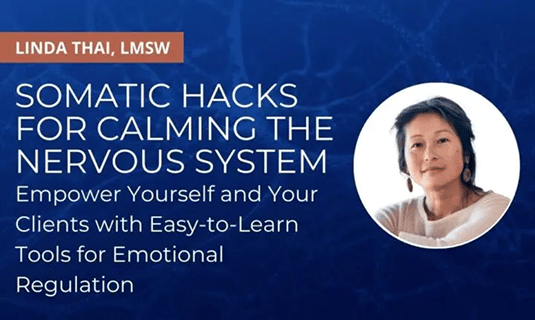
What you´ll learn:
- Vestibular Engagement for Emotional Regulation
- Using the Eyes to Hack the Stress Response System
- Subtle Sounds to Release the Peri-Trauma Response
- Effective Self-Holding and Self-Swaddling Techniques
- How and When to Apply Bilateral Stimulation
- Integration and Completing the Stress Response Cycle