
What is Structural Dissociation in Trauma Therapy?
Q: How does structural dissociation affect trauma survivors in therapy?
A: Structural dissociation divides a survivor’s personality into parts that manage daily life and parts stuck in survival modes like fight, flight, or freeze. Healing requires compassionate integration rather than confrontational techniques.
reframe survival responses as protective parts rather than pathology.
Beyond Resistance: Moving from Pathology to Survival
In our community of therapists, we frequently encounter clients who seem stuck, repeating patterns that disrupt their progress. It is easy for traditional clinical frameworks to label this behavior as resistance or non-compliance. However, Dr. Janina Fisher teaches us that these clients are not resisting the therapeutic process. Their nervous systems are simply organized entirely around survival. When a person experiences overwhelming or chronic threat, the psyche protects itself through a process known as structural dissociation. This is not a choice or a sign of brokenness. It is an exquisite, intelligent defense mechanism.
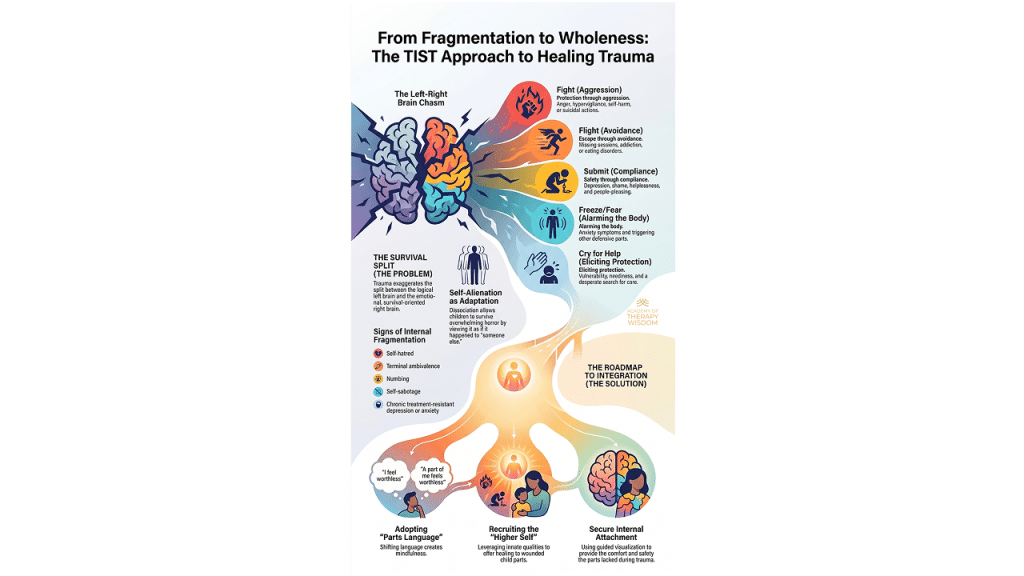
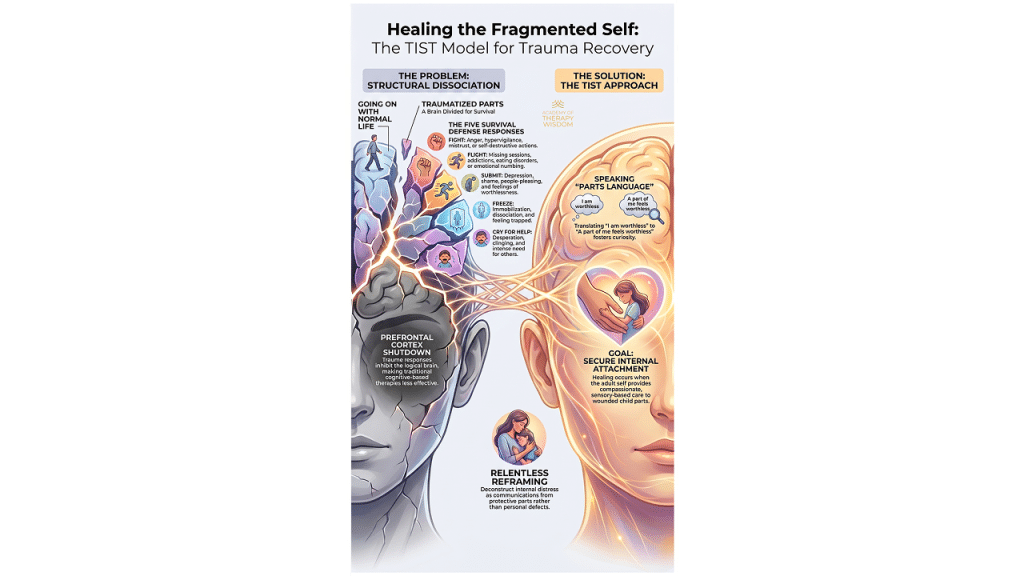
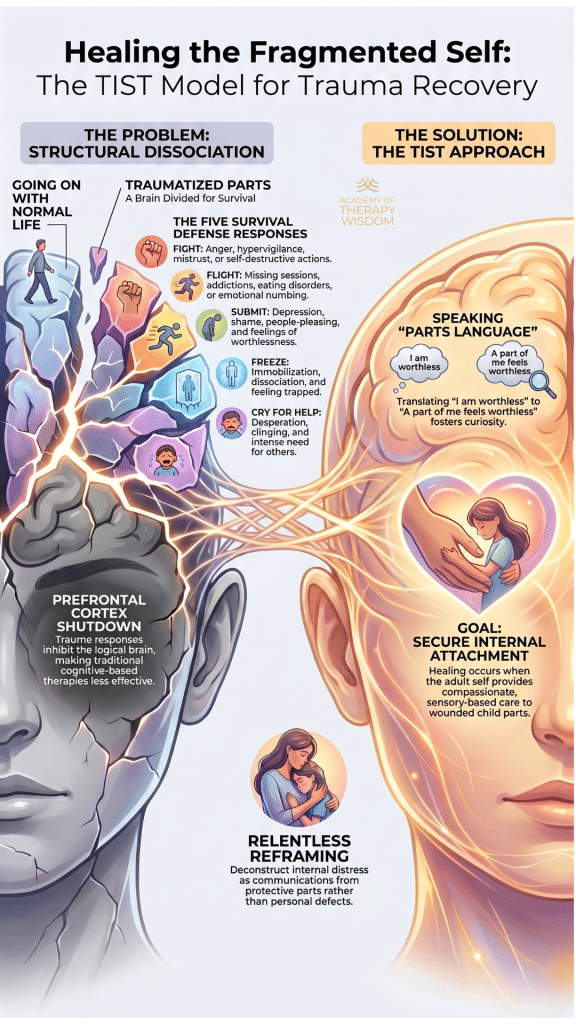
The personality splits to allow the individual to keep functioning in the world. One part carries the burden of getting to work, paying bills, and managing relationships. Meanwhile, other parts remain frozen in time, holding the raw energy of fight, flight, freeze, submit, or attachment-based survival responses. When we see our clients through this lens, our clinical approach shifts entirely. We stop trying to fix a pathology. Instead, we begin to appreciate the profound wisdom of their protective systems.
The Neurobiology of Survival and Parts Work
During trauma activation, something distinct happens in the brain. The prefrontal cortex essentially shuts down. This means our clients lose access to logic, language, and reflection when they feel threatened. Expecting them to talk through their experiences logically during these moments is a clinical misstep. Because traditional cognitive processing is offline, we must utilize a body-informed, parts-oriented framework. This is where Trauma-Informed Stabilization Treatment becomes indispensable.
Symptoms like hypervigilance, sudden emotional numbing, or intense people-pleasing are not random defects. They are active, somatic communications from parts that believe the danger is still happening right now. By introducing parts language into our sessions, we offer our clients a powerful tool for regulation. When a client learns to say, “A part of me feels completely worthless,” rather than, “I am worthless,” a profound shift occurs. That tiny shift in language creates a healthy distance from the overwhelming shame. It opens up a small pocket of space where curiosity and self-awareness can finally breathe.
Cultivating Secure Internal Attachment
True integration does not happen by fighting or banishing the parts that cause distress. We cannot force a client’s system into healing. Instead, sustainable recovery is built on the development of secure internal attachment. The adult self must learn to relate to these wounded, defensive parts with genuine compassion and patience. According to research published by organizations like the American Psychological Association, the quality of the therapeutic relationship is the single greatest predictor of successful outcomes. Our clients do not just need our interventions. They need our presence.
Our own regulated nervous systems serve as an anchor, communicating safety directly to their biology. As we model compassion for their most difficult parts, the client gradually learns to internalize that same compassion. They discover how to listen to the somatic impulses of their body without judgment. Over time, the fragmented pieces of the self begin to realize that the crisis has passed. They can finally step down from their survival roles and integrate back into a whole, cohesive life.
Frequently Asked Questions
What is the primary goal of Trauma-Informed Stabilization Treatment?
The primary focus of this modality is to help clients stabilize by recognizing that their symptoms are actually defensive parts. By understanding these survival responses through a neurobiological lens, individuals can reduce shame and stop the cycle of dissociation that keeps them stuck.
How does using parts language help with emotional regulation?
When clients use parts language, they shift from being completely overwhelmed by an emotion to observing it. This language pattern helps them step into a state of mindfulness, preventing the window of tolerance from narrowing and allowing the prefrontal cortex to stay online.
Why do traditional cognitive therapies sometimes fail trauma survivors?
Cognitive approach models rely heavily on top-down processing, which requires an active prefrontal cortex. Because trauma often triggers a temporary brain shutdown, incorporating somatic therapy and parts work is usually necessary to access the body’s stored survival states.

Join Dr. Janina Fisher for a FREE webinar
Healing the Fragmented Selves of Trauma Survivors
In this free webinar, Dr. Janina Fisher will help you:
How to identify and work with fragmented selves in trauma survivors.
How to stabilize chronically at-risk clients using TIST principles.
How to address self-alienation and dissociation to foster self-acceptance.
How to navigate therapeutic gridlock and work effectively with resistant, stuck, or emotionally overwhelmed clients.