
Dear Friends,
Do prayers really make a difference?
Not in an abstract theological way, but in a practical, human way.
When a friend is suffering, when a loved one receives a difficult diagnosis, when we hear of a community grieving and someone reaches out and says, “I’m keeping you in my prayers.”
Are we simply comforting ourselves? Does it really make a difference? And to be clear, I am not suggesting prayer as a substitute for social action when there is injustice.
Every major wisdom and religious tradition is centered around prayer. And yet roughly half the country is not affiliated with any religious organization, with almost 30% identifying as atheist or agnostic. So are the traditions feeding us something that no longer holds?
I don’t think so. But I think we need a different way of understanding what prayer actually is.
I was reminded recently of the experiments by Masaru Emoto, the Japanese researcher who became well known in the 1990s for claiming that human thoughts and prayers could affect the structure of water.
His method: expose water to different words, intentions, and music. Some samples were labeled with words like “Love” or “Thank You.” Others with words like “Hate” or “You Fool.” The water was then frozen and the resulting crystals photographed under a microscope. Emoto claimed that positive words produced beautiful, symmetrical crystals, while negative words produced distorted, irregular ones.
Scientists have questioned his methodology and his selection of photographs. I hold the experiment loosely. But the question underneath it doesn’t go away: does intention leave a trace in the world?
More rigorously, the researchers at the HeartMath Institute have explored this territory. Their work suggests that the heart generates the body’s strongest electromagnetic field, and that emotional states like appreciation, compassion, and gratitude produce measurable differences in our physiology.
The science is still evolving. But one thing is hard to dispute: our inner state affects our outer presence. We are always transmitting something.
Therapists know this in their bones.
So much of what heals a client is beyond words. It lives in the quality of attention we bring into the room, our shape, our embodiment, before we say a single word. A regulated nervous system communicates safety. A grounded presence communicates that this moment can be tolerated. An open heart communicates that the person across from us is not too much.
This is the invisible made visible.
Research consistently shows that the therapeutic relationship, not the model or the technique, is the strongest predictor of outcome. Clients don’t primarily remember what you said. They remember how they felt in your presence. They remember whether something in you reached toward something in them.
Maybe that is what prayer is, too.
Not mysterious magic. Not a bypass of hard work and social action. But a practice of orienting ourselves inward, of cultivating the qualities we most want to bring outward. Compassion. Patience. Courage. Love. Our inner lives ripple outward in ways we may never fully see.
Maybe prayers change the world. Maybe they change us first, when we place someone else’s suffering above our own mundane needs.
Warmly,
Brian Spielmann
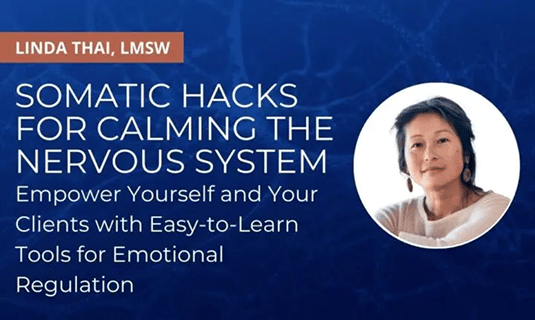
What you´ll learn:
- Vestibular Engagement for Emotional Regulation
- Using the Eyes to Hack the Stress Response System
- Subtle Sounds to Release the Peri-Trauma Response
- Effective Self-Holding and Self-Swaddling Techniques
- How and When to Apply Bilateral Stimulation
- Integration and Completing the Stress Response Cycle