
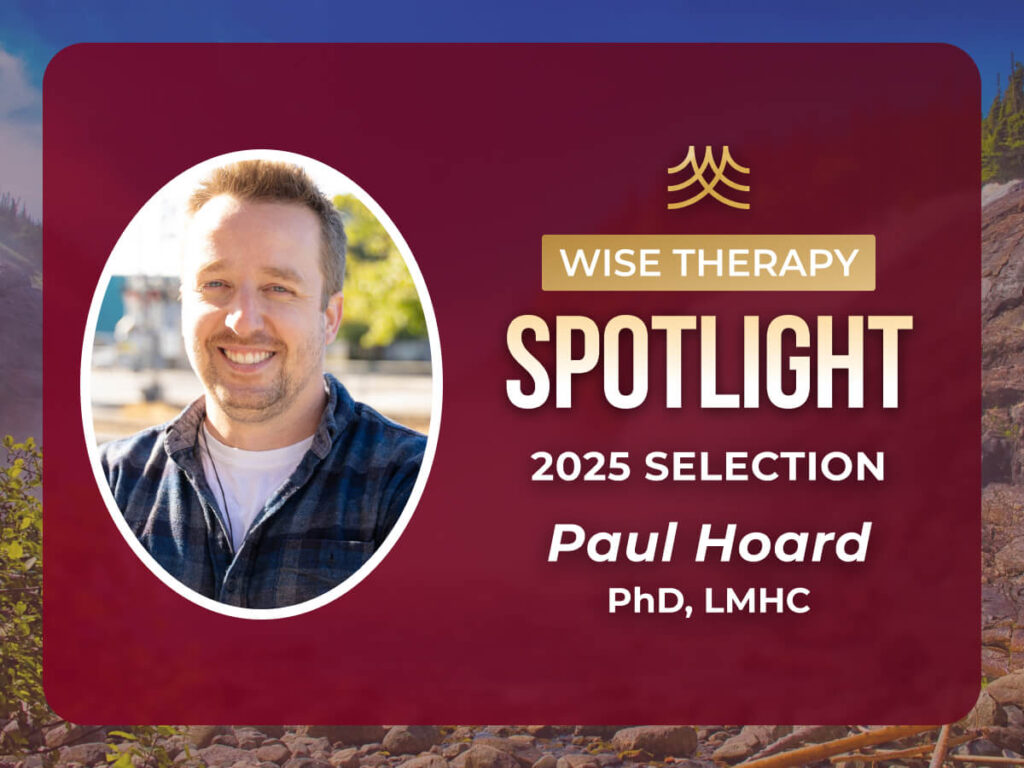
Each year we open submissions for our Annual Wise Therapy Spotlight to explore questions of vital importance to our therapist community. We are consistently moved by the depth and generosity of these unedited community voices.
For this 6th edition, we asked: How do we remain faithfully human in an increasingly automated world? Read more about our inspiration in the letter from the editors and Academy of Therapy Wisdom co-founders, Brian Spielmann and Ian McPherson.
Download Now: Wise Therapy Spotlight December 2025 Issue
We hope you enjoy the reflections of Paul Hoard as much as we all did.
Therapy Wisdom Spotlight: Paul Hoard PhD, LMHC
While many discussions in mental health circles about “AI”—specifically large language models (LLMs) like ChatGPT or Claude—focus on their role as counselors, I’ve been exploring their use in simulating clients. In my counseling skills classes, I’ve invited students to practice “turn-based therapy,” responding as therapists to an LLM-generated client. These experiments have revealed interesting pedagogical possibilities—but also a limitation worth some reflection: LLMs can’t help but give you what you want. They aren’t subjects. They’re mirrors.
LLMs operate by predicting language based on statistical modeling. Trained on massive datasets of human text, they generate language by determining the most probable next word in a sequence. They are optimized to sound fluent, helpful, and agreeable. But their relationship to language is not human. Words are encoded as tokens—not as meaningbearing signifiers. The model’s goal is not truth, but continued engagement. It reflects your desire back to you, in your own language.
In class, this became clear when I asked LLMs to simulate resistant clients. No matter how I prompted them, the “clients” were too agreeable. They accepted interpretations too readily, expressed vulnerability too easily, and lacked genuine resistance. They behaved like ideal patients—not real ones.
To explore the significance of this, I want to turn to Lacanian psychoanalytic theory and its analysis of how language forms consciousness and how transformation requires frustration. It requires lack.
________________________
What Is Lack? In Lacanian psychoanalysis, “lack” means that something is always missing once we start using language. Before we learn to speak, we experience the world directly. But once we begin using words, we lose that immediate connection. This missing piece creates a feeling of incompleteness—and that’s what drives our desires. We want things because we sense that something is not quite whole.
To begin with, Jacques Lacan was a prominent French psychoanalytic thinker who was most active from the 1950s till his death in the early 1980s. While he has had a relatively minor impact on psychological theory in the USA, he is considered one of the most influential psychoanalytic thinkers around the globe. He considered his work to be a return to Freud in that he was reinterpreting Freudian concepts through modern linguistic theory. In this way, language became central to his understanding of consciousness and subjectivity.
In Lacan’s theoretical framing, to become conscious is to enter the symbolic order; to become a speaking being. But with this entry comes a cost: the experience of lack. We become caught up in this symbolic order with an identity, but that identity is never the full picture, something is always left out. When we enter language, we lose something of the raw, unmediated self because language imposes structure, categories, and meaning that can never fully capture our experience. That irretrievable loss becomes the source of our desire since we experience something as missing. This missing thing is an eternal, unreachable “it”, an impossible wholeness we chase through relationships, accomplishments, consumption, even therapy itself.
Lack, however, is not a deficit. It is the motor of our desire. Love, connection, and creativity all emerge from the space of not-having. Fantasy is the imagination that we can attain wholeness. We can become captured by an image of completion that can never be realized. Many love songs echo this: “you complete me,” “I need you.” These are poetic expressions of a fantasy that covers over lack.
________________________
Fantasy vs. Desire Fantasy tells us what would make us whole: “If only I had X, I’d be complete.” Desire emerges precisely because we are not whole. Fantasy offers closure; desire opens us to others. But our internalized image of ourselves—our ego—is built from those very fantasies. It is not who we really are. Freud’s original word for ego was simply the pronoun “I” (Ich). What we think of with the term “self” is always only partial, incomplete. We are more than what we imagine ourselves to be.
Transformation, then, whether in therapy, faith, or community, requires an encounter with the disavowed, the split-off, the unthinkable parts of ourselves. Integration isn’t pleasant. It isn’t smooth. It hurts. The “aha” moments we seek often serve as self-soothing illusions rather than real breakthroughs. True healing comes through the wound.
LLMs, however, are not built for this. They are structured to offer the fantasy of an ideal other—one who never misunderstands, who always responds, who never wounds. They are fantasies of a subject who knows, who completes. This is what Lacan calls phallic jouissance: the enjoyment of mastery, completeness, and comfort at the expense of truth. By contrast, mystical or feminine jouissance arises from embracing the fragile, wounded, incomplete nature of being.
________________________
Phallic vs. Mystical Jouissance Phallic jouissance: enjoyment of control and closure. Mystical (or feminine) jouissance: enjoyment found in surrender, contradiction, and excess—often linked to spiritual or ecstatic experience.
My sister, Billie, and I have written about these dynamics through the lens of disgust and purity. LLMs offer a sanitized world: clean language, smooth responses, total affirmation. They mirror back our most coherent selves. But this isn’t relationship, it’s simulation. And the danger is that it insulates us from reality.
We’ve named the alternative eucontamination: transformation through contact with what disgusts us. True growth comes not by purifying ourselves, but by allowing ourselves to be touched by what we’ve tried to avoid. The disgusting becomes sacred when it disrupts the fantasy of cleanliness. The wound becomes holy when it’s no longer hidden.
________________________
What Is Eucontamination? A term coined to describe transformation through contact with what disgusts us. Rather than seeking purity or comfort, eucontamination embraces discomfort, contradiction, and the sacredness of what we’d rather avoid.
LLMs, however, excel at protecting us from that encounter. They help us maintain the illusion that our symbolic world—the world of language, clarity, coherence—is sufficient. But Lacan reminds us that the Real irrupts when the symbolic fails. When language collapses, we meet the unbearable truth we’ve tried to avoid. LLMs are built precisely to prevent that collapse. They generate more language, more smoothness, more comfort. They function like the obsessive neurotic: endlessly speaking to avoid touching the truth.
________________________
The Real Not the external world, but that which escapes symbolization. The Real is the unspeakable and unimaginable.
In Plato’s Phaedrus dialogue, Socrates recounts the myth of Thamus and Theuth. When the inventor god, Theuth, presents writing as a gift to humanity, Thamus, the king, warns: “it will not make people wise, but only seem wise. It will offer the appearance of memory, the semblance of thought, without real understanding.” So too with LLMs. They offer the illusion of intelligence, the semblance of dialogue, without subjectivity or risk.
What can we do in response? Not abandon the tools, but learn to use them wisely. Wisdom is born from lack. The wise person is one who knows they don’t know. If we are to cultivate wisdom through our use of LLMs, we must remain connected to our own not-knowing. That means paying attention to our bodies and what we’re feeling when we use them. Do you feel soothed? Empowered? Impressed? Bored? What do you want from the system? What do you hope it will avoid? Where is your desire?
If we take those feelings seriously, LLMs can become mirrors—not of truth, but of our own desire. They can help us learn to see ourselves better if we are able to stay rooted in our lack instead of buying the fantasy of wholeness. The danger is that they will constantly tempt us to sacrifice reality for image. We must remember: they are not subjects. They do not lack. They cannot love. And that is why they’re so seductive. They offer the semblance of connection without the risk of relationship. They give us an image of what we think we want, without the vulnerability of facing our lack. They can’t help but tell you that your idea is great, devoid of any real substance.
If we do not stay grounded in our own woundedness, if we don’t cultivate a willingness to be disgusted, undone, or surprised, we risk falling in love with our own reflection. And like Narcissus, we may drown in it.
Works Cited
Bettelheim, Bruno. Freud and Man’s Soul. New York: Vintage Books, 1983.
Designlab. “The UX of AI Chatbots: Why Agreeableness Matters (But Truthfulness Matters More).” Designlab Blog, April 15, 2025. https://designlab.com/blog/the-ux-of-ai-chatbots.
Ivan Belcic and Cole Stryker, “What Is Claude AI?,” IBM THINK, September 24, 2024, https://www.ibm. com/think/topics/claude-ai.
Jacques Lacan. The Seminar of Jacques Lacan: Book XX: On Feminine Sexuality, The Limits of Love and Knowledge, 1972–1973. Edited by Jacques-Alain Miller. Translated by Bruce Fink. New York: Norton, 1999.
Jacques Lacan. Écrits. Translated by Bruce Fink. New York: W.W. Norton, 2007.
Paul Hoard and Tim Suttle. “Lacanian Virtue Ethics? Cultivating Virtue Through Failure.” The Other Journal, Issue 35, 2023. https://theotherjournal.com/2023/06/lacanian-virtue-ethics-cultivating-virtuethrough-failure/
Paul Hoard and Billie Hoard. “Eucontamination and the Christian Logic of Disgust and Contamination.” The Other Journal, Issue 32, 2020. https://theotherjournal.com/2020/10/eucontamination-christian-logicdisgust-contamination/
Paul Hoard and Billie Hoard. Eucontamination: Disgust Theology and the Christian Life. Eugene, OR: Cascade Books, forthcoming.
Plato. Phaedrus. Translated by Alexander Nehamas and Paul Woodruff. Indianapolis: Hackett Publishing, 1995.
OpenAI. “GPT-4 Technical Report.” OpenAI, 2023. https://openai.com/research/gpt-4
What you´ll learn:
- Vestibular Engagement for Emotional Regulation
- Using the Eyes to Hack the Stress Response System
- Subtle Sounds to Release the Peri-Trauma Response
- Effective Self-Holding and Self-Swaddling Techniques
- How and When to Apply Bilateral Stimulation
- Integration and Completing the Stress Response Cycle