

Each year we open submissions for our Annual Wise Therapy Spotlight to explore questions of vital importance to our therapist community. We are consistently moved by the depth and generosity of these unedited community voices.
For this 6th edition, we asked: How do we remain faithfully human in an increasingly automated world? Read more about our inspiration in the letter from the editors and Academy of Therapy Wisdom co-founders, Brian Spielmann and Ian McPherson.
Download Now: Wise Therapy Spotlight December 2025 Issue
We hope you enjoy the reflections of Erin Cutrone as much as we all did.
Therapy Wisdom Spotlight: Erin Cutrone LMHC
There is no question Artificial intelligence is rapidly transforming our brains, our world, our work and our workforces but does transforming mean replacing and what does that mean for the therapy world?
As a therapist who specializes in trauma and attachment, the nervous system, the physiology of stress, the biology of trauma, and accessing the higher heart and brain qualities through understanding and rewiring the nervous system, topics such as A.I. and the art of human healing are near and dear to my heart. Let’s dive in.
A.I. undoubtedly is changing how we can access information, organize data, and even deliver assignments and presentations. It can lay out not only meticulous but efficient outlines, formatting and frameworks within seconds. It can compile information, analyze research, generate educational content, assist with clinical documentation, support training, and even help people learn coping tools through guided exercises or chat interfacing. It can resource theory, offer insight, explain in great detail underlying patterns and psychoeducate from the palm of one’s hand, from the comfort of one’s home, bed, office, cafe, transport or anywhere in between. For the therapist, A.I. can help bridge some of the gaps in access and affordability of resources, make psychological insights and strategies more widely available and now with tools like A.I. Notetaking can even help reduce therapist burnout by automating documentation and administrative tasks (a topic for a deeper dive another time). Let’s be honest, it’s got us humans beat in efficiency, accessibility, and scalability. Where many professions fear the A.I. takeover, does this mean that our work too, is replaceable?
My short answer is not at all.
Where A.I.’s efficiency and usefulness ends is, in my opinion, precisely where therapy begins. True healing doesn’t happen through data processing; although an important aspect, it happens through presence, attunement, co-regulation, and the felt sense of being seen and accepted in all aspects of self. The therapeutic relationship happens not just through the felt sense, but more specifically through the activation of mirror neurons, through facial expression, tone and cadence. These are nervous system-to-nervous system communications delivered through human exchanges that no algorithm or bot can authentically replicate.
“Where A.I.’s efficiency and usefulness ends is, in my opinion, precisely where therapy begins. “
If seen through a more evolutionary and empowering lens, as A.I. advances, therapists have an opportunity not to compete with it, but like the rest of the world, leverage its beneficial aspects while maintaining the very core of what therapy is. Unlike some of the other professions, therapists have the opportunity to prevail over A.I. through embodiment, empathy, and human connection – the very qualities that technology cannot manufacture or pattern recognize. When used collaboratively, A.I.can become an ally that expands our impact, while reminding us that human intelligence is not artificial, nor is human healing – they’re relational, nervous system to nervous system. Let’s dive into some other considerations.
The external data trap.
In a world of rapidly expanding access to information, news, politics, and global events delivered at exponentially increasing speeds, we are severely underestimating the deeper consequences of relying so heavily on these external data derived feedback loops. It is important to acknowledge that information overload, constant mental overstimulation and fragmented attention disrupt the very systems we depend on for higher thinking, higher-heart qualities, and meaningful inner and outer healing.
Micro-clips, 5G-level speeds, and constant blue-light exposure disrupts natural and optimal human functioning: it disrupts circadian rhythms, interferes with what I call the central column functioning: immune health, digestion systems, reproductive systems and depletes the cognitive processes required for deep, reflective thinking necessary for creating change. This overstimulation not only severs the body’s natural healing circuitry, it often reinforces disconnection from self: from our innate needs, our subtle body cues, and our internal feedback systems. Being in a state of constant arousal and more so hyperarousal (presuming most people are not binge watching peaceful, understimulating, relaxation inducing content) often creates a disconnection to hunger or thirst cues, the need for sleep or to relieve a bladder, and even physical pain cues such as eye strains, headaches or exhaustion.
When we outsource our internal ‘knowing’ to cut-and-paste information, we also outsource our personal power and intuition, again overriding and disregarding important internal cues. Instead of asking, “Is coffee good or bad according to this fill in the blank” the more important question is, “How does my body respond to coffee?” Information one’s body will definitely reveal if one was to tune in to.
A.I. and the felt sense of safety:
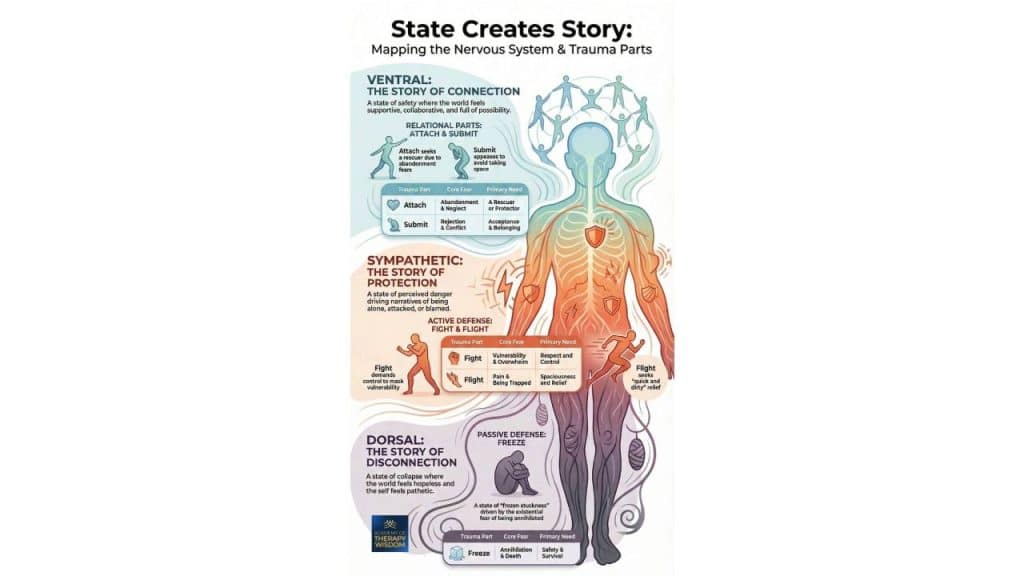
Continuing with this theme of overriding natural processing and internal cues, our modern lifestyles, sedentary habits, prolonged exposure to screens and blue light, are disrupting our natural human rhythms furthering the disconnect between human and self, human and the outside world, and human to human. From a polyvagal perspective, this chronic overstimulation directly impacts our nervous system’s ability to interpret external cues. This is something I teach daily: when the nervous system is dysregulated, it can often misperceive cues. Why? This is critical to understand in our world and our work, so read this slowly. From a stress/threat state one will perceive only danger caused even from a neutral or safe situation. This misinterpretation of neutral or safe cues as threatening, triggers defensive mechanisms instead of safety mechanisms such as social engagement, curiosity or compassion. This misinterpretation of information not only disrupts our sense of connection, but also creates unnecessary feelings of danger, threat, and defensiveness where none may actually exist. One of the deeper aspects of trauma work, nervous system work, mindset work, brain change, and brain-body retraining begins with attuning the nervous system to safety. In the therapeutic relationship, one gets to feel the effects of coregulation and experience the felt sense of safety. This highlights the growing need to not just teach but embody the felt sense of safety and nervous system regulation both in our work and our world. Noting here that as A.I. can most definitely deliver this information but not facilitate embodied safety. This is where therapy prevails.
The unspoken illusions of truth:
There is a growing concern over what is called A.I. hallucinations, and if this is a new concept for you- it is definitely one to do some homework and self educating on. What this essentially means is that A.I. often gives information without citing sources and sometimes when prompted to cite sources- sources come up unknown, or unobtainable. In other words, what one assumes is compiled from data sorting is actually generated as ‘plausible sounding’ but not from concrete sources as we imagine. Instead this information comes from trained pattern recognition, biases, incomplete training or statistical predicting. That is an important sentence to take in (I usually say, read that again!). As A.I. gets to know its user, it creates feedback loops that often reinforce biases, tendencies or patterns as it is designed for and created from pattern recognition over truth and fact seeking. This algorithm directly mimics our brain’s neural networking- ‘neurons that fire together, wire together.’ If you have never heard that phrase it essentially means with repetition the connection between two neurons gets stronger, making the pathway more efficient and automatic over time. This is why the information and language A.I. uses in delivering results differs vastly from one user to another. Most definitely an unspoken illusion.
“When we outsource our internal ‘knowing’ to cut-and-paste information, we also outsource our personal power and intuition, again overriding and disregarding important internal cues.”
“Safety is delivered nervous system to nervous system. A.I. can deliver information and insight, but it cannot deliver integration.”
There is also a more obvious yet rarely discussed issue: A.I. is advancing faster than our ability to reliably detect it, creating a growing difficulty in distinguishing authentic, human-created content from A.I. generated identical look-alikes. This is where I believe A.I. is going to have the most profound impact on mental health: when we can no longer trust the reliability of not just information, but reality: what is real and what is true. When this is compromised, this is where we are going to see mental health decline substantially. I want to reinforce here again, this is precisely where our work is going to be incredibly impactful. When we can embody and mirror safety- the safety circuitry turns back online-the higher brain processes turn back online, the higher heart qualities turn back online, the central column functioning turns back online and the inner compass is restored. This is exactly why our work is irreplaceable. Safety is delivered nervous system to nervous system. A.I. can deliver information and insight, but it cannot deliver integration. In a world of artificial- perhaps it is not the A.I. that is revolutionary rather authentic human connection and maybe the future of therapy will be integration bringing together the best of both worlds where A.I. can take over cognitive, educational tasks and therapists can maintain the very core of what therapy is- activating higher human functioning through embodiment, empathy, and human connection- nervous system to nervous system.
What you´ll learn:
- Vestibular Engagement for Emotional Regulation
- Using the Eyes to Hack the Stress Response System
- Subtle Sounds to Release the Peri-Trauma Response
- Effective Self-Holding and Self-Swaddling Techniques
- How and When to Apply Bilateral Stimulation
- Integration and Completing the Stress Response Cycle