
I was scrolling through social media last week and noticed yet another viral post vilifying narcissists, complete with a checklist of “red flags” and comments urging people to cut all contact. This portrayal of narcissism as pure evil has become ubiquitous online, with countless TikTok videos and Instagram infographics reducing complex human behavior to a simplistic character flaw. What struck me was how this popular discourse completely misses what Dr. Janina Fisher trainings show us and trauma-informed approaches teach us—that treating a narcissist effectively requires understanding narcissism not as a moral failing but as a protective response to developmental trauma. This reframing has transformed how I understand narcissistic tendencies, and I think it could be supportive to you in your clinical practice, as well.
In the video above, Dr. Fisher eloquently explains that the “narcissistic wound” stems from childhood experiences where vulnerability felt dangerous without secure attachment. As she notes, “The narcissistic wound, for children, is that they’re vulnerable. And vulnerability is dangerous unless there is secure attachment.” This perspective fundamentally shifts our understanding of narcissism from a character defect to a survival strategy developed in response to early relational trauma.
This trauma-informed approach to narcissism represents a paradigm shift in therapeutic practice. Rather than confronting narcissistic defenses head-on, which often strengthens resistance, Dr. Fisher’s method acknowledges the protective function these patterns serve and works with, rather than against, the client’s internal system.
If you´re not yet familiar with Dr. Janina Fisher, she is a world-renowned expert trauma therapy trainer and developer of the TIST (Trauma-informed Stabilization Treatment) therapy modality. If you are interested in TIST, or comparing online therapy CE courses for trauma work, you may be interested in Dr. Fisher´s free TIST training webinar. In the meantime, I hope this article proves useful and valuable to your clinical work.
Beyond Social Media Stereotypes: Understanding Narcissism Through a Trauma Lens
Though social media has proliferated a simplified narrative around narcissism, portraying those with narcissistic traits as villains to be identified and avoided, therapeutic approaches grounded in trauma research reveal a more nuanced reality. What appears as entitlement or superiority maneuvers, or even the so-called “covert” victim-like narcissist behaviors, often mask profound shame and vulnerability. Research from the American Journal of Psychiatry supports the perspective that narcissistic defenses typically develop as protective adaptations to early attachment disruptions, neglect, or emotional abuse.
Key Trauma Factors in Narcissistic Development
- Childhood invalidation – When a child’s emotional needs are consistently dismissed
- Conditional love – When affection is tied to performance or achievement
- Attachment disruptions – Early relationship ruptures that create a sense of fundamental unworthiness
- Emotional neglect – The absence of attunement and emotional mirroring
The Neurobiology of Narcissistic Defenses
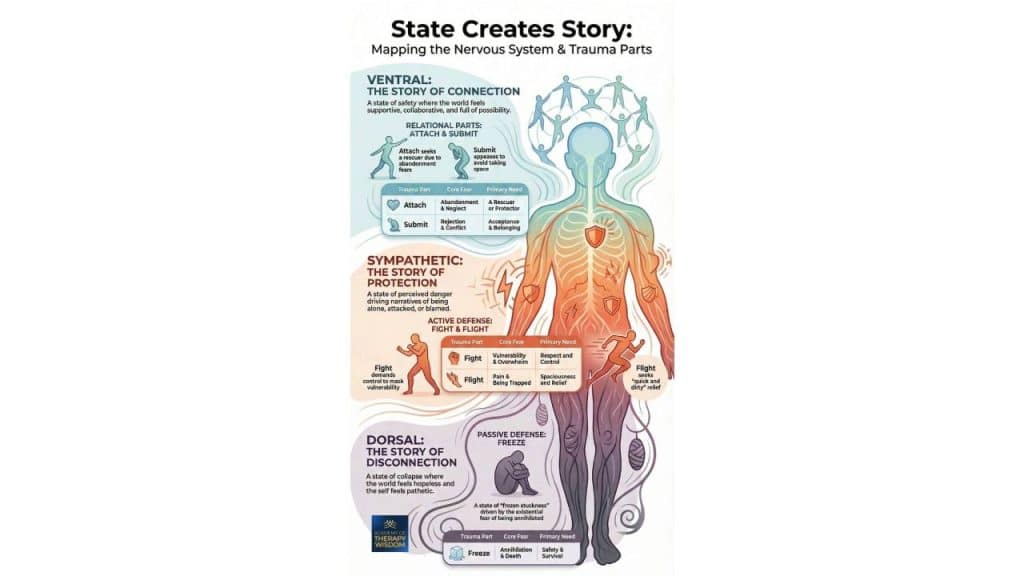
We now understand that narcissistic traits are deeply rooted in the brain’s threat-response system. When working with narcissistic clients, therapists must recognize that beneath the grandiose exterior lies a hypervigilant nervous system primed to detect and defend against shame.
“The narcissistic wound, for children, is that they’re vulnerable. And invulnerability is dangerous unless there is secure attachment.” – Dr. Janina Fisher
Trauma-Informed Stabilization Treatment (TIST)
Dr. Fisher’s TIST approach provides a framework specifically designed to address the underlying trauma that fuels narcissistic behaviors. Rather than confronting defenses directly, TIST works with the client’s internal system to create safety and gradually allow for vulnerability.
Parts Work in Treating Narcissism
TIST incorporates elements of Internal Family Systems to help clients recognize the protective function of their narcissistic parts while fostering self-compassion for the wounded aspects of self.
Effective Therapeutic Approaches for Treating a Narcissist
When working with narcissistic clients, we’ve found that traditional confrontational approaches often backfire, strengthening defenses rather than creating change. Instead, research published in the Journal of Clinical Psychology suggests that attachment-based interventions that acknowledge the client’s need for safety show significantly better outcomes.
Evidence-Based Strategies for Narcissistic Clients
- Validate Before Challenging
Create safety by acknowledging the protective function of narcissistic defenses before inviting change - Focus on Somatic Awareness
Help clients identify bodily sensations associated with vulnerability to build tolerance for uncomfortable emotions - Titrate Exposure to Shame
Carefully manage the therapeutic pace to prevent overwhelming shame responses that reinforce defenses - Build Relational Safety
Establish consistent, predictable therapeutic boundaries that allow for gradual relational risk-taking
Therapeutic Pitfalls to Avoid
Many therapists unintentionally reinforce narcissistic defenses by:
- Confronting grandiosity directly – This often triggers shame and strengthens defenses
- Moving too quickly toward vulnerability – This can overwhelm the client’s regulatory capacity
- Missing the protective function – Failing to honor how narcissistic traits have helped the client survive
- Becoming entangled in power struggles – Engaging in battles for control within the therapeutic relationship

Join Dr. Janina Fisher for a FREE webinar
Healing the Fragmented Selves of Trauma Survivors
In this free webinar, Dr. Janina Fisher will help you:
How to identify and work with fragmented selves in trauma survivors.
How to stabilize chronically at-risk clients using TIST principles.
How to address self-alienation and dissociation to foster self-acceptance.
How to navigate therapeutic gridlock and work effectively with resistant, stuck, or emotionally overwhelmed clients.
Practical Applications of Trauma-Informed Treatment
We recognize that applying these concepts in clinical practice requires specific techniques and interventions. A study published in BMC Psychiatry (2024) highlighted the strong association between adverse childhood experiences and the development of narcissistic traits, particularly vulnerable narcissism, supporting the need for trauma-informed approaches when working with these clients.
Clinical Interventions That Work
- Somatic Resourcing
Teaching clients to identify and strengthen internal resources for regulation - Parts Dialogue
Facilitating communication between protective narcissistic parts and vulnerable exile parts - Shame Reduction
Specific protocols for managing and metabolizing shame responses - Attachment Repair
Creating corrective emotional experiences within the therapeutic relationship
Reframing the Narcissistic Wound
As Dr. Fisher points out in the video, “Let’s not call it a narcissistic wound. It’s not a wound to pride; it’s a wound to the heart. That’s really what it is.” This powerful reframing helps therapists approach narcissistic clients with compassion rather than judgment, recognizing that beneath the defensive grandiosity lies a wounded child seeking safety.
“We make a mistake as therapists; we go straight for the vulnerability. That’s simply going to be threatening to most trauma survivors.” – Dr. Janina Fisher
Next Steps for Therapists
To effectively implement trauma-informed approaches to treating narcissism, therapists need specialized training and supervision. The integration of somatic awareness, parts work, and attachment theory requires a comprehensive understanding of how trauma shapes personality development.
Video Transcript
“In the narcissistic wound for children is that they’re vulnerable and and vulnerability is dangerous unless there is safe secure attachment and I think that’s the narcissistic wound in some clients you see very big fight and fight Parts guarding the parts that have been wounded I don’t know why we call it a narcissistic wound because in fact what it is is it’s a wound two very small children that then becomes defended by very um very vigorous fight and flight parts and uh and I think I think narcissistic parents are very frightening parents often um the emptiness I see as either The Emptiness of a submit part feeling um like a nothing or the The Emptiness of an attached part because attached part need parts need connection just like all little kids right little kids need connection and so so I help clients work with developing a non-vulnerable connection to their fight and flight parts we make a mistake as therapists we go straight for the vulnerability that’s simply going to be threatening to most trauma survivors so I say let’s go first to validating they fight and flight Parts defense of that wounded child and let’s not call it a narcissistic wound it’s not a wound to Pride it’s a wound to the heart that’s really what it is.”
If you’re working with therapy clients that exhibit narcissistic tendencies and finding traditional approaches ineffective I encourage you to explore Dr. Janina Fisher’s training on trauma-informed treatment. Her approach to working with trauma survivors (including treating a narcissist) offers a compassionate framework that acknowledges the protective function of defensive parts while creating pathways for healing the underlying wounds. By understanding protective parts as an adaptive response to developmental trauma rather than character flaws, we can move towards genuine therapeutic connection. Your willingness to see beyond the defensive facade could be the key that finally unlocks healing for clients who have long been misunderstood and stigmatized.
Warmly,
Heather