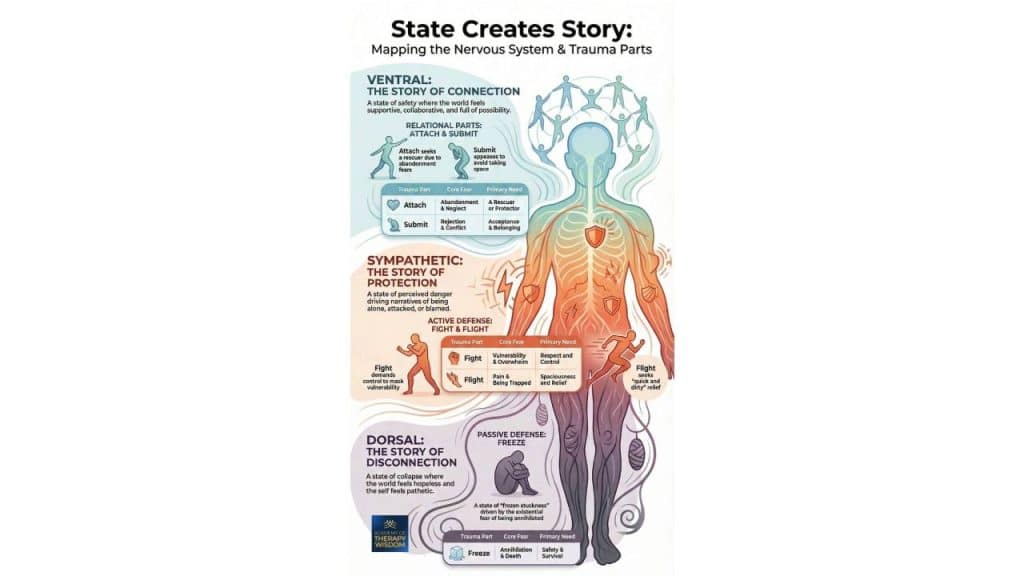


In this three-part article series extracted from Janina Fisher Ph.D.’s Trauma-informed Stabilization Treatment (TIST) therapy certification program, we´re going to talk about the importance of the therapist becoming an outspoken advocate for trauma-related parts as a way of modeling this for the client.
Think about the dilemma of a child in a traumatic world. That child needs to be heard, needs to be understood, which is what we do when we whisper to the parts. That child also needs an advocate, somebody who will give full voice on her behalf.
The Laws of Dissociation in Trauma Therapy with Janina Fisher, Ph.D.
Janina shares…
“This idea of being an advocate goes back to what I called the laws of dissociation, which I made up back in the early ’90s. These laws began to formulate in my head because I was seeing DID (dissociative identity disorder) clients at a time when very little was known about DID. I was overwhelmed by the very difficult cases I was seeing. So I created the laws to simplify their complexity and ease the stresses of treatment.
Law of Dissociation #1: A part is just a part.
One idea I developed early was this idea that the more complex the client, the simpler the therapy had to be. It didn’t work to try complicated approaches with complicated clients. So law number one became:A part is just a part. No matter how sweet, no matter how compliant, no matter how angry, no matter how numb, a part is just a part. And there are always other parts of the client who are not numb or who are not angry or not suicidal.
Law of Dissociation #2: The system was designed for survival.
Law number two: the system was designed for survival, not destruction. So many of my DID clients were suicidal and self-destructive, creating daily anxiety for me. I would think, “Would the client live through the night? Should they be in a hospital?” Law #2 reminded me that this individual had survived time and time again, that survival instincts could be counted on. . Using this law, I could just keep reminding myself that clients would be okay. The system was designed for survival, not destruction, no matter how destruction-driven some parts are.
Law of Dissociation #3: For every action, there will be an equal and opposite reaction.
Rule number three came out of the experience of feeling jerked around. There would be a good session followed by a terrible session, followed by an okay session, followed by a not-so-great session. Progress was never straightforward. I began to realize that I just had to expect that if it was a good session, which back in the ’90s meant the client cried or the client was vulnerable, the next session would be a nightmare. Now I understand that this happens because the vulnerable parts would disclose in one session, and the protectors would batten down all the hatches in the next session.
Law of Dissociation #4: The therapist is the therapist for all the parts.
The very last law of dissociation, probably the hardest, is that the therapist is the therapist for all the parts and for the system as a whole. That means we are the therapist for the parts that we like, for the parts that are easy to work with. And we’re also the therapist for the parts that offend us, or intimidate us, or shame us, or try to undermine our best efforts. That is not always easy. So how do we become the therapist for all the parts, when we’re used to being the therapist for the client, for this person with one body and mind sitting in front of us?
It doesn’t mean that we’re the therapist for five, or 10, or 15, or 20 different clients. We have to be like family therapists who treat the many or few members as a family group, not just as individuals. The biggest mistake we made with DID clients in the 90s was treating the parts as if they were separate individuals instead of as parts in a dynamic system..
Advocating for all the fragmented parts of trauma survivors, loud or silent, can be challenging.
Often, the client presents in therapy with a part that’s arguing a particular point of view–for example, arguing in favor of suicide, arguing in favor of self-harm, or substance abuse, or self-hatred or rejection of the parts.
Sometimes there are parts that never get advocated for because they’re silent or withdrawn. If I think about my clients, and I assume that also relates to your clients, most of my clients come in with particular parts that are louder than other parts.
I have one client, we´ll call her Suzanne, who always comes with her complaining part front and center, telling me about every way that her husband and three children have failed her. And until I’ve heard the complaining part complain, there is nothing else that we can get done. Now, that’s challenging. Therapists don’t really want to listen to 15 or 20 minutes of complaining when we feel there’s work to be done. But to be an advocate, I have to find a way to speak for this complaining part, for the part that wants me to know that people have treated her badly. And that, of course, was her history.
Her history was, “I was treated badly, and nobody acknowledged it and nobody did anything.” Even though I may not wish to hear the litany of complaints from the complaining part, it’s important that I acknowledge that part because that part is in charge of letting me know who has done Suzanne wrong. And I understand that part is speaking on behalf of young wounded parts.. Because at the heart of Suzanne’s trauma history was a family in which adults did the children wrong and no one acknowledged it. So I have to find a way to acknowledge that complaining part. The part that wants me to know every unjust thing that’s happened in the past week. And then, I can advocate for that part by listening and validating how hard it is day after day even now.
We will discuss more about how to be an advocate for these fragmented parts of trauma survivors in part two of this blog series. We hope sharing this key aspect of the Janina Fisher TIST therapy certification training is supportive to your work as a therapist. We invite you to explore the Trauma-informed Stabilization Treatment certification for therapists via the link below. We hope to see you in the trainings!

Join Trauma Informed Stabilization Treatment Webinar by Dr. Janina Fisher
Helping Trauma Survivors Get Unstuck: A Fragmented Selves Approach in Therapy
In This NEW Janina Fisher Webinar you will learn:
How to understand perplexing clients using the TIST perspective so you can see the fragmented selves at work.
How to organize a treatment plan using the TIST model so you have an effective approach to care.
How TIST helps shift even the most stuck clients so they can finally make progress.
How to relieve your frustration and prevent burnout with more effective trauma treatment.