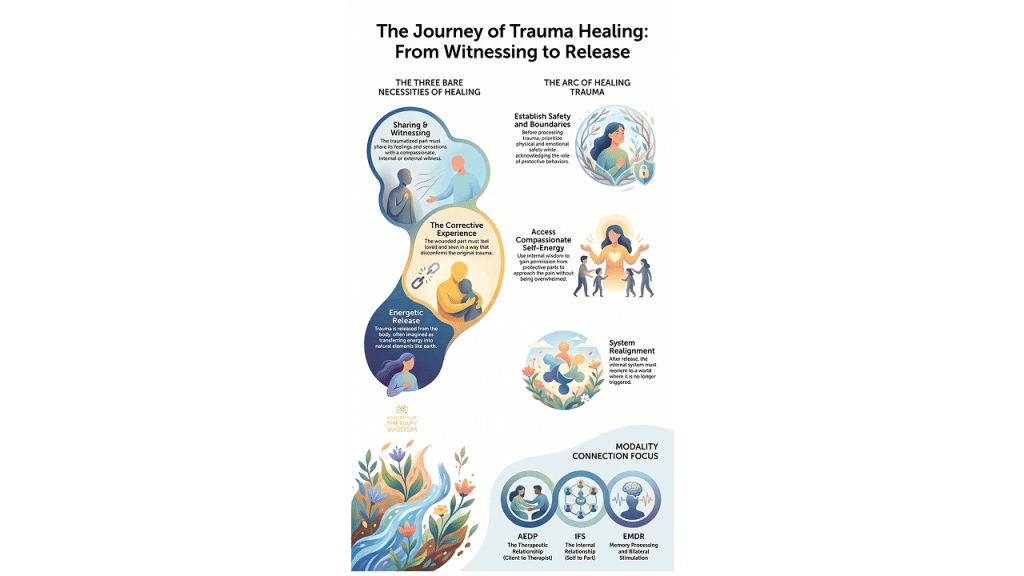

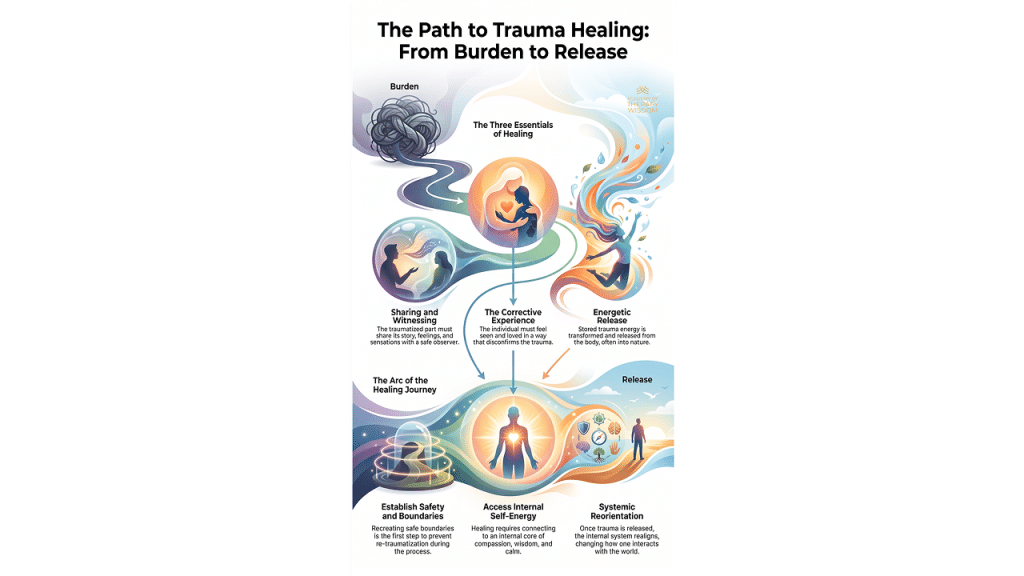
Moving from Survival to Somatic Integration
In our community of therapists, we often talk about the profound shift that occurs when a client stops merely reliving past pain and begins to relate to it from a place of curious observation. For long-term recovery, the goal is never to force a client back into the fire of their worst moments. True healing means establishing a secure foundation so they can look back at their history with genuine self-compassion.
Q: What is the core mechanism of non-linear trauma healing in modern psychotherapy?
A: Trauma healing relies on establishing enough relational and neurological safety for clients to witness their experiences rather than relive them. Through corrective emotional experiences and somatic processing, clients gradually release defensive survival patterns, allowing wounded parts to integrate safely into the nervous system over time.
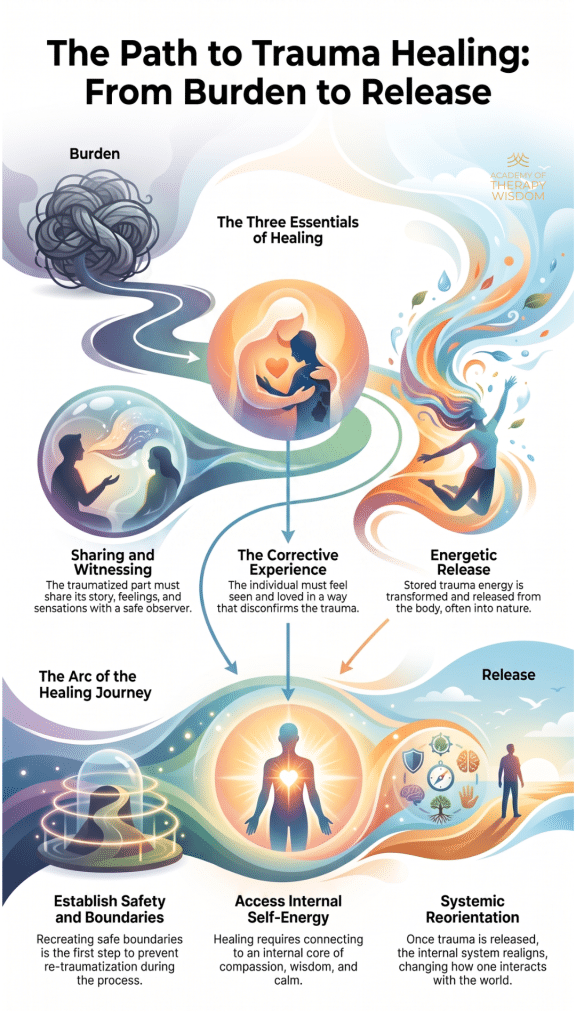
and connection rather than forced reliving of past stories.
The Journey of Compassionate Witnessing
When individuals undergo severe or chronic stress, their survival-based neural pathways remain locked in hyper-activation. Reliving the narrative repeatedly in talk therapy can inadvertently reinforce these rigid loops. Modern clinical psychology emphasizes that observing the narrative from a grounded baseline is where neuroplasticity takes root.
Expert clinician Frank Anderson notes that moving from being in the trauma to being with it alters a person’s entire relationship to their internal system. By remaining anchored in the present moment, individuals build the capacity to tolerate bodily sensations that once triggered immediate emotional hijacking or profound dissociation.
Cultivating Corrective Emotional Experiences
A vital piece of this process involves offering the client what was missing during the initial threat or neglect. Wounded, isolated parts of the self require real-time attunement, protection, and safety to update their old operating files. According to the American Psychological Association, an effective therapeutic alliance provides a corrective emotional experience where the client experiences a safe relationship that disconfirms childhood misbeliefs.
This work mirrors the foundational goals of Internal Family Systems and attachment-based models. When we sit with someone and offer an untroubled, compassionate presence, their internal system recognizes that the historical danger has passed. The protective parts that have spent years managing daily survival can finally contemplate stepping down from their exhausting roles.
Somatic Release and the Non-Linear Path
We cannot think our way out of deep structural wounding because the legacy of threat lives primarily in the body. True trauma release requires both a neurological shift and a somatic release. Chronic muscular bracing, shallow breathing, and autonomic instability must be met with gentle, body-centered interventions.
[Safety Foundations] ➔ [Compassionate Witnessing] ➔ [Corrective Experiences] ➔ [Somatic Integration]
As the nervous system settles, integration occurs organically. Yet, we must constantly remind ourselves and our clients that this trajectory loops backward and forward. A client might settle beautifully into a state of deep clarity, only to find themselves thrown back into intense hyperarousal the following week. This shifting baseline is completely normal. Returning to an earlier phase of the loop is a natural sign of the system gathering strength to process a deeper layer of memory.
Integrating Parts Work and Somatic Psychology
Bringing these concepts together requires an approach that respects both mind and body. Clinicians who utilize somatic therapy look closely at how neuroception dictates a client’s capacity to open up. If the lower brain stems perceive threat in the room, cognitive insights remain entirely inaccessible.
By prioritizing nervous system regulation first, we create the somatic container necessary for deeper parts work. This dual focus ensures that the client is never pushed beyond their capacity. Instead, they are supported as they gradually rebuild their internal flexibility and reauthor their life story from a place of wholeness.
Frequently Asked Questions
How does witnessing trauma differ from reliving it in a clinical session?
Reliving trauma floods the nervous system, which can re-traumatize the client and reinforce defensive threat loops. Witnessing involves observing the memory from a state of dual awareness, allowing the client to look at the past while remaining anchored in present safety. This baseline allows the brain to update emotional memories safely through neuroplasticity.
Why is trauma recovery considered a non-linear process?
The human nervous system opens up in layers based on its immediate perception of internal and external safety. Clients naturally cycle through periods of integration and moments of defensive activation as deeper wounds surface. Moving back into an early defensive stage simply means the client’s system is preparing to process a complex layer of material.
What role do corrective emotional experiences play in parts work?
Corrective emotional experiences deliver the missing relational elements, such as protection, validation, and warm attunement, that wounded parts missed during the original painful events. This safe relational input allows burdened parts to release their historical survival roles and integrate into a state of self-energy.

Join Free Webinar with Frank Anderson
Therapy for Forgiveness After Trauma with Frank Anderson
Helping Clients Gently Forgive Themselves and Others for Lasting Recovery
In this free Webinar, Frank Anderson will teach you:
Forgiveness as a path to peace and resilience.
Forgive without excusing harm; honor truth and boundaries.
Practice self-forgiveness to soften self-criticism.
Forgiveness eases trauma, supports recovery, and relationships.