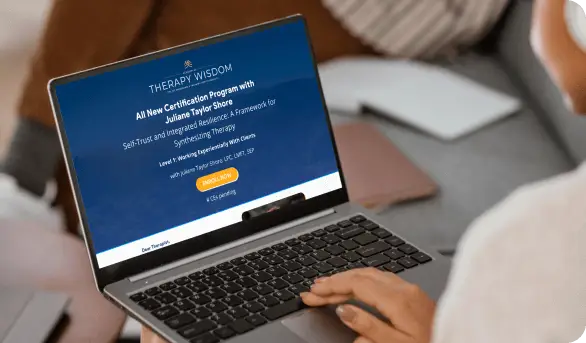
Introducing a Certification Program with Juliane Taylor Shore:
Use what you already know to make your therapy integrative, experiential and exponentially more effective...

Self-Trust and Integrated Resilience (STAIR):
A Framework for Synthesizing Therapy

STAIR Method Level 1: Working Experientially With Clients
Taught LIVE starting January, 2026
Instant access to 20+ hours of training available NOW

with Juliane Taylor Shore, LPC, LMFT, SEP

20 CEs available. Click here for full info.

Imagine this:

You're mid-session, and your most difficult client is just starting to open up. You have 3 different modalities in mind, and you are scrambling to decide which one will finally take this session somewhere productive...

In that moment, wouldn't it be amazing to know your next step with neurobiological certainty?

Introducing the STAIR Method: Jules Taylor Shore's "meta-modality" that gives you the framework to turn all of your existing modalities into a reliable treatment plan in the moment, so you can be confident you are leading clients toward lasting change, every time.

Forget scrambling to take every course you can find, in the hope you can finally get to the bottom of "trauma." It turns out that learning a dozen different modalities doesn't actually help you get better at your job: learning to use them effectively does.

In this training, you'll discover how to streamline and effectively utilize your existing toolkit to support neurobiological change. This means you will know how to apply the right therapeutic tools at the right moments.

You'll learn to work harmoniously with your clients' brain processes to facilitate real, lasting healing. Because when you know how what you're doing is affecting your client's brain, and you know the processes that will move them forward...

Therapeutic progress becomes basically inevitable.

This training is about enhancing your ability to use what you already have with greater precision and confidence. And along the way, you'll come to understand why  what you're doing works, why it sometimes doesn't, and how you can tell so you can always choose the most effective strategies.

Expect to deepen your understanding of experiential therapy and how to engage even the most reluctant clients in transformative work.

We can't wait to see you inside of the program!

Warmly,
Academy of Therapy Wisdom
Juliane Taylor Shore, LPC, LMFT, SEP

juliane-taylor-shore

STAIR Method Level 1 Training Overview:

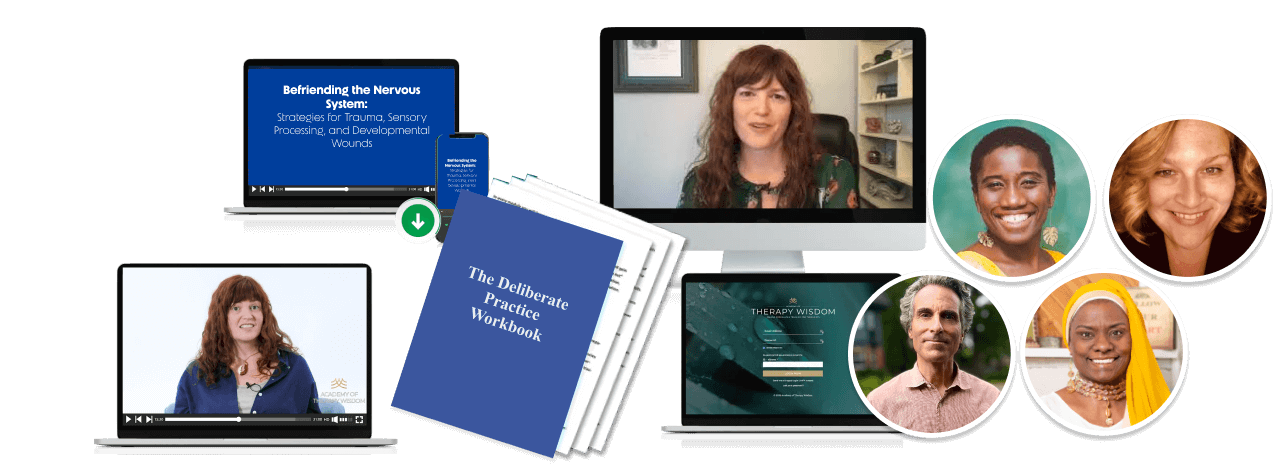
  • 5 Core Modules (~20+ hours)
  • 10 Live, 90-minute sessions with Jules (Jan–May 2026)
  • Deliberate Practice Workbook
  • Downloadable audio/transcripts
  • Private STAIR practitioner community
  • Plus Exclusive Bonuses!

In the course, you'll discover:

  • How exactly you need to organize your therapeutic modalities to support neurobiological change so that you can efficiently activate the precise brain pathways needed for your clients' healing, making your therapy sessions more targeted and effective.
  • How to do experiential, body-based therapy for the most impactful trauma healing so that clients can connect deeply with their physical sensations and emotions, fostering a more profound and lasting recovery.
  • Why experiential therapy is phenomenally better at treating trauma so that you understand the mechanisms that make it so effective, allowing you to communicate the benefits more convincingly to your clients and integrate these methods with confidence.
  • How to get a reluctant client engaged in experiential therapy so that they feel safe and motivated to participate, ultimately leading to breakthroughs even in sessions where progress has stalled.
  • Which experiential therapy intervention to use in a session depending on the circumstances so that you can tailor your approach to each client's unique needs and emotional state, enhancing the adaptability and effectiveness of your therapeutic practice.

But that is only the beginning. Self-Trust and Integrated Resilience: A Framework for Synthesizing Therapy is Level 1 of Jules' STAIR Method Certification Training program.

STAIR (Self-Trust and Integrated Resilience) is the very framework Jules uses to blend therapeutic modalities, neurobiology, somatics, and heart into her signature way of working with trauma.

Check Out What Other Therapists Are Saying About The STAIR Method...

Once You’ve Completed STAIR Method Level 1 Training:

  1. You Will Notice MANY Fewer "Stuck" Moments
    This is perhaps the most immediate and powerful benefit of taking this training. Using a brain-based roadmap, move from “talking about problems” to working directly with sensation, image, and parts—so sessions stop looping and start landing. You’ll learn how to read dysregulation as useful data and add regulation in real time—so shutdowns soften, agitation organizes, and you can guide clients through the here and now.
  2. You Will Feel More Present, Grounded, and Less Drained
    When you shift from “fixing” your client to co-creating safety and trusting their system, it reduces the pressure on you to have the perfect intervention, and instead builds your capacity to be a curious, compassionate witness. By teaching you how to manage your own internal state (your "warning states," agendas, and judgments), the course directly addresses a primary source of therapist burnout, and allows you to cultivate longevity and resilience with every session.
  3. You Will Develop a Cohesive "Operating System" for All Your Modalities
    Many therapists collect techniques from various models (CBT, IFS, Somatic, etc.) but lack a way to integrate them. This course provides that integration. The STAIR method doesn't ask you to discard your existing skills—instead, it provides a foundational, neurobiologically-informed "operating system" that helps you understand why and when to use the tools you already have. By understanding the core STAIR Method principles, you will be able to tailor your interventions moment-to-moment, responding creatively and intuitively to what is emerging in the room, making your work feel more like an art form.

About Your Instructor

juliane-taylor-shore

Trusted Trauma & Neurobiology Expert,

Juliane Taylor Shore, LPC, LMFT, SEP

With over 13 years of experience, Jules is uniquely qualified to show trauma therapists how and when to use their therapeutic tools to create the quickest, most profound changes.

Jules Taylor Shore, LPC, LMFT, SEP (AKA Jules) is a therapist and trainer of therapists in Austin, Texas. She specializes in applying Interpersonal Neurobiology to the healing of trauma and the creation of relational health with clients she sees. She uses her knowledge of the brain and the implicit mind to go decisively to the root of the issue with gentleness and depth.

Jules has been a specialist in trauma recovery and in couples counseling and loves to work experientially because that is how to invite shifts in the implicit mind.

She is the author of Setting Boundaries That Stick: How Neurobiology Can Help You Rewire Your Brain to Feel Safe, Connected, and Empowered.

Here's What Others are Saying About Self-Trust and Integrated Resilience

stars

"STAIR is an organizing system for your careworker toolbox."

"Learning from Jules…has transformed my work. I am a far more effective coach and a far better human in general because of my work with her. What I love best about STAIR is that it works with so many modalities and perspectives."

-   Libby Sinback, relationship coach, podcast host of Making Polyamory Work, Atlanta, GA

stars

"A transformation from the inside out."

"Jules has brilliantly crafted a way to work with the best pieces of multiple models and deliver therapy with intention, precision and art. This is what I was longing for and I can't imagine turning away from this way of seeing things. This is not a new skills set, this is a transformation from the inside out."

- Kat Elrod, LPC

stars

"...the essence of emancipatory practice with marginalized people."

"As a Black Practitioner from the Global South, I have been blessed by this model. I can sit with the principles of this work in truly liberatory practice, as this work does not seek to wed clients to any outcome or modality. It accommodates their self-trust, which is the essence of emancipatory practice with marginalized people."

Enroll Now in Jules' Transformative Course:
Self-Trust and Integrated Resilience: A Framework for Synthesizing Therapy
PLUS...
Get access to Jules' LIVE teaching cohort starting January, 2026!

Here's Everything That's Included in Your Enrollment

This 5-module course shows you how to bring together what you already know into a cohesive whole. You'll receive instant access to pre-recorded modules to help you build a foundation of neuroscience knowledge, expand your understanding of how the brain and body work, dive into experiential therapies, and learn how to integrate all these components effectively. Then, in the live interactive sessions, you will build more skills with exercises, demonstrations, Q&A, and more.

With each skill you integrate, you'll become more adept and insightful as a therapist. Your newfound competencies will enable you to approach each client interaction with greater confidence and precision, ensuring that you can adaptively respond to the needs of your clients with the right interventions at the right time.

Here's What You'll Receive…

what-you-get

Instant Access to 5 Training Modules
~20+ hours of content

Each professionally filmed and edited on-demand module includes presentations on new concepts, introduces new skills, explains unique techniques, and provides demo tapes showing you what it all looks like in practice.

5-in-depth-training
lives-calls

2026 Live Training Access
Ten 90-minute sessions

Dive deeper into the content and develop your skills through hands-on practice, demonstrations, and live Q&A. You'll gain confidence and competency to start using these practices with clients right away.

Sessions start in January, 2026 and run for five months. A full list of dates is below.

Downloadable Course Materials

Audio recordings, transcripts, handouts and more allow you to revisit the material on your schedule. Our dedicated support team is here to help with any questions.

download-course-material
private-member-dashboard

STAIR Method Training Community

Join past and current STAIR Method students inside your own confidential bubble for discussion, Q&A, support, and networking.

By the end of this course, your enhanced skills will not only deepen your therapeutic effectiveness but also increase your satisfaction and reduce burnout, as you feel more empowered and capable in your therapeutic practice.

Enroll Today And You'll Also Get…

jamie-marich

Working Experientially with Dissociation - An interview with Jamie Marich, PhD

In this discussion, Jules connects with Jamie Marich about how to add experiential work into therapy with folks who have experiences of dissociation. They talk about exploration and grounding practices, and how to create spaces that invite the systems wisdom into the room.

Jamie Marich, PhD, (she/they) is a clinical trauma specialist, expressive artist, writer, performer, short filmmaker, Reiki master, TEDx speaker, and recovery advocate. She's the author of 11 books on EMDR, trauma, arts, and dissociation, and the founder of the Institute for Creative Mindfulness. Her personal journey through an addictive disorder and a dissociative disorder fuels her mission to eliminate the stigma surrounding dissociation.

Colonialism in Mental Health: Integrating Therapies with Empowerment and Self-Trust - An interview with Akilah Riley-Richardson

Jules and Akilah discuss the practice of decolonizing therapy, and highlight Akilah's thoughts on what it means to be a fugitive therapist. They explore how power-with dynamics are essential for therapists wanting to help clients discover their inner wisdom and trustworthiness.

Akilah Riley-Richardson, MSW, CCTP is a published researcher, Relational Healing Facilitator, STAIR Method Certified clinician, couples therapist and Certified Clinical Trauma Professional. She has been a helping professional for seventeen years and has experience working with couples and persons practicing consensual non monogamy, both in the Caribbean and internationally. Akilah also specialises in work with sexual minorities and racial minorities. As an educator and facilitator, she has provided consultancy services to organizations such as NASTAD (National Alliance for State and Territorial AIDS directors), I-TECH (International Training and Education Center for Health) and CVC (Caribbean Vulnerable Communities). She has presented in various spaces including the Psychotherapy Networker Symposium, the Academy of Therapy Wisdom and the Black Mental health Symposium. She has been a Social Work Educator at the University of the Southern Caribbean since 2012. She is the founder of the Relational Healing Institute and creator of the P.R.I.D.E model.

akilah-riley
David Elliot

The Ideal Parent Protocol for Attachment Healing - An interview with David Elliot

Jules and David explore the process of attachment repair and healing. David shares his views of how the ideal parent figure process can help clients more easily access implicit attachment memories, can provide new experience of attunement and delight and soothing, and how it might support earned secure attachment for those who had insecure attachment experiences. They also discuss the presence of the therapist and the collaborative nature of attachment work.

David Elliot, PhD, is a clinical psychologist who received his Ph.D. in Psychology from Harvard University in 1989. He is a faculty member of the International School for Psychotherapy, Counseling, and Group Leadership, in St. Petersburg, Russia, and is on the faculty of the Psychosynthesis Academy in Stockholm, Sweden, where he teaches about attachment and psychotherapy to advanced-level trainees.

David is co-author, with Daniel P. Brown, of Attachment Disturbances in Adults: Treatment for Comprehensive Repair, and co-creator of the Integrative Attachment Therapy training program.

Compassion and Love in the Therapy Room - An interview with Sabrina N'Diaye, PhD

In this discussion, Jules and Sabrina talk about the roles of compassion, love, and ritual in the therapy space. They talk about how traumatic and painful experiences can block our access to our inherent worth and what a therapist might do to create a space in which the client can rediscover the truth about themselves: that they are a precious being who deserves love and protection.

Dr. Sabrina N'Diaye, PhD, is a therapist, storyteller, peacebuilder, and student of Sufism. She is the founder of the Heart Nest Center for Peace and Healing in Baltimore, Maryland. Her superpowers are compassion, empathy, desire to serve, capacity to deeply listen, a hearty laugh, and a full heart.

Sabrina has helped groups in the wake of community-wide trauma in Las Vegas, Houston, the Pine Ridge Reservation, New York City, Marjorie Stoneman Douglas High School in Florida, the Middle East, Central Asia, East Africa, the U.S. Capitol Police, and following the massacre in East Buffalo.

Sabrina is the author of Big Mama Speaks: Love Lessons from a Harlem River Swan.

Sabrina N'Diaye
Practice Workbook

The Deliberate Practice Workbook

This workbook will support you as you engage with this training in an experiential way. Research has shown that therapists who practice discrete skills feel more empowered and competent in the room and their clients' outcomes improve dramatically. The STAIR Method training incorporates deliberate practice activities so that you can get the benefit of deliberate practice at home even when learning virtually.

More Praise for Juliane (Jules) Taylor Shore:

stars

"This is the therapy of the future."

"At a time when there are dozens of different trauma treatments, our field is in desperate need of a way to integrate them and at the same time tie in the latest neuroscience. The STAIR method achieves this beautifully, offering respectful practices steeped in equal parts compassion and brain science, honoring each clients' inner wisdom and innate capacity to heal. Juliane Taylor Shore models an effective, clear and power/with approach that will transform both your own life and your clients lives too. I cannot recommend this training enough!!"

- Terri Delaney, LICSW, SEP in private practice in Minneapolis, MN

stars

"This training is the best money I have ever spent on professional growth."

"I was not overwhelmed from the beginning with my thoughts of 'How am I going to learn all of this? How do I even start to put this into practice? How do I shift what I'm currently learning to do 'this' instead?' This framework helps me conceptualize and organize my skills like nothing else ever has….As an added benefit, this training has allowed shifts in me as a person, wife, and mother as well."

- Vickey Easa, LICSW, Norwood MA

Our courses are at the intersection of psychotherapy, spirituality and social change.

We know you have options for learning and Continuing Education. Here’s what sets us apart:

Emphasis on Your Learning

Emphasis on Your Learning

We offer a friendly, intuitive learning portal designed specifically so you can easily find your course content, connect with your colleagues, and have fun actually completing it!

Professional Production Quality

Professional Production Quality

A real camera crew with high-end equipment, a deeply involved content director who works closely with every presenter, and a top-notch editing team with over 200 courses produced to date all make our video lessons second-to-none. Each learning module is split into digestible video segments so they are easy to watch and reflect on.

Unparalleled Customer Service

Unparalleled Customer Service

We're proud to maintain a customer happiness rating of over 90%, with 85% of inquiries responded to within 6 hours. We're here for you, every step of the way.

We ensure that your learning experience is not just adequate, but exceptional.

We believe learning should challenge and change you.

Here's A Closer Look At Each Training Module…

Jules designed each module to build your integration skills incrementally. But it's so much more than integration. You'll gain powerful new insights and techniques for understanding and applying the principles of neurobiology to your therapy sessions.

Each module not only deepens your knowledge of how different parts of the brain interact with therapeutic techniques but also enhances your ability to apply this knowledge in real-world scenarios.

You'll learn to tailor your approach to each client's specific neurological needs, enabling more personalized and effective therapy. With these tools, you can facilitate profound emotional and psychological healing, fostering resilience and self-awareness in your clients.

brain-integration-treatment

Module 1

Brain Integration and Treatment Planning

Live Sessions January 16 & 30, 2026
10-11:30am PST/1-2:30pm EST/6-7:30pm GMT

How we define mental health matters. Definitions of mental health and wellness have been largely defined by cultural norms and this has left those who do not fit those norms labeled in ways that have often been unhelpful and even harmful. In this module, we look at the possibility of defining mental health through a complex systems lens. You will learn how to make experiential treatment plans and learn about brain states that support change.

You will learn:

  • To define mental health through lens of complex systems theory.
  • How to assess how the client is responding to experiential therapy.
  • What treatment plans lead to more flexible and fluid brain integration.
  • To differentiate between treatment plan and how to maintain change states in experiential therapy

Core Skills of Power-With Experiential Work

Live Sessions February 13 & 27, 2026
10-11:30am PST/1-2:30pm EST/6-7:30pm GMT

In this module, we'll focus on core skills of experiential work. We'll discuss how power dynamics affect therapy and how to work with that reality to create spaces in which clients can more easily discover their power and wisdom. We'll cover power-with- being in the clinical space that supports your client's self-trust and experiences of empowerment, both of which have been found to be important predictors of positive therapeutic outcome.

You will learn:

  • Interventions and skills that support your experiential work and brain integration.
  • How to hold a co-empowered stance in a clinical setting.
  • Techniques that help you refocus the work in the moment.
  • The difference between micro contracting and marco contracting.
  • The role of visceral sensations in emotion.
mind-skill

Module 2

module-3

Module 3

Witnessing Mind Skills: Teaching Your Client to Use Therapy and Be in Positive Relationship with Themself

Live Sessions March 13 & 27, 2026
10-11:30am PDT/1-2:30pm EDT/5-6:30pm GMT

In this module, we'll discuss the regulating power of the witnessing mind. We'll cover how to activate that system in the brain intentionally and how to differentiate between witnessing mind tracking and task oriented tracking. You will add experiential skills to your toolbox and you will learn how to teach your clients to use the therapy space to deepen their processes.

You will learn:

  • How to identify the witnessing mind system in the brain.
  • The neurobiological effects of systems on other brain processes.
  • Techniques to help a client learn to track their body.
  • How to talk to clients about the neurobiology of self-compassion.

Witnessing Mind and the Parts of Us

Live Sessions April 10 & 24, 2026
10-11:30am PDT/1-2:30pm EDT/6-7:30pm BST

In this module, we'll explore the core elements of parts work. Parts work is a valuable skill set because it helps clients connects with right brain implicit experiences so well. There are many parts work models and all of them share core elements. You will learn those core elements so that you can add parts work to your clinical work or deepen the parts work skills you already have.

You will learn:

  • How to do a parts map intervention.
  • How parts work can increase access to the witnessing mind system within the brain.
  • How to create a space in which the client can see with depth the ways their subcortical brain made sense of the events in their history.
module-4

Module 4

module-5

Module 5

Undoing Aloneness: Adding Regulation through Therapeutic Presence

Live Sessions May 8 & 22, 2026
10-11:30am PDT/1-2:30pm EDT/6-7:30pm BST

In this module, we'll discuss the four core relationships that are the underpinning of solid therapeutic presence. We'll explore how insights from polyvagal theory and neuroscience research into self compassion can support your relationship with yourself, your relationship with your work, and your availability to connect with clients in the hardest therapeutic moments.

You will learn:

    • The autonomic nervous system as laid out in polyvagal theory.
    • How the ANS warning state shows up for you within clinical situations.
    • How self-compassion within the therapist will add to client regulation.
    • The three core relationships that support therapeutic presence.
    • How to build a personal practice that can be practiced both in and out of sessions to support your relationship with you.

Through each weekly training, you'll gain skills and confidence to effectively integrate multiple therapeutic modalities so you can tailor each session to the unique needs of your clients.

The transformation will be swift, tangible, and long-lasting, enabling you to achieve deeper, more meaningful therapeutic outcomes that truly resonate with and empower your clients.

Register Today:

If you are a BIPOC helping professional,
please accept our discounted enrollment price for this course by clicking here for single payment
and clicking here for the payment plan.
We are glad to have you with us!

STAIR Trained Therapists Are So Impressed With The Power Of STAIR...

risk-free-img

100% Risk-Free Money-Back Guarantee

We are confident you will learn new skills in this online training. However, if 14 days after purchase you don't believe you will learn anything to apply with your clients, please contact our support team at support@therapywisdom.com and we will give you a full refund, no questions asked.

stars

"STAIR is something brand new…"

"STAIR is something brand new in the busy and often contradictory world of trauma-informed therapy.  This framework teaches you how to hold each client with deep acceptance without losing sight of your treatment plan. The more I understand the process underlying why therapies work, the less pressure I feel to fit a client into a modality and the more freedom I feel to craft the therapy to fit the client."

- Rebecca Pancoast, LPC, Austin Texas

Frequently Asked

question

Free Access Now