What is Embodied Transformation?
In this module, you will be introduced to embodied transformation and the “soma.” You’ll learn the key components of somatic methodology, including somatic awareness, somatic opening and somatic practices. We’ll explore the key connections between the personal and the systemic—why healing trauma and working towards social justice are key to each other. We’ll explore embodied commitments to manifest the future we want, personally and collectively.
In this session, we will:
- Explore key pieces of the somatic methodology: connecting the personal and social
- Learn the somatic practice of Centering, a core practice we’ll continue to build from
- Unpack inherent “desires” for the future, from longings and commitments that align with your vision and values.
- Be introduced to daily somatic practices and the “homework” for this program
Cultivating Resilience
In this module, we explore what resilience is and isn’t, through a somatic lens. We’ll explore your inherent resilience and that of your clients—learning how to access it, embody it, and cultivate it. Resilience is never about permitting or minimizing harm to or oppression of communities, peoples, or used to fuel “spiritual bypassing.” Instead, resilience creates a space from which we can be more creative, responsive, effective, and present with the unknown.
In this session, we will:
- Discover inherent resilience and how it operates somatically
- Learn practices that can deepen your own and your client’s resilience
- Understand and interrupt how “resilience” can be used to minimize or allow for harm
We are Shaped: Safety, Belonging, and Dignity
In this module, we’ll explore our inherent needs of safety, belonging, and dignity, as well as material resources (housing, clean water and food, education, etc.) We will learn about typical natural and automatic adaptations to these core needs and how they become generalized in the mind/body, limiting our choices. We will learn how we are shaped by many levels of experience: from family and community to social norms and broader institutions. Lastly, we’ll work with the automatic reactions and habits and learn how to change them holistically.
In this session, we will:
- Discover our inherent needs for safety, belonging and dignity, and our automatic adaptations to try to meet these
- Learn how we are shaped and impacted by family, community, and society
- Work with these embodied habits, changing them holistically
Trauma + Healing + Social Justice
In this module, we’ll deepen our somatic understanding of individual and systemic trauma and its predictable impacts. We’ll explore the automatic and embodied survival strategies that can cross generations, and how to work with them. We’ll dive into somatic opening: understanding the processes for change and the places where history and protective impulses get stored in the mind/body.
In this session, we will:
- Gain a somatic understanding of individual and systemic trauma
- Discover how survival strategies and protective impulses get stored in the mind/body, creating further suffering
- Understand somatic opening and the processes for opening those held places in the body.
Arc of Transformation
In this module, we’ll unpack the Somatic Arc of Transformation—to gain understanding of the multiple components of embodied transformation and their relationship to each other. We’ll examine the bridge between embodied trauma healing and social justice movements and how these are interconnected and can serve one another. We’ll explore embodied practices that trauma and oppression don’t teach us, like centered boundaries, mutual connection, dignifying ourselves and others, centered surrender, and more. We’ll learn how we can purposefully practice these in order to embody them, even when we are under pressure.
In this session, we will:
- Understand the Somatic Arc of Transformation and how to use it as a dynamic map for yourself and those you work with
- Explore the interconnections between embodied trauma healing and social and climate justice—discover where you are on this continuum.
- Discuss the differences between cognitive knowing versus embodying through practice, mentorship, and community


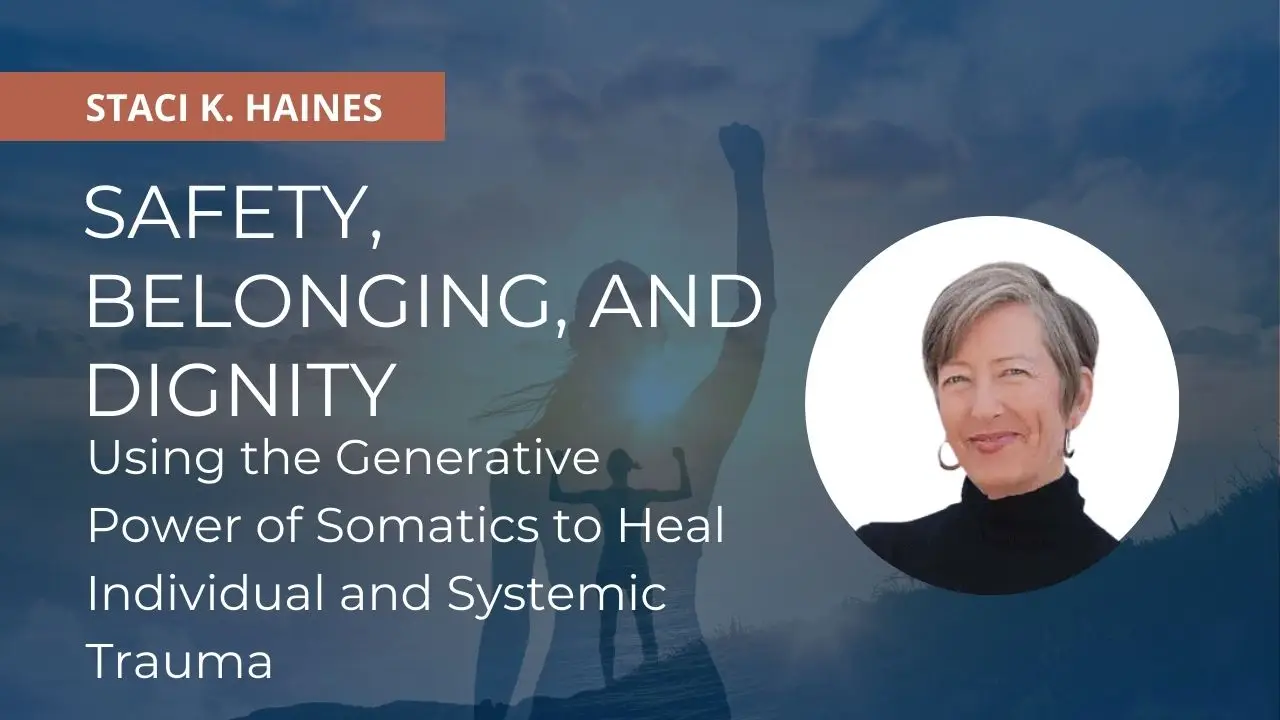



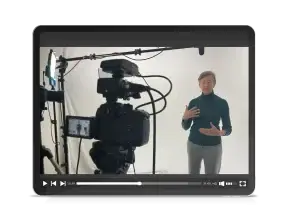


 Staci K. Haines is a national leader in the field of Somatics, specializing in intersecting personal and social change. Her latest book, The Politics of Trauma: Somatics, Healing and Social Justice (2019), is based on her work to transform the impact of individual and social trauma and violence, and strengthen the interdependence of personal and social change. Staci is the co-founder and former director of generative somatics (gs), a social justice organization bringing somatics to social and climate justice movements. She leads programs in somatics, trauma, and resilience, and embodied leadership for healers, social change leaders, and innovators. She is also a senior teacher at Strozzi Institute and a Certified Master Somatic Coach. Staci is also the author of Healing Sex: A Mind Body Approach to Healing Sexual Trauma (1999, 2007), and is the founder of generationFIVE, a community based organization whose mission is to end the sexual abuse of children within five generations.



Reviews
There are no reviews yet.