Memory Reconsolidation Basics
It’s time to learn all about memory! You will learn about explicit and implicit memory systems and take a look at how memory is created and re-experienced, and how it changes. We will uncover the core elements that are necessary for reconsolidation to be completed so that you don’t miss any crucial steps and can set the stage for success in every client visit. Once you have this knowledge, you will have the tools and skills to support therapeutic reconsolidation experiences.
In this session, these topics are discussed:
- Memory and Perception – How memory is recalled and the “psychological floor” that holds memory so you can identify implicit memory when it shows up
- Memory Consolidation and Reconsolidation – When you know how memory happens, you’ll understand which therapies are inherently doing memory reconsolidation (whether they know it or not) and why reconsolidation doesn’t “work” all the time (and what you can do to support your client in those stuck moments)
- Sticky Symptoms and Emotional Knowing – Learn the difference between a symptom and an emotional knowing, how the symptom came to be, and how it shows up so you can recognize it
- How Brains Are Complicated – What to do when emotional knowings will not unlock, how to detect mismatches in the mind, and the right brain state for mismatches can be resolved
- A demo tape that shows the three basic principles in action
Holding Healing Brain States
The brain has to be in a certain state for reconsolidation to occur. Learn how to create the right balance of activation and regulation — at the same time — so the mismatch can be both discovered and integrated. You’ll also discover that stances you hold might hinder your client’s reconsolidation process.
In this session, these topics are discussed:
- Healing Brain States – The relationship between mismatch detectors and the juxtaposition process so you can facilitate more reliable reconsolidation
- Building Coherence – How to facilitate coherence through deep listening
- Building Compassion – How to support your client’s regulation through compassion, coherence, dual empathy, and presence
- Therapeutic Presence – How letting go and trusting while using clinical tools will support mismatch and juxtaposition processes
- Demo tapes of healing brain states, finding coherence, finding compassion, dual empathy
Finding the Emotional Knowing
Recognizing this difference between the symptom and the emotional knowing is essential to supporting memory reconsolidation. Missing this distinction is one of the common reasons that clinicians feel unable to assist their clients with reconsolidation experiences. Another common issue that is addressed in this module is how to support the network holding the emotional knowing in an embodied way so it can become open to learning new information. You will leave with interventions and tools to help your clients discover their subconscious knowings and deepen their embodied experiences.
In this session, these topics are discussed:
- Emotional Knowing or Sticky Symptom? – How to identify emotional knowings as differentiated from your client’s symptom, and the precise language to use so you can help your clients reconsolidate with more ease and permanence
- Symptom Deprivation and Sentence Completion – Learn the interventions for symptom deprivation and sentence completion and how to slow down enough to listen for the image, history, or language
- Tracking the Joints and the Viscera – How to track the basal ganglia, joints, limbic system, and viscera as a way to find emotional knowings
- Helping the Knowing Become Embodied – Get enough electricity flowing through the network so the prediction is embodied and active and the mismatch will be discovered naturally.
- Demo tapes of symptom vs. knowings, symptom deprivation and sentence completion intervention, tracking viscera, helping the knowing become alive in the body, and using parts map to find the emotional knowing
The Mismatch, the Support, and the Double Check
The key for Memory Reconsolidation is to notice the moment of mismatch and learn how to recognize a successful opening in previously locked networks. You will learn to spot spontaneous reconsolidations and juxtapositions and learn how to support them to completion. You will also learn how to create spaces in which clients will find their own mismatches that are already present within themselves and learn what to do when a needed mismatch is not present. Finally, you will learn how to double check your reconsolidation work.
In this session, these topics are discussed:
- Finding the Mismatch, It Is Already There – Learn to recognize when a mismatch or spontaneous juxtaposition has successfully occurred and how to wait for your client to discover it
- What About When There Is Not a Mismatch – How to build mismatch through mindful focus and interventions you can use (such as using yourself) to create new experiences for your client
- Keeping a Reconsolidation Going Once It Starts – The five-hour window for deeper integration, going back and forth between knowing and mismatch, and interventions to use right after a session
- Double Checking the Reconsolidation – How to check-in about a symptom after reconsolidation and what to do if it didn’t work
- Demo tapes of a mismatch moment, back and forth, and using yourself as juxtaposition
Memory Reconsolidation for Specific Issues
Memory reconsolidation is a powerful tool for several specific issues. It can be helpful with improving self-worth and empowerment, in attachment repair, and in unlocking couples that are mired in long-held stories about who the other is. You will also explore how shock trauma is helped with memory reconsolidation.
In this session, these topics are discussed:
- Memory Reconsolidation and Self Worth – Understand the points of origin and consolidation of belief for low self-worth as symptom, and and learn several interventions so you can use to improve your work with clients who struggle with self-worth
- Memory Reconsolidation and Empowerment – Understand the points of origin and consolidation of belief for low empowerment emotional knowings, and use memory reconsolidation experiences to discover resiliency and empowerment in embodied forms so you can improve your work with clients who struggle with a history and current experiences of oppression, threat, and disempowerment.
- Memory Reconsolidation and Attachment – A review of attachment theory and how to look at attachment through the lens of prediction so you can set up scenarios for predictions and mismatches for your clients with attachment difficulties
- Memory Reconsolidation and Couples – Untangle the knowing from personal history and within the couple dance and introduce interventions in your couples sessions
- Memory Reconsolidation with Shock Trauma – Learn to separate the knowing from the incident and how to find the mismatch in the body so you can help your clients embody their survival
- Demo tapes of memory reconsolidation for self-worth, empowerment, and couples counseling




 Each module explains the theory of memory reconsolidation in language that’s accessible to you. Jules will teach you the steps to take to facilitate memory reconsolidation, and more…
 She’ll discuss each tool she uses so you can try them out and feel confident and assured you can help your clients when it’s you in the chair.
 All your course materials in one easy-to-navigate platform, supported by our dedicated customer service team.
 Recordings, transcripts, and handouts so you can re-watch and dive in deeper at your own pace.
 Jules and John discuss Brainspotting and Jules helps break down some of the neurobiological underpinnings of why it works so well.
 Peter and Jules discuss Somatic Experiencing and how memory reconsolidation is one of the underlying experiences that Somatic Experiencing is supporting in assisting clients with their healing journey through trauma.
 Toni and Jules discuss the gifts that IFS has shared in helping clients hold healing brain states with more stability and how memory reconsolidation experiences are supported by the IFS model.
 Akilah and Jules discuss Akilah’s new model, PRIDE, and highlight how it supports both healing brain states and embodied reconsolidation experiences.
 Bruce and Jules discuss some of the common misunderstandings in the reconsolidation neuroscience and offer tools from Bruce’s Coherence Therapy model that is centering therapeutic reconsolidation.
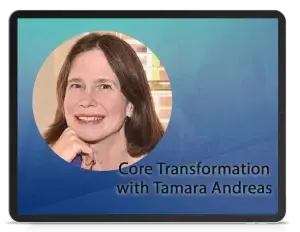 Jules meets with Tamara Andreas to discuss how Core Transformation elicits the neurological process of memory reconsolidation.
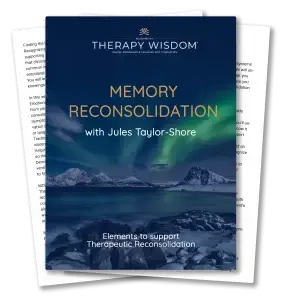 A one-page cheat sheet for you to reference. It displays all the elements to support therapeutic reconsolidation.
 Juliane Taylor Shore, LPC, LMFT, SEP (AKA Jules) is a therapist and trainer of therapists in Austin, Texas. She specializes in applying Interpersonal Neurobiology to the healing of trauma and the creation of relational health with clients she sees. She uses her knowledge of the brain and the implicit mind to go decisively to the root of the issue with gentleness and depth.




Reviews
There are no reviews yet.