



Build, knowing we are building ruins:
Create forms of care that honour transience rather than promise stability, so that our offerings remain humble, alive, and responsive to the ever-changing conditions of the world.
Make sanctuary with cracks:

Dwell with rupture as a site of possibility instead of a flaw to be repaired, so that healing becomes an act of witnessing rather than fixing – an invitation to gather around what aches.
Practice obliquity:

Move sideways when progress deepens the groove of harm, so that new patterns of aliveness can emerge beyond the narrow logic of improvement or control.
Cultivate weird fidelities:

Stay loyal to what cannot be commodified or healed away: the grief, the mystery, the monstrous, the impossible, so that we remember our belonging to what exceeds understanding, and find wonder in the places where meaning unravels.
VIDEO Keynote Interview Between Báyò & Willow Defebaugh
What must be decomposed in order for our species to mend its relationship with the Earth? In this keynote conversation bridging the spiritual and ecological, philosopher, writer, and founder of The Emergence Network Báyò Akómoláfé is in conversation with Atmos Editor-in-Chief, Willow Defebaugh, as they invite us into a deeper understanding about the transmutations and murmurations our world is faced with today
VIDEO A New Theory of the Self with Indy Johar

What if the self is not as estranged or as independent as we often suppose it is? If we are to take seriously notions of entanglement and ecological imbrications, how do we come to see identity? What might this mean for democracy, for our understanding of our roles as temporality-makers (instead of just inhabitants of fixed, monolithic time), for the Anthropocene, and for the future?
Podcast Episode - Báyò Akómoláfé on Cracks, Tricksters, and Dancing Sideways with Collapse
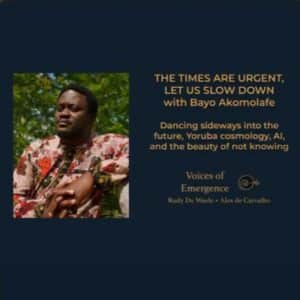
Báyò shares what it means to be a “recovering psychologist” in the face of modernity’s certainties. He speaks of the Trickster, of “cracks” – those unstable, porous thresholds where the dominant story breaks down, of AI as a mirror and a myth, and of the strange ways the soul shows up when we stop trying to make sense and start sensing instead.
ESSAY - Sanctuary is Not a Place
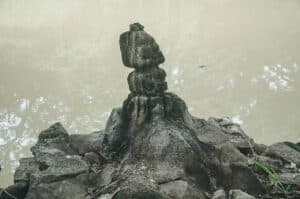
Báyò Akómoláfé invites us to rethink sanctuary, not as a fixed location, but as a living, fragile practice of becoming-with a world in turmoil. As old certainties tremble and collapse, he writes, we are called not only to endure, but to transform, to host grief, listen with our feet, compost what has fallen, and make refuge in the movement of connection itself.
ESSAY - How to Be Available Now: Sidenotes from the Para-Pragmatic
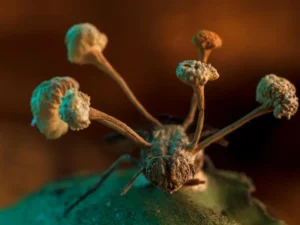
Báyò invites us to rethink what it means to be available in times of crisis, not simply by doing something, but by listening into the cracks of urgency, staying with ambiguity and letting usefulness loosen its grip. He calls this approach the para-pragmatic: a movement past quick fixes, where we lean into what is unmeasured, unplanned, and yet alive.

Growing up in the Christo-centric southwestern worlds of Lagos, Nigeria, Bayo Akomolafe imbibed a familiar notion of the soul from multiple evenings spent taking notes at Pentecostal revival assemblies and church sermons on Sundays. An image slowly distilled through years of education, through the tears that remembered his father’s death, and through a precocious determination to ask questions that mattered: the soul was the disembodied replica of the self that lurked between the neuronal thresholds and sinews of the material body. The ghost in the machine. The essence that escaped death. A private thing.

Ashana –
It has given me so much to think about.
It was a great experience.
Jessica –
It’s brought depth and a lot of brain food to my world!
More break out rooms would have been nice, but I also really appreciated the amount of condensed time we had to hear from Bayo!
Dawn –
It was great as it was.
Leslie –
Helps me know where to go when I’m with clients. Anti-psychiatry/Westernization is not new to me. Bayo helps me ground it for where we are TODAY and I’m able to incorporate his wisdom (and wake up my own) in my relationships with my clients.
Maybe bring in that some of us are working in these “crack” ways and we get to see the miracles that occur through the people we work with –things we couldn’t have predicted, things THEY couldn’t have predicted.
I LOVE the course and Bayo’s teaching! Just wishing a place for this part to connect in.
Anonymous –
gave voice to what I’ve been contemplating, feeling, experiencing for a long season but also deepened and expanded my sense of being and becoming; beautifully disruptive
Anonymous –
It has affirmed the way I work, holding space and being alongside rather than ‘healing’ which could be a way of helping clients to accommodate.
I found I couldn’t keep up with the speed and complexity of his language, so had to trust I was imbibing that which I needed.
Artur –
It reinforce the way I’m working… I’m very thankful
Carolina –
It has helped me in my personal growth and therefore in my relationship with my clients.
Anonymous –
it has connected me to a great community
it has made my work lighter
Regine –
Personally I have been working to address my trauma and this course came at the perfect time. In fact, it is also helping me see my work in the environment space differently. It has served me with abundance.
Anonymous –
it has made me more curious about how modernity informs how I show up as a therapist
Anonymous –
It has broken open the way I think about the space between practitioner and client.
Anonymous –
it changed perspectives, practices and possibilities to stay with the trouble, healing, trauma and care.
it was just perfect
Chantelle –
it has both provided validation in intuition and created greater and curiousities as I am exploring the black