Dear friend,
When Oscar Wilde wrote The Picture of Dorian Gray, he may not have imagined the strange theoretical significance his story would one day carry.
In that tale, a young man makes a bargain: his body remains untouched by time… while a hidden portrait absorbs the cost.
While his body moves through the world, the portrait accumulates the wear and tear. The face stays smooth, impervious. The painting, locked away in an upstairs room, absorbs every cruelty, every dissipation, every accumulation of years. Dorian becomes the optimized body—ageless, agreeable, legible—while the portrait, behind a closed door, registers what the face cannot hold.
The novel is usually read as a moral fable.
We read it differently here.
We read it as a study of an accommodation—a temporary settlement of coherence that requires a locked room, forgotten and tied up, to function. The smooth face is not innocent of the portrait. The smooth face is the portrait, read from the side the drawing room can bear to see.
Dorian is not a man who has hidden his sins. He is the figure of every body shaped by the bargain modernity offers: that one may go on, legible and untroubled, in exchange for a closed door upstairs where the cost is kept out of view.
Lord Henry, the seducer of Wilde’s early chapters, is the patron saint of optimization. Realize your nature, he tells Dorian. Be young as long as you can. The aim of life is self-development. His sermon has not stopped being preached. It is the gospel of flourishing—charming, assured, and convinced that the realization of the self is what the self is for.
And then there is Basil Hallward—the painter, the witness, the one who saw Dorian without the bargain. The one whose love was not a treatment plan and whose seeing was not a protocol. Basil is taken to the attic, shown the portrait, and murdered there.
The murder is Wilde’s quiet thesis.
The accommodation must kill the witness in order to keep running.
Basil is what Therapolis silences in every practitioner—the part of you that loved before sorting, that saw before assessment, that recognized a person before the protocol arrived.
The portrait, meanwhile, does what the wellness paradigm does not quite have language for. It does not “store” wounds. It churns. It ages, deforms, accuses. It becomes monstrous in shapes the locked room cannot stabilize.
It is living material, registering what the face has had to forget in order to remain a face.
This anomalous troupe—Dorian haunted by smoothness, Lord Henry sermonizing about wellbeing, Basil murdered in the attic of his witnessing, and a portrait churning in the dark—is the ragtag band at the heart of the journey we are calling:
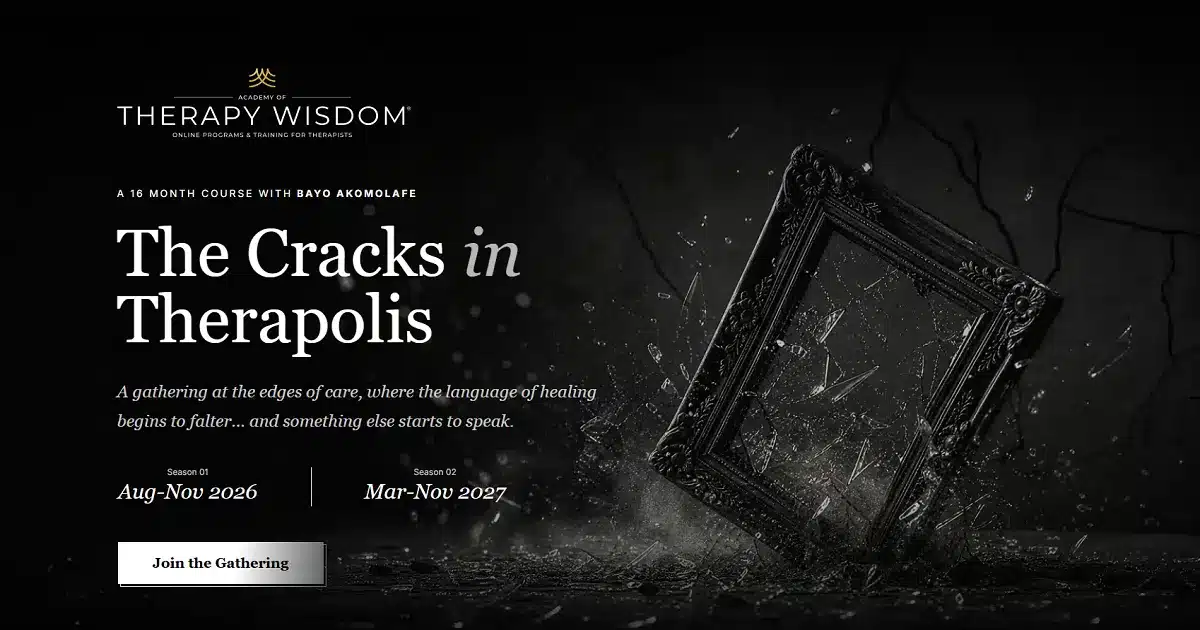
The Cracks in Therapolis.
I invite you to explore this with us…
Bayo Akomolafe
& Academy of Therapy Wisdom