
Prentis Hemphill’s What It Takes to Heal: How Transforming Ourselves Can Change the World emerges as a pivotal read for therapists and coaches. This profound work delves into the intersection of personal healing and societal change, presenting a compelling case for why embodiment practices, healing, and social change go hand in hand – and why advanced trauma therapy training is necessary. 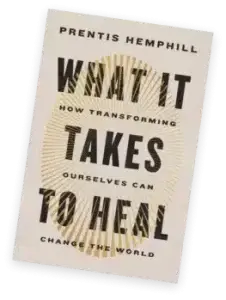
This book explores the trauma and upheaval we’ve all experienced, historically and over the last few years, and talks about how community healing, rather than just on an individual level, would have more impact:
“healing in solitude eventually brings us home only to realize that what causes us pain, what causes many others pain, are issues much bigger than our singular lives, and those issues remain.”
Prentis asserts that disconnecting from the community and trying to heal on your own is often mistaken for healing when, in fact, it’s more about seeking control and comfort. What if what we really need in order to heal is to come together and work on the issues at the core of the traumas we’ve experienced:
“…even when we are able to address trauma through individual healing, it’s not enough. Only when we come together to shape, dismantle and rebuild the world can we start to end the ongoing cycle of collective trauma, caused by systems obsessed with profit, and not the wellbeing of all humans and the planet. We can’t change the world if do not heal what has become embodied in us, and we cannot truly heal if the conditions that break and isolate us don’t change too.”
Integrating Somatic Practices in Therapy
Prentis’ book is a treasure trove of insights for those seeking to understand why somatic practices and embodiment are so impactful in therapy sessions. It emphasizes the importance of connecting mind and body, illustrating how trauma-informed embodiment can enhance therapeutic outcomes. Therapists will find practical insights and examples for using somatic therapy techniques to foster deeper healing and resilience in their clients.
By demonstrating how somatic practices can be used for healing trauma, they provide therapists with the tools to address trauma not just cognitively but also physically. This holistic approach can lead to more sustainable and profound healing, making it a crucial addition to any therapist’s toolkit.
Embodiment and Social Change: A Call to Action
The book underscores the vital link between embodiment and social change. Hemphill asserts that personal healing is a precursor to societal transformation: “Healing helps us fight in the places we need to, and love in the places we long to.”
This perspective is particularly relevant for those engaged in advanced trauma therapy training and those who view their work through the lens of social justice. Integrating these principles into practice not only benefits individual clients but also contributes to broader social healing.
Hemphill’s work reminds us that the personal is political. By pursuing trauma therapy certification, professionals can better understand and dismantle the systemic barriers their clients face. This approach not only enhances individual therapeutic outcomes but also fosters a more just and equitable society.
Who Should Read This Book?
This book is for anyone interested in healing, social change, and developing a deeper understanding of themselves and other people. In short, it’s an excellent book for all therapists, practitioners, and coaches to add to their collection.
The book is a rich resource for those ready to explore healing from a community perspective, those interested in the places where therapy and social justice meet, or those looking to incorporate somatic elements into their practice to encourage healing on a deeper level.
Key Takeaways for Therapists:
- Practical somatic therapy techniques for therapists to incorporate into sessions.
- Examples for integrating somatic therapy for trauma recovery.
- Insights into the role of embodiment in fostering social change.
- Ideas for merging individual healing with community healing for social change and how you can take action in this direction.
Somatic Therapy Techniques + Connecting With Other People
In “What It Takes to Heal,” Prentis returns to their approach of healing through somatic practices in multiple chapters. They provide examples of somatic work with clients and personal experiences that shed light on how embodiment in psychotherapy can lead to profound transformation. They also offer insights into how those somatic practices can be used to improve connection with other people…
Their willingness to share their personal experiences and vulnerabilities through their work showcases their honesty, integrity, and dedication to bringing about the kind of community healing they describe throughout the book.
Prentis talks about how a willingness to be vulnerable and authentic in relationships can open the door to opportunities for healing on a grand scale. Even when, or perhaps especially when, there are societal and historical boundaries between people, and those boundaries are born from the issues that are causing trauma (income disparity, generational trauma, otherness, etc.), we have the power to work together toward healing:
“When we look to the nature of our relationships with one another, we can become more skillful and authentic in our interactions and see that there are ways of relating that might allow us to connect and come out of the automatic past and entrenched ways of being so that we can meet one another now, not bypassing our history, but moving forward in it’s knowledge. Our ability to do this is key. Our relationships, our social connections, are the bridge between individual and societal transformation.”
Embodiment and Trauma Recovery
The concept of embodiment is central to Hemphill’s approach to trauma recovery. By understanding the ways in which trauma is stored in the body, you can develop more effective interventions. Hemphill’s book offers insights into how to integrate somatic and trauma therapy, backed by examples of this practice at work.
Hemphill’s insights into embodiment and trauma recovery are particularly valuable for helping your clients tap into their own power and their connection to others:
“To me the root of any power is in the body, specifically in our ability to be embodied in a way that organizes our cells and our self to act out a vision. As trauma disconnects part of our knowing in our bodies it can make our actions less congruent and it can diminish our realization of our own power. But power is not only an individual’s expression. It is first felt in the alignment of our own bodies, then multiplies and amplifies in our syncopation, in our coordination with one another. We cultivate power in ourselves, and we build power when we work together.”
Social Justice and Psychotherapy
A significant theme in Hemphill’s book is the intersection of social justice and psychotherapy. Hemphill argues that true healing cannot occur in isolation from the broader social context. By addressing issues of systemic oppression and inequality, therapists can support their clients in a more holistic and effective way, but that’s just the beginning.
This perspective is especially important for you as a therapist if you’re committed to social justice and equity, want to participate in activist movements, or want to be a strong ally.
Hemphill’s book provides valuable guidance on how to navigate these complex and essential aspects of therapeutic work and personal development.
Praise for Prentis Hemphill and What it Takes to Heal
Prentis’ book has received a lot of praise from others in the field:
“I love this book. Prentis Hemphill offers us a visionary, personal, compassionate, empowering guide for our healing as individuals, within the histories of our families and deep within the broader contexts of our communities, societies, and the world at large.”
—Bessel Van Der Kolk, author of The Body Keeps the Score
“In the tradition of James Baldwin, Hemphill invites us in close and personal to experience life, pain, beauty, injustice, and healing. I’ll read this again and again.”
—Staci K. Haines, author of The Politics of Trauma
“This book reckons with our major issues—trauma, race, social upheaval—and opens us up to the possibility that everything actually could be different. And it does so one gorgeous sentence after the next.”
—Resmaa Menakem, author of My Grandmother’s Hands
Conclusion: Why What It Takes to Heal is a Must-Read
Prentis Hemphill’s What It Takes to Heal is not just a book; it’s a call to action for therapists and coaches dedicated to personal and social transformation. By exploring embodiment practices for therapists and integrating somatic therapy techniques, mental health professionals can elevate their practice and contribute to a more just and compassionate world.
But even beyond that, this book is a must-read for anyone serious about contributing to meaningful change. Prentis Hemphill digs deep into what it will take for us to heal as individuals and as communities – how we can ideally begin to overcome some of the wider issues that keep us divided and fuel suffering and ongoing trauma for so many. And they point out that courage and love are at the core of achieving that change:
“Courage is contagious and more powerful when we share it.”
“When more of us are courageous, when we stand up to what is unjust or untrue, we lighten each other’s loads, we share the weight of the risk and create more safety for all of us.”
“It is only through love that we are ever really changed.”
What it takes to heal ourselves is deeply intertwined with the journey to heal our communities and the world. Hemphill’s book provides the roadmap, blending healing and social justice into a powerful narrative of change. By embracing these principles, therapists can become catalysts for transformation, both within their clients and in the broader society.

Join Prentis Hemphill for a live, 2-hour workshop
Changing the World by Transforming Ourselves: Embodiment and the Practice of Healing
During this workshop, you will:
Learn practical tools for integrating embodiment practices into your therapeutic work.
Discover ways to foster deeper connections within your community and support collective healing.
Explore how to embody your values and take meaningful action towards social change through your embodiment.