
As part of our online therapist training community, you may have seen us ask this question of therapists last year:
“How do you sustain hope and resilience?”
We received dozens of answers in the form of essays, poetry, and visual art for consideration for our third annual Therapy Wisdom Spotlight, published in December 2022. One of the thoughtful and wise responses came from Michael G Bricker, shared below and published in December´s issue. You are warmly invited to download the full PDF publication here (it´s free): Wise Therapy Spotlight December 2022 Issue
Flying Starfish, Puppies in the River, and Trauma-RESPONSIVE Care
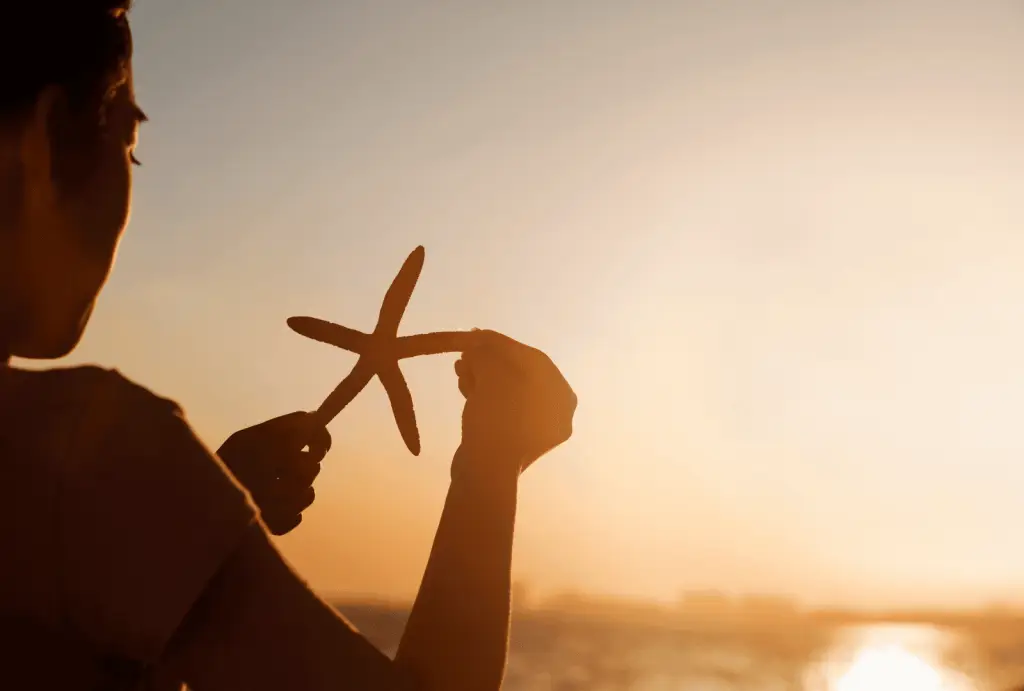
 By Michael G Bricker MS, CADC-II, NCAC-2, LPC You know the story – a young boy walking on the beach finds hundreds of starfish washed up on shore after a storm. So he reaches down and tosses one back into the ocean…then another…then another. A man walks by and asks: “What’re you doing, son?” The boy replies “I’m saving the starfish!” The man chuckles and retorts “Look at the hundreds of them on the beach…you’ll never save them all!” The boy tosses another starfish – “Well, I saved THAT one!” In behavioral health, that’s a pretty apt metaphor. (In fact, I never metaphor I didn’t like!) But as we all know, the storms of life keep washing starfish onto the beach…sometimes ones we recognize and remember. That’s discouraging for us and leads to burnout…and also not much fun for the starfish! I’d like to call your attention to another story. Someone is relaxing on the bank of a swiftly flowing stream…just basking in the sunlight. Suddenly they hear a panicked puppy barking – and there it is, thrashing downstream through the water! So they jump in the water and manage to bring the puppy safely to shore. They get a few “thank you” licks, and the puppy is on its way. So the person stretches out in the sun to dry…only to hear another puppy! So, still wet – back into the water to rescue another puppy. And another. And another. Finally – exhausted – they realize they can’t save them all. But when they look upstream…there’s a guy throwing puppies in the river! So up the stream they go and – after some energetic discussion – convince the guy to STOP throwing puppies in the river! The parallels with the work we do are pretty obvious…or maybe not? Metaphorically, who’s the guy who hates puppies? The drug dealer on the corner? The bartender who’ll let you drink all night in exchange for your Sobriety Coin? “Big Pharma” who floods the river with pills? As terrible as those things are, I think they miss the point. For most of our peeps – especially the “frequent flyers” – the upstream villain is trauma. And we stand puzzled why – after we rescue them, dry them off, surround them with love and coping skills – so many of our “puppies” run back upstream…only to be thrown again into the river. The common denominator may well be coming from the experience of trauma. It doesn’t matter much if it’s “big T” trauma like rape and war, or a childhood full of “little t” trauma like domestic violence or neglect. The cumulative effect on the nervous system is only a difference of degree. Why is it that our best efforts as clinicians sometimes seem to have only a temporary benefit? I believe that, when it comes to treating people who come from the experience of trauma, we may not be using the right tool for the job. We all know that the impact of trauma gets stored in the bodymind in different ways – sometimes as a “body memory”, sometimes an unconscious implicit memory stored in the “fight/flight” limbic system of the brain. What do both of these trauma repositories have in common? They are inaccessible to most of our treatment interventions! Since the limbic system doesn’t understand language – and has no concept of linear time – it’s simply impossible to “logic people out” of being trapped in their story. Traditionally, most of our treatment modalities (with the exception of EMDR and Somatic Experiencing) rely on psychoeducation, cognitive restructuring and skills acquisition. So our evidenced-based manuals hammer home the benefits and pathways to recovery from mental health and substance use disorders. But when it comes to treating the trauma that keeps tossing our patients back in the river…it’s like trying to drive a SCREW with that hammer. You might be able do it – if you’re really careful and really good…but it’s not the right tool for the job! The many evidence-based practices in our toolbox are wonderful for pruning, weeding and watering the garden of woes that bring patients to us. But why do some of them stop growing and go to seed? And others seem to bloom brightly for a while…only to wither and die? Our patients can’t grow healthy plants in poisoned soil! Their roots are sunk deep into the pain of the past, so it unconsciously contaminates – and sabotages – their best efforts (and OURS) to get well. Don Coyhis and the Native Wellbriety movement talk about a “healing forest” of healthy trees growing in healthy soil. We do wonderful work “re-potting” our patients in treatment so we can nurture and water them back to health. But when we “replant” them after treatment the toxic underground can take a toll – some wither and die, others fail to thrive and just hang on. So what’s the antidote to the poisoned soil? The answer, I believe is HOPE! Our main job as clinicians is to help our patients borrow hope from us. Not some platitudinous “just make lemonade” hope – but vibrant capital H HOPE that they no longer have to be prisoners of their past! “Heart Open…Please Enter” is a slogan from AA. Another is “When your Heart Opens the Pain Ends” So how can we honor this opportunity with our patients? One way to begin is with the ACEs Survey or a trauma-informed psychosocial interview to see how deep the soil of trauma is. Then we begin to honor and build on the resilience that helped them find their way to our door. I tell every patient “if surviving it didn’t kill ya…getting over it isn’t going to!” So our main job as clinicians is to hold open the door of possibility, and guide our patients through to a life worth living! After all, isn’t that why you do this work? You want to be the difference that MAKES a difference in the lives of the people you serve. And that, my friends, is work worth doing! _____________________________________________ Learn more about Michael G. Bricker and his work at Stemss Institute. _____________________________________________ We invited you to read the Wise Therapy Spotlight December 2022 Issue in its entirety. Download the PDF now.