

Alongside our enriching online therapy courses, we proudly presented the much-anticipated annual 2023 Wise Therapy Spotlight publication -a compilation of profound essays and captivating artwork from our esteemed psychotherapy training community. We extend our sincere gratitude to all contributors who shared their insights and talents, making this publication a true testament to the brilliance within our community.
A special congratulations to our featured authors! Your responses to the pivotal question, “How, as a community, do we repair a sick world when it is anguished with mental suffering?” have left us inspired.
If you’re interested in downloading the full Wise Therapy Spotlight December 2023 Issue, Click to Download the PDF now.
From the Despair of Impossibility to Finding Hope in Possibility

My colleague, Terry Hunt, EdD, CBT (Certified Bioenergetic Therapist), defines depression as follows. “Depression is an economic solution to a perceived impossible condition.” Given the conditions that humanity currently faces, which seem impossible, including climate change, conflict in the Middle East, the war in Ukraine, overpopulation, racism, sexism, homophobia, the ongoing impact of the pandemic, and more, no wonder we face a global mental health crisis!
Still, while these issues serve as a backdrop, in my experience, most clients coming to therapy focus on issues they face directly in their lives. Their presenting problems include depression, anxiety, the ongoing effects of trauma, and relationship or job dissatisfaction. Our path to help, then, must happen on an individual level. For example, a Ukrainian client I work with suffers from anxiety related to the war. However, the ongoing effects of abuse she suffered as a child and how her family is handling this now impact her more directly.
My simple answer, then, to the question: “How, as a community, do we repair a sick world when it is anguished with mental suffering?” is that we can’t. Repairing the world is impossible for us alone or as a community. Aiming to repair the world could lead us as clinicians toward hopelessness, overwhelm, and despair. What we can do is find what is possible within the problematic realities of the world and do our part to help. Seeing what is possible includes caring for ourselves and offering our best to help the people we serve.
Towards that end, I offer a story about my work with a client who suffers from the impact of horrific childhood trauma. At age two, a family adopted her and used and abused her in the most terrible ways imaginable. The abuse included participating in cults and rituals where she experienced sacrifices of animals and children, along with frequent sexual and physical violations. As a result, she has ongoing symptoms of severe PTSD, depression, and anxiety, with recurring nightmares, difficulty eating, living in poverty, and relational challenges.
As a bioenergetic, body-oriented psychotherapist, I am challenged by her lack of body awareness. Survival, for her, meant shutting down her body signals. She has difficulty with essential body awareness, including identifying hunger or thirst, knowing if she is cold or hot, and when she needs medical attention. She generally cannot answer the basic question I regularly use to guide my clients,” What are you aware of sensing in your body right now?”
In addition, she has limited ability to assert boundaries with people in her life or advocate when she needs help. As a child, her father punished her for protesting his abuse. Thus, she learned to allow people to do whatever they want with her. This inability from her childhood has caused significant problems in her personal life as she often attracts people who take advantage of her. While she has made considerable progress in this area over the 13 years we have worked together, she continues to suffer the impact of people violating her boundaries.
Her health also remains fair to poor. She has failing kidneys, chronic infections, arthritis, and GI issues. She had a liver transplant a few years ago. She also has difficulty feeding herself nutritiously and can’t bring herself to drink sufficient water.
Further, many routine life events, such as spending time with her grandchildren, holidays, bright lights, and even eating (especially having a full belly), activate memories of abuse in her. She has learned to disconnect from her emotions, as her father also punished her for crying. Self-harm, through cutting, has become a way she distracts herself to cope with intolerable feelings and memories. This behavior persists despite many methods of attempting to address it.
Amidst the enormity of these challenges, I sometimes feel overwhelmed. Indeed, my client faces many conditions that she perceives as impossible and contribute to her ongoing depression. She regularly pleads to me, “Please don’t give up on me.” Giving up would be understandable for either of us. But my heart and conscience won’t allow it.
I regularly ask myself: as her therapist, what can I offer when even the most basic techniques I use with clients are too much? At times, I struggle with feeling helpless in the face of the enormity of her struggles. I believe she has what some people would label “treatment-resistant depression.” But I prefer to think of it as depression rooted in trauma that requires a different kind of treatment.
My treatment approach, of course, includes listening—always. I bear witness to the depth of her suffering, including the seemingly endless stream of horrible memories. I always make space for her grief, anger, and pain as it emerges organically. I also encourage her to write about her memories and nightmares and bring her writing to review. Sharing her writing helps her to feel less alone with the memories. Naturally, I support her in tolerating her feelings. I remind her that I will never be angry at her for crying and provide comfort when she does cry. I encourage her to express her anger when it spontaneously arises without hurting herself or harming anything,
I also answer with care and dig deep for patience with the question she repeatedly asks me, “Are you angry?” Among the traumas that she experienced, one of the worst involved her parents’ constant anger. She worries that I (and everyone else) will be angry at her for everything. Any misstep she perceives in herself – getting sick, spilling a tiny amount of water, being late for an appointment, etc – causes her increased anxiety and worry that I will become angry.
When I tell her I’m not angry, she sometimes follows my response with the question, “If you’re not angry, what are you?” “Present,” I respond. Present, I think to myself, with my humanity and an open heart, I am available to consider what she needs from me moment to moment to expand her ability to enjoy life.
Her psychiatrist has recommended ECT treatment, but she would never agree to this as it would activate memories of abuse. Some medications help with sleep, and antidepressants provide some relief. Psychedelic-assisted treatment would frighten her too much. Focusing more on her traumatic memories only keeps her stuck in them. Since we cannot erase her past, we can superimpose positive, healthier images over them.
Similar to the question, “How do we repair a sick world when it is anguished with mental suffering?” I ask the question, “How do I help my client who is anguished by the suffering from the horrific trauma she experienced?” Further, what do I offer when my usual techniques don’t fit my client’s needs? Addressing her trauma requires a different kind of creativity. Fortunately, the bioenergetic approach allows a wide range of options for helping people, including inventing a technique based on the client’s needs.
Recently, I attended a church called the Church of the Woods. Services take place outside in the warmer months and in a sparse cabin during the winter. The middle part of each service involves the congregants going out into the woods to meditate on the message, seek solace, and, if desired, bring back something to share with the group.
The message that Sunday involved finding God/The Infinite in ordinary, day-to-day places. As I walked, I noticed leaves, a variety of trees, and intricate patterns in ice that had just begun to form on a stream. I collected a small pine branch, a miniature pine cone, and dried ferns.
As I gathered these items, I recalled that I used to bring small offerings of nature to my client to encourage her to see and focus on the beauty in the world. I did this as an antidote to the suffering she lived. I brought colorful leaves in the fall, pointed out snowflakes in winter, and called her attention to spring bulbs and flowers in summer. Directing her to notice nature shifted her attention from her past to seeing beauty in the present.
So, that day, I brought things I gathered to my next session with this client, and I had an idea. She often walks through the woods to my office. She talked about how she typically does not notice anything on her walks as she gets absorbed in her thoughts. So, I encouraged her to see and bring things that called to her attention the next time she came to my office. And she did – she brought colorful leaves, bark from a birch tree, a dried flower.
Did this solve all her problems? Does it solve the impact of the horrible trauma she lived or her relational or health issues? Does this fix the global conflicts and wars? Not short-term, no. Does it help shift her focus to something positive and improve the world? I say yes.
Expanding options for responding to our clients’ needs increases our capacity to address the mental anguish they suffer. Both for ourselves and our clients, finding solace in nature through beauty and appreciating the simple abundance of this planet is one of many creative treatment options to transform depression and overwhelm into moments of joy.
I also consider a situation from a larger context with overwhelming anguish and suffering. The Oct 7, 2023 attacks on Israel by Hamas brings me to deep care and concern for my colleagues and friends in Israel, and Jewish clients, friends, and colleagues locally. My heart goes out to the unspeakable pain and fear caused by this brutal and horrific attack. The losses suffered and the anguish it has created for Jewish people adds to the pain of the world. The ensuing increase in antisemitism is unacceptable.
As I searched to learn more about the history, I found a book titled: “They Called Me a Lioness: A Palestinian Girl’s Fight for Freedom” by Ahed Tamimi and Dean Takruri. In the book, Tamimi recounts her experience growing up in the village of Nabi Saleh in the West Bank.
Tamimi writes about the Israeli settlement of Halamish, illegally established in 1977 on land previously owned by the Palestinians of her village. Over time, the occupation included the Israelis taking control of the village spring, Ayn Al Qaws Spring, waters held sacred by the Nabi Sale villagers. Israeli settlers claimed rights to the spring, with soldiers patrolling it and refusing access to the Palestinians. Losing access to their spring fueled anger by the residents of Nabi Saleh, who responded by holding weekly non-violent protests.
Throughout the book, Tamimi describes the response to these protests, of horrific treatment by Israeli soldiers towards her, her family members, and other protestors. She experienced friends and relatives, including both of her parents, being arrested and taken away by the Israeli military. The military also regularly sprayed them with tear gas and putrid-smelling “skunk water” and raided their home. She was shot in the hand and witnessed the murders of close friends and relatives.
When an Israeli soldier shot and killed Tamimi’s favorite uncle (who was unarmed) at close range and then her fifteen-year-old cousin (also unarmed), Tamimi responded by slapping, pushing, and hitting soldiers who invaded her family’s property. She states: “Unless you’ve experienced a foreign army occupying your land, imprisoning your parents, killing your loved ones, and shooting you and virtually everyone you’re related to, you’ll have a hard time understanding the rage with which I was overcome.” (Tamimi, pp 113 – 114).
After her cousin posted the video of Tamimi slapping the soldiers on Facebook, the Israeli army arrested Tamimi. She relates the terrible treatment she experienced as a teenager. After being arrested, she underwent repeated interrogations while alone, torture, strip searches, and imprisonment for several months. Tamimi describes many other Palestinians who suffer similar experiences in Israeli detention centers and jails.
It struck me that despite what she has suffered and lived, Tamimi has not become buried under the weight of depression. I believe the regular protests with her friends, family, and community keep Tamimi from sinking into despair. She focuses not on what seems impossible but on hope and a commitment to living together peacefully.
Further, Tamimi’s humanity also strikes me. She expresses compassion for the Israeli soldiers stating:
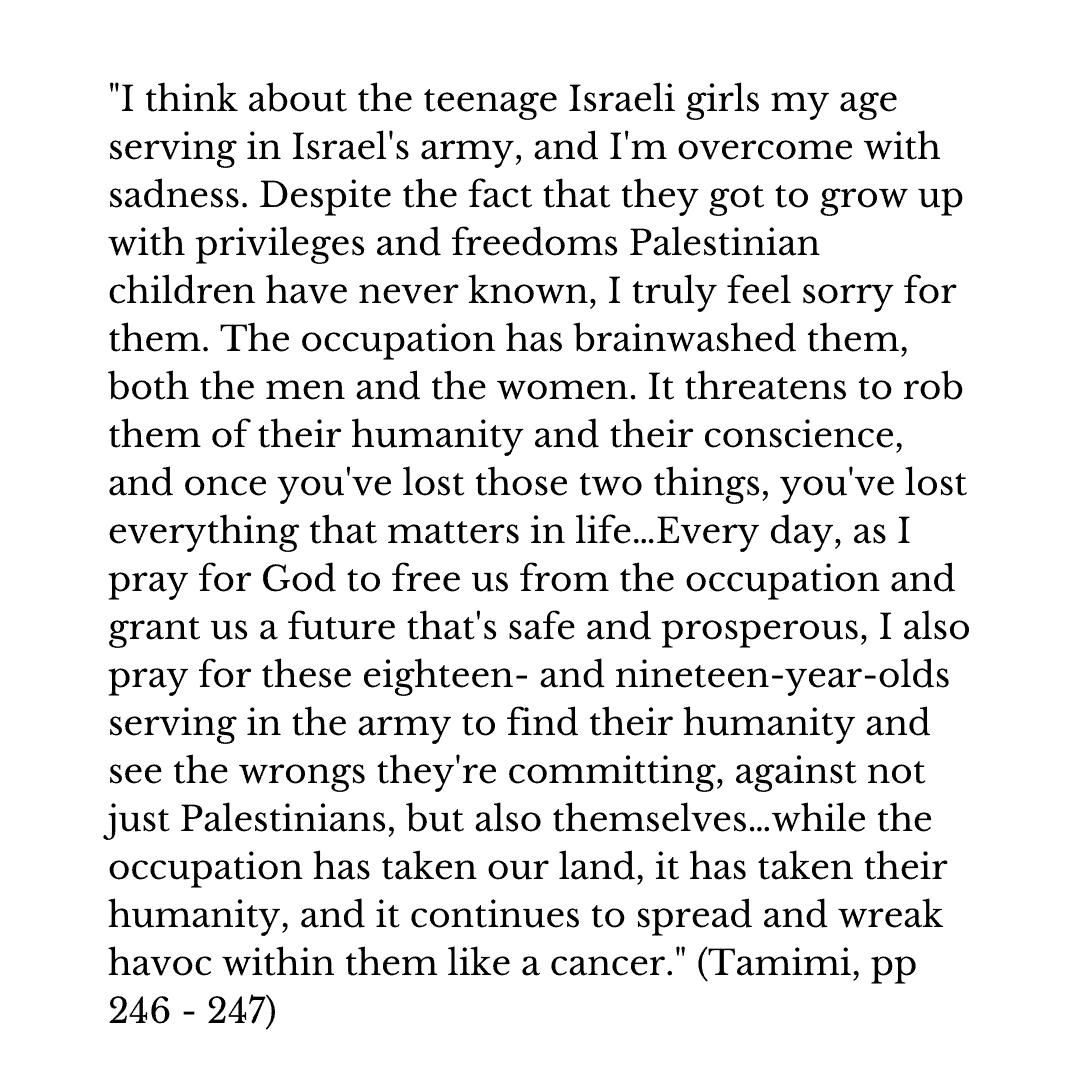
Sadly, Tamimi was arrested and jailed again in early November.
From the perspective of Israelis and Jewish people worldwide, those who have not lived the mass murder of millions of family members or ancestors and a calculated plan to annihilate the rest of our population can barely begin to appreciate the deep need for self-protection, refuge, safety, and solidarity. We may scarcely comprehend what Jewish people, especially Israelis, but also around the world, experience with the ever-present threat of attack and the accompanying terror embedded in one’s body. I don’t believe we fully understand the long-term and enduring impact of this trauma.
While the complexity of this situation can lead us to feel overwhelmed, hopeless, and helpless, we can choose to expand our hearts to hold the painful realities of both the immense trauma, suffering, anguish, and terror experienced by Jews through antisemitism and of the deaths, destruction, oppression, displacement, and mistreatment of Palestinians. We can hold hope for and work towards a solution for all oppressed people that includes honoring the dignity, protecting the safety, and working for the right to equal access to resources for everyone.
As mental health professionals, in our work with individuals, families, groups, and communities, we may not be able to repair the world. But, through creative approaches, including connecting with nature, encouraging peaceful protest, keeping our hearts open, and our ongoing work of listening and caring, we can shift from the despair about all that seems impossible to find glimmers of hope in the possibility of connection and compassion that everyone deserves.
Reference:
Tamimi, A., Takruri, D. (2022). They Called Me a Lioness: A Palestinian Girl’s Fight for Freedom. NY: Penguin Random House
If you would like to be inspired by more of the essays and artwork published in the Wise Therapy Spotlight December 2023 Issue, Click to Download the PDF now.