

In her revolutionary course, Becoming a Master Therapist: A Deliberate Practice Approach, Tori Olds, Ph. D. focuses on the skill development needed for you to feel competent as a therapist and build a successful clinical psychology practice. She provides a safe environment for experiential, vulnerability-led learning. The course offers you the knowledge and the skills you need to engage more effectively and get better results with your clients.
Here Tori teaches us the five steps to building our own roadmap to clinical excellence.
What is Deliberate Practice for Therapists?
Tori shares…
So you might not have ever heard the term deliberate practice although you likely have kind of heard of the ideas. For instance, through Malcolm Gladwell’s popular book Outliers where he talks about the 10,000 hour rule which is drawing on deliberate practice.
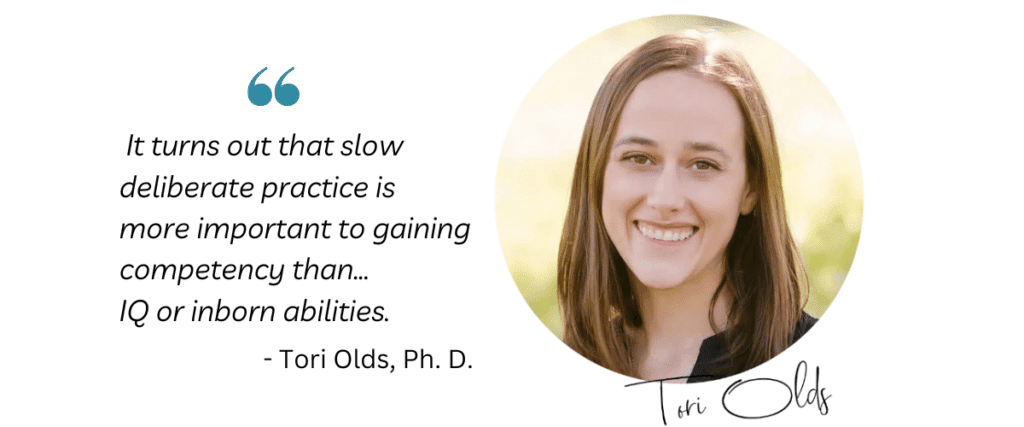
But deliberate practice is not unique to our field [as therapists]. It’s actually just in general the study of what it takes to gain mastery and expertise in really any highly skilled area. It turns out that slow deliberate practice is more important to gaining competency and expertise, as compared to innate sort of IQ or inborn abilities.
And what is amazing is that pretty much any highly skilled field other than our own uses deliberate practice – whether music or athletics or aviation. Whether they call it that or not they’ve really kind of honed in on what are the skills and the micro skills, and how we teach those to our students. If you are a musician you learn scales or chords. If you’re a basketball player you learn to dribble, shoot, free throws, and you’ll do that again and again.

JOIN a FREE Training with Dr. Tori Olds
Introduction to Deliberate Practice in Psychotherapy
In this video series, you will learn:
The essential problem with most other therapy training programs.
Six myths about becoming a more effective therapist.
What Deliberate Practice is and why it is so important
The five steps on the roadmap for clinical excellence
The Five Skills of Master Therapists: A Roadmap
What are these skills or these sorts of domains of skill development that we need to focus on? Remember I talked earlier about sort of developing that road map? So let me go through them with you now.
1. Develop Therapeutic Presence
The first might not surprise you – which is the importance of developing therapeutic presence. However, even though this is something that most of us know, there’s actually a lot to say about this that might surprise you or make you think about it in a different way… We’ll really delve into it not just through an attachment perspective but also a positive psychology perspective – of why our presence helps clients move out of avoidance themselves and into engagement.
2. Overcome Experiential Avoidance
The second area to focus on is overcoming our own experiential avoidance. That means really digging in to see what are areas of human experience, relating, emotion we are not inclined to go toward that will inhibit the work that we’re doing with our clients.
I know we talk a lot about the importance of therapists doing their own inner healing work and therapy, but I really wanted in this section to go beyond the cliche of that… to really give some concrete advice on how to work with our own triggers and integrate our own nervous system enough as to reduce our own experiential avoidance… to be able to more fully show up for our clients.
3. Work with Resistance
The third area is learning to work with resistance. Now there’s a lot to say about learning to work with resistance. It’s one of the hardest things we have to learn. So I really took my time to delineate sort of four main steps in working with resistance. With each one… sort of what are the choice points where we could do it this way or that way depending on our strengths and values… and really kind of dig into what are the pieces and options and micro skills really in terms of working with resistance.
And within that talk we’ll also talk about developing collaborative skills – because those are really important in minimizing resistance – and sort of breaking those into micro skills that we can develop as well.
4. Focus Treatment
Then number four we’ll talk about the importance of learning how to focus treatment because it turns out while what theory you do doesn’t matter, focus treatments do get better results than unfocused ones. You know, ones where they’re just getting support or talking about their week – but focusing treatment is a real skill. And so we’ll really look at how to focus treatment.
But also i hope in that video to really break the idea that treatment either has to be focused or deep. So in that section we’ll not only talk about the importance of focus but also how to use that focus to be more experiential to give our clients an experience. That’s really important because not only does the research show that focused treatments get superior outcomes, but also the same is true when the clients can have an experience.
5. Keep Growing with Deliberate Practice
And finally, we’ll talk about this broad area of deliberate practice and sort of what it takes to keep growing. We’ll talk about the super shrink research which discusses the extra effort and the extra deliberate practice, and how the humility and work that the top 25 percent of therapists tend to put into their work.
____________
Ready to go deeper? Tori Olds, Ph. D. has partnered with Academy of Therapy Wisdom to offer a course for therapy professionals designed to help you master your craft and build a successful clinical practice.
Visit Becoming a Master Therapist: A Deliberate Practice Approach to learn more about this self-paced online course with live question-and-answer sessions, an online community, bonus interviews and training, and more.