

Dear Friends,
There is a kind of grief that lives in the particular silence between sessions.
Not the grief you witness in the room or the tears of your clients, or the weight of their stories, though you carry those too. I mean the grief that belongs to you, the therapist. The grief that accumulates quietly, year after year, in the work itself.
A client you worked with for three years, with whom you built something rare and real, suddenly stops coming. You never find out why… (I once shared one of my newsletter’s with one of my own therapists to let him know that I’m still kicking and doing ok.)
Someone you helped through the darkest chapter of their life moves away, heals, goes on to build something beautiful, and you’re deeply glad, but also, if you’re honest, a little bereft.
You lose a client to suicide, and the professional training kicks in: consult with colleagues, review your documentation, practice self-care. But underneath all of that, there is simply grief. Raw, human, personal grief.
Or maybe it’s more diffuse than any one moment. Maybe it’s the accumulated weight of years of bearing witness. The way you drive home after a hard day, and the radio sounds a little tinny, and the world outside the windshield feels slightly unreal. The way, over time, you notice yourself keeping a careful distance from your own sadness.
I don’t think we talk about this enough.
Linda Thai, one of the voices I return to often on this subject, names something worth sharing. Within a grief-phobic society, the overwhelming desire to numb in order to avoid difficult feelings can express as denial, dissociation, or escapism. The inability to mourn prevents us from fully returning to the land of risking loving once more, and drinking from the nectar of beauty, purposefulness, and aliveness.
If we cannot mourn our professional losses, we slowly lose our access to the very aliveness that makes us effective. The warmth, the curiosity, the willingness to be moved; these are not soft extras, they’re the core of what we offer.
Linda also teaches something particularly important for those of you who carry grief from multiple directions at once. She distinguishes between personal loss and what she calls collective and ancestral grief, pointing out that the vast realm of grief encompasses more than individual, personal losses. Collective losses and the loss of the collective, culture, ancestors, ecosystems, also need to be named so that they, too, can be mourned.
For therapists, you’re not just holding your own losses. You’re sitting daily in the accumulated grief of your clients, their families, and their histories. You’re, whether you name it or not, doing collective grief work. And you probably have no container for that…
In most helping professions, grief is treated as a hazard to be managed. You have frameworks for it: vicarious trauma, compassion fatigue, countertransference. These are useful containers. But containers are not the same as tending.
There’s a difference between understanding why you’re grieving and actually grieving.
In meditation we talk about a strong back and soft front. (I once said a straight back and my yoga wife quickly corrected me that our backs has natural curves). The back is our stability, our capacity to bear witness without being swept away. The front is our heart, openness, our willingness to be touched. Both are necessary, but in your training, you often develop the back at the expense of the front… You learn to hold, and you don’t always learn to release.
The irony is that unmetabolized grief doesn’t disappear, it just gets heavy. It starts to sit in the room with your clients, even when you can’t name it. It can harden into a subtle numbness, a protective distance, a going-through-the-motions quality that both you and your clients can feel but no one names.
Your grief needs somewhere to go.
What does it look like to actually tend to this? Linda points toward the body first, before the story. Grief grips the body in many ways: the numbness and disorientation of shock, the body armoring of frozen love and loss.
Before you can process what you’ve lost, you often need to first notice where you’re holding it. The tight chest after a hard session, the exhaustion that sleep doesn’t quite fix, or maybe in the held breath…
For some, tending looks like formal ritual: the Japanese concept of kuyo involves creating ceremony to honor endings, even professional ones. Some therapists keep a small journal of transitions, others find that movement, time in nature, or honest conversation with a trusted colleague does what no amount of clinical reflection can.
Linda’s work suggests that movement, breath, and sound together can begin to transform the numbness of grief and shock through reconnection, rhythm, and sound.
The capacity to grieve is not a weakness. It’s part of what makes the work possible. The ability to be genuinely moved by a life, and then to find your footing again, is its own kind of mastery. To keep an open heart again and again, even with all the suffering of the world.
Whether there are losses in your practice that haven’t been fully honore, endings that happened too quickly, clients who moved you deeply and whom you’ve never been able to name as significant, because the professional container doesn’t quite have language for it, I’d love to hear from you…
Not what you’ve been trained to say about grief, but what is actually true for you.
What has this work cost you, in the best sense of that word? And how do you tend to it?
Join us in the Therapy Wisdom Network. Your colleagues are there, many of them carrying the same quiet weight.
With warmth,
Brian Spielmann, Founder Academy of Therapy Wisdom
P.S. If you’re feeling the cumulative weight of this work and looking for both community and deeper support, our Therapy Wisdom Circle offers monthly live calls, somatic sessions, and a library of trauma-informed training. A place to be held as well as to learn.
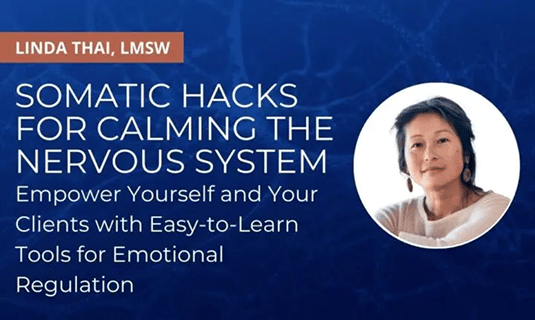
What you´ll learn:
- Vestibular Engagement for Emotional Regulation
- Using the Eyes to Hack the Stress Response System
- Subtle Sounds to Release the Peri-Trauma Response
- Effective Self-Holding and Self-Swaddling Techniques
- How and When to Apply Bilateral Stimulation
- Integration and Completing the Stress Response Cycle