
Dear Friends,
I know we need a strong, powerful movement toward peace now more than ever. And in this cycle of my life, I find myself wondering how I can most effectively contribute.
Part of me wants to go to peace demonstrations. But with healing neck bones, I can’t afford any confrontation. That physical limitation has forced a deeper question: If I can’t show up in the way my younger self might have, how do I show up now?
Culturally, I carry imprints to try to perform impressive heroic acts to make a difference. But if I’m honest, that striving has some drops of ego and pride mixed into not-so-pure intention.
That realization is humbling.
Most of us in the Therapy Wisdom community didn’t choose this work casually. We wanted to help. To reduce suffering. To stand for something that matters. And yet, there are moments when the desire to be useful quietly turns into the desire to be important. To be seen as wise, ethical, or on the “right side” of history.
If that resonates with you, it doesn’t make you a bad therapist. It makes you human.
In times like these, when the world feels loud and reactive, it’s easy to believe that meaning must come exclusively from bold actions, strong positions, and visible impact. Even in your professional life, there can be pressure to speak louder, produce more, or prove your relevance.
But meaning doesn’t always arrive through force.
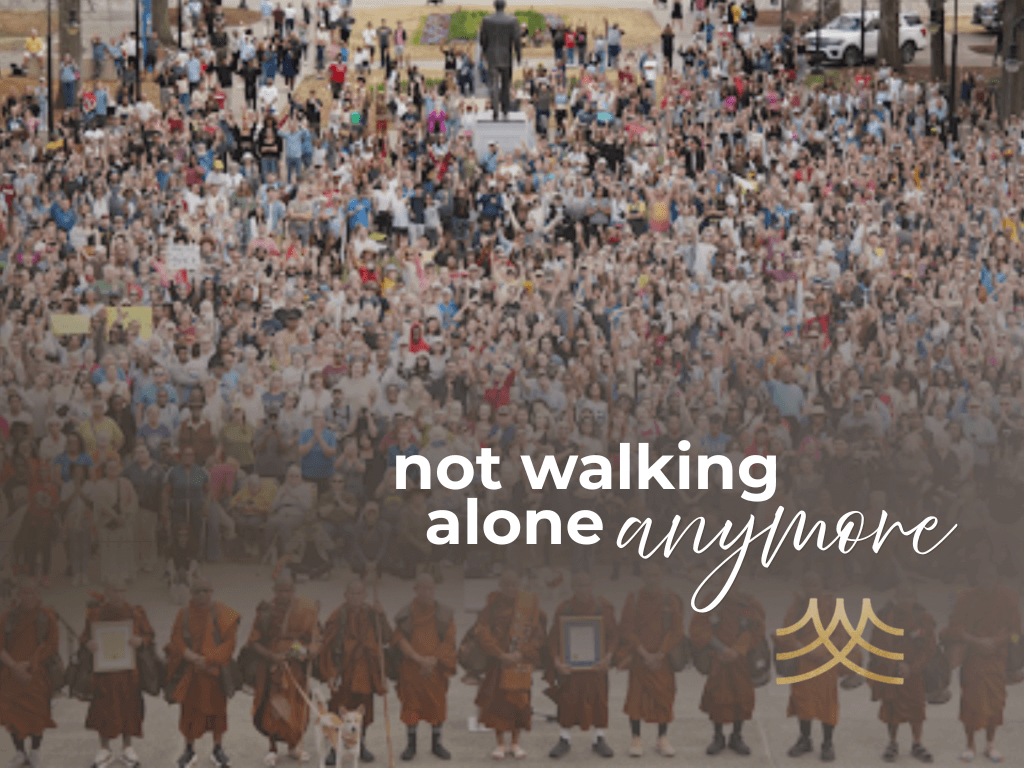
I’ve been deeply moved by two dozen monks walking 2,600 miles across the United States as part of a Walk for Peace, expected to arrive at the White House today. There is no political or religious messaging. No debates. No PR stunts. Just walking, day after day, through snow and uncertainty, making their way toward as many state capitals as possible.
And something unexpected happens when leadership is purely about peace.
People soften. Strangers embrace. Food and warm clothing appear, and funds are even raised for a dog in need of medical care. Children stand quietly, watching. People unfamiliar with the monks’ traditions feel a calm they can’t explain. Nothing is being sold or being demanded. Yet something is unmistakably transmitted.
As a therapist, this should feel familiar.
You know that presence often does more than persuasion. That regulation precedes insight. That a calm, steady mind is contagious. By simply being, something in the room begins to reorganize.
When people ask, “How do I live a meaningful life?” we need to be careful and know that meaning is not a feeling like happiness or fulfillment. Those rise and fall. It does not come from constant opposition or righteous intensity.
Meaning seems to emerge when we take responsibility for something that matters and commit to it with sincerity, even when no one is watching.
For therapists, that commitment might look like staying with a client when there is no solution. Choosing ethical care over visibility.
Regulating your own nervous system instead of trying to fix the world. Letting humility guide you when certainty feels tempting.
Perhaps the next Dalai Lama, the next Rabbi Abraham Heschel, the next Muhammad, is not an individual, but the community as an ecosystem of grounded, regulated, compassionate humans.
That’s us.
We are not walking alone anymore.
Peace,
Brian
Apologies, we recently experienced a malware attack on our site. Our tech team has assured us that your data was never compromised, it is safe and secure. We’ve been experiencing slower load times as our servers reset. Thank you for your patience!
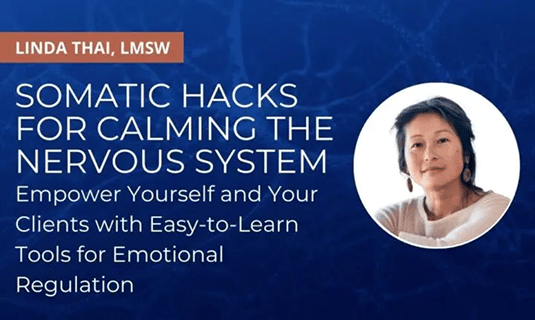
What you´ll learn:
- Vestibular Engagement for Emotional Regulation
- Using the Eyes to Hack the Stress Response System
- Subtle Sounds to Release the Peri-Trauma Response
- Effective Self-Holding and Self-Swaddling Techniques
- How and When to Apply Bilateral Stimulation
- Integration and Completing the Stress Response Cycle