

Each year we open submissions for our Annual Wise Therapy Spotlight, where we ask a question of particular importance to our wider therapist community. We are always moved by the depth and generosity of our community voices.
This year, we asked our community, What Is the Soul of Therapy? Read more about our inspiration for this, our 5th edition, in the letter from the editors and Academy of Therapy Wisdom founders, Brian and Ian.
Continue here to read the submission by Ana Karen San Emeterio Castillo, Certified Art Therapist (BA, DKATI). We hope you enjoy it as much as we all did.

Fostering Hope in Times of Global Uncertainty
Acquiring wellness, coming home to oneself, improving quality of life, reaching self-actualization, and coping with challenges positively are all things we hear people searching for therapy want to bring into their lives. From the art therapy framework I accompany people, these goals cannot be seen as separate from justice-doing (Reynolds, 2014).
The path that led me into art therapy was activism. I am a survivor of gender violence and was part of a Mexican women’s collective that promoted through creative strategies the human rights of people living in the street, displaced people, and migrant communities. While taking action made us feel less helpless amidst the realities we saw every day, a part of us was withering. I wondered how we could make this work emotionally sustainable and if art therapy could be a tool to achieve it. This background and experience migrating are some of the most significant components that informed my knowledge of how the processes of colonization and systems of oppression have marginalized specific ways of being and generated power dynamics that keep this in place through discourses and policies that reinforce disconnection, prejudice, and discrimination against all which does not comply to the norm. When I was trying to figure out how art therapy and activism could intersect, I came across with Vikki Reynolds’ concept of justice-doing and have integrated into my practice some of the elements she proposes, for example, witnessing as an active role, the importance of interconnectedness, celebration of the acts of resistance of the people not mattering if they are “successful,” critical thinking along with accountability, and placing dignity at the center of the work. (Other mental health professionals I look at for reference on how to approach the hurt derived from the disparity that the people I accompany face, from a social justice lens, are Gabor Maté, Jennifer Mullan, Kai Cheng Thom, and Resmaa Menakem, to name a few).
Reflecting on what exists at the golden core of my art therapy practice, I found these four tenets: co-creation of dignity, co-creation of safety, working with “safe enough,” radical tenderness (Coleman & D’Emilia, 2014 ), and celebration of people’s resistance.
- Co-creation of dignity.
Through the therapeutic alliance, the participant and us, the therapist, co-create dignity. One of the things that survivors of violence or marginalized people have gone through is being subjected to discourses and policies that question our value as people or contest the idea that we deserve to be treated with respect. Making sure to create space where the people that we accompany with therapy feel that all of who they are, what they decide to share as well as their silences are welcome and held with care is essential, as well as taking actions to create balance in the power dynamics embedded within the therapeutic relationship by approaching with transparency, not exercising interpretive violence, emphasizing the freedom of choice, and meeting them where they are without judgment.
- Co-creation of safety and working with “safe enough.”
For a lot of the people I work with, safety has felt, at best, an off-and-on experience and, at worst, an unattainable privilege. We must not assume that because the therapeutic space was created with care and intention to be a safe container, that is the experience they are having. Therapeutic safety is co-created and is a process. It requires understanding how trauma (individual, intergenerational, cultural) works and what happens when leaving spaces that feel unsafe is not an option. Providing tools for facing these realities and learning how to allow respite to our nervous system within these realities is essential while acknowledging that, for some, trauma and lack of safety are ongoing everyday experiences, and accepting without demonizing the coping mechanisms that allows them to continue living while we work together on finding more benign options. Finally, and equally important, is the acknowledgment that our job of creating safety goes beyond the session; it expands into reflecting on how and where we do our work, the organizations or care programs that employ us, the associations we are part of, and knowing what type of policies and protocols we implement, if they support oppressive practices that may harm the populations we work with or not, and if there are mechanisms in place to holding us accountable.
- Radical tenderness
I have adopted some aspects of transfeminist activists and educators d’Emilia & Coleman’s concept of radical tenderness as guides for my therapeutic interactions. Starting by being critical and tender with ourselves and others, accepting that having contradictions is human and that our identities are constantly transforming. Remembering our interconnectedness, yes, we are here to hold space, but we are also responding with our whole being to this experience. Remember to be open to letting ourselves be transformed with every interaction and refusing to conform to the idea of the therapist as an empty vessel or passive witness. Finally, practicing how to be with what we do not understand or agree with from a place of respect and curiosity instead of judgment.
- Celebration of people’s resistance.
We sometimes fail to highlight what we have tried to feel better if the outcome was different from what we expected. It is then crucial to amplify our sense of autonomy and power in the face of policies and systems designed for the opposite to make room for celebrating life and each act of resistance. To approach the experiences that were not successful with an open, reflective mind to be able to recognize the effort and emotional resources put in them, the drive we have to effect change in our life and see them as proof that we are not just resilient but able to take action and celebrate the joy we do have, to learn from other generations before us that we have creative tools to transmute all the heaviness in our hearts in something that fuels our soul. Reframing these attempts and celebrating them, as well as our successes, helps us to be able to sit with uncertainty without losing ourselves (our physical health, our spirit, or the ability to keep our hearts open without dissociating or numbing) in the process.
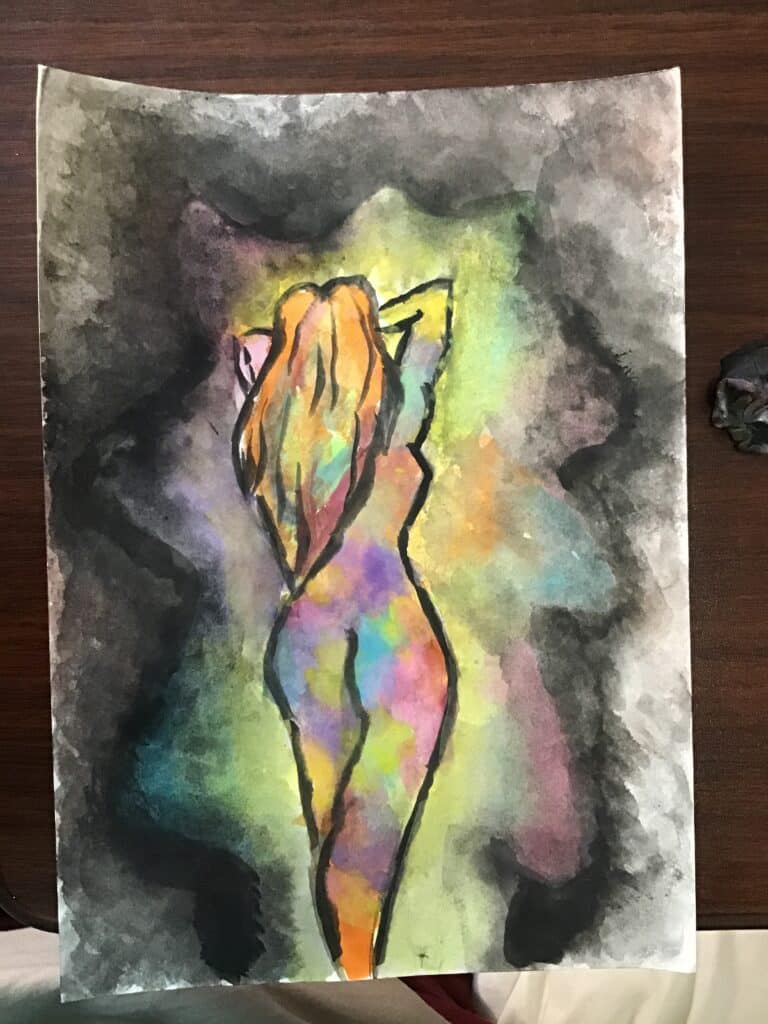
Part of our work as therapists is holding both: believing that the clients can be active agents of their healing process and have the capacity to self-actualize through inner work while acknowledging that we do live in a system that limits our access to safety and have our basic needs covered and for this to change it needs to happen at a systemic level. Art therapy is a powerful tool to explore this ambivalence, especially when talking feels too hard or we feel words are not enough to hold the uncertainty mixed with pain, tiredness, helplessness, and anger of the world, or when we need a way to start exploring how to find joy, beauty and celebrate existence while holding all of this complexity.
We can be a voice that amplifies within the people we accompany the belief that even drylands can be revitalized and that green can flourish in them again with care, proper tools and strategies, inner work, and patience. We can be a voice that reminds them, and ourselves, to expand our vision to look for and celebrate expressions of joy and resistance around us and within us when it feels there is just pain and uncertainty for our societies and our planet, especially when living in less privileged places or communities.
The work we do requires us to keep believing and being able to acknowledge the world as it currently is without compromising our drive to change the status quo. It requires conducting ourselves to higher ethical standards, flexibility, accountability, and self-compassion to be willing to commit to the process of unlearning and revising our beliefs and being okay with not knowing and sitting with uncertainty. Being a therapist is choosing to share the best part of our humanity and put it at service, the part of us that holds sacred the belief that all people deserve spaces to heal where we can experience dignity, connection, safety, joy, and belonging. Let us keep holding onto that and fostering hope within ourselves and our clients in a world full of echoes of pain and uncertainty.
REFERENCES
D’Emilia, D. & Coleman, D. B. (2014). Radical Tenderness Manifesto.
Reynolds, V. (2019). Justice-Doing at the Intersections of Power. Dulwich Centre Publications.
Mullan, J. (2023). Decolonizing Therapy: Oppression, Historical Trauma, and Politicizing Your Practice. W.
W. Norton & Company.
The views expressed in this essay are not necessarily the opinions of Academy of Therapy Wisdom, its presenters or its staff. This is part of a series featuring the unedited voices of our community in conversation. All content is used with permission and is copyright 2024 by Academy of Therapy Wisdom. Only the author may reproduce their content.
To read more articles or download a free copy of the final publication visit Wise Therapy Spotlight.