
We take our selection of courses for therapists very seriously, listening to our student and faculty needs, and striving to keep our finger on the pulse of important trends in psychotherapy so that we can provide the best and most-needed training that helps you create even more positive change in the world. For some time now, as we follow the news and mental health statistics, we have been taking notice of the growing trends in mental health risk among gender diverse youth and it has worried us.
Something we think is important to remember is that these “gender diverse youth” are not a distant subset of the population to be seen as statistics and specialties that some of us help and others refer out to “specialists”. These ARE our youth, and they need us all to do our very best to include them, and give them expert care and attention, even when it stretches our comfort zone and skills to do so. The recent APA reports support this, and we want to make sure you are aware of the trends while offering some ways to help you navigate them and respond in your unique professional way.
Mental Health Trends: 2024 Monitor Report by the APA
The American Psychology Association recently published their special report 12 EMERGING TRENDS FOR 2024 What’s ahead for psychologists and the field? and we´ve gone from worried to alarmed. Among the 12 trends covered, APA highlighted the mental health risk to the LGBTQ+ community as heavily influenced by policy trends. They also spoke to how psychologists can fight back by advocating for their clients, and continuing to give them the care they need and deserve, even as policy changes threaten to reduce their legal capacity to do so.
We know that, as a community of educators and therapists, we can and must do more. At Academy of Therapy Wisdom, our entire team is committed to helping psychotherapists expertly support diverse people as part of their regular clinical practice, overwriting an outdated paradigm that the issues of diverse clients (such as our LGBTQ+ youth) were something to refer to a “specialist”. We agree with Sarah Burgamy, Psy.D., our resident gender diversity specialist, who asserts (along with many of her peers) that gender identity is too much a part of the core human identity for therapists to not know how to work with it. Sarah leads our popular (and free) gender identity training for therapists Everything You Wanted To Know About Gender Identity But Were Afraid to Ask! Or, Who Says Gender-Competent Mental Health is a Specialty?
We need to help these people navigate gender land, especially young people and their families.
Because our education did not prepare us to competently work with gender diverse clients, therapists have shied away from clients like these, and where possible, referred them to “specialists”.
However, unlike specialization areas such as eating disorders or PTSD, gender identity is too much a part of the core human identity for therapists to not know how to work with it.
You need to feel competent and confident when working with your clients to address this sensitive, universal part of being human.
– Sarah Burgamy, Psy.D.
2024 LGBTQ+ Mental Health Trends, Impacts, and Advocacy Efforts
In today’s landscape, LGBTQ+ individuals in the U.S. are facing a wave of concerning policies that are impacting their well-being and rights. From attempts to ban gender-affirming care for transgender youth to censorship of LGBTQ+ topics in schools, the challenges are significant and wide-reaching.
“The individuals affected by these policies may find it increasingly difficult to get the mental health care they need, too. As the legal environment becomes more fraught, psychologists may become wary of discussing health care services like abortion or gender-affirming care with their patients. But psychologists are already fighting back, both within the therapy office and beyond: They are empowering patients to advocate for themselves and fighting misinformation with science-based evidence.” – Rebecca A. Clay for APA Special Report
Here is a look at specific current trends, highlighted recently by a special trends in psychology 2024 report by the American Psychology Association.
Current Trends and Impacts:
- School Censorship: Efforts to ban or censor discussions on sexual orientation and gender identity in schools are on the rise. These policies are not just limiting educational opportunities but are directly affecting the mental health of LGBTQ+ youth.
- Anti-LGBTQ+ Legislation: A staggering number of anti-LGBTQ+ bills are in play, with detrimental effects on mental health. Young LGBTQ+ individuals are reporting poor mental health due to the hostile environment created by these policies.
- Gender-Affirming Care Restrictions: Policies targeting transgender and gender-diverse youth are particularly harmful. Restrictions on gender-affirming care have led to increased depression, suicidality, and decreased access to essential medical services.
Insights and Advocacy Efforts:
- Community Impact: These policies are not limited to specific groups; their repercussions are far-reaching, affecting families, friends, and health care providers.
- Psychologists’ Response: Psychologists are actively advocating for LGBTQ+ rights, both within their practices and in broader advocacy efforts. Organizations like the APA and The Trevor Project are supporting evidence-based advocacy to counter misinformation and protect LGBTQ+ rights.
- Individual Empowerment: Psychologists are empowering LGBTQ+ individuals to advocate for themselves in various ways, from protesting to engaging in political advocacy.
- Creating Change: By engaging in advocacy, sharing evidence-based information, getting more educated and trained to support gender diverse clients, and collaborating at different levels, mental health providers are playing a crucial role in supporting LGBTQ+ rights and well-being.
2023 U.S. National Survey on the Mental Health of LGBTQ Young People
The Trevor Project is a leading nonprofit organization focused on providing crisis intervention and suicide prevention services to LGBTQ+ youth, offering vital support and resources for mental health professionals looking to assist this vulnerable population.
The Trevor Project’s 2023 U.S. National Survey on the Mental Health of LGBTQ Young People highlights the experiences of over 28,000 LGBTQ+ individuals aged 13 to 24 in the United States.The survey reveals significant data:
- 85% of LGBTQ youth reported facing anti-LGBTQ victimization, linking it to increased suicide risk.
- 72% expressed a desire for mental health care but encountered barriers in accessing it.
- 94% emphasized the importance of creating affirming spaces and respecting pronouns to support LGBTQ youth.
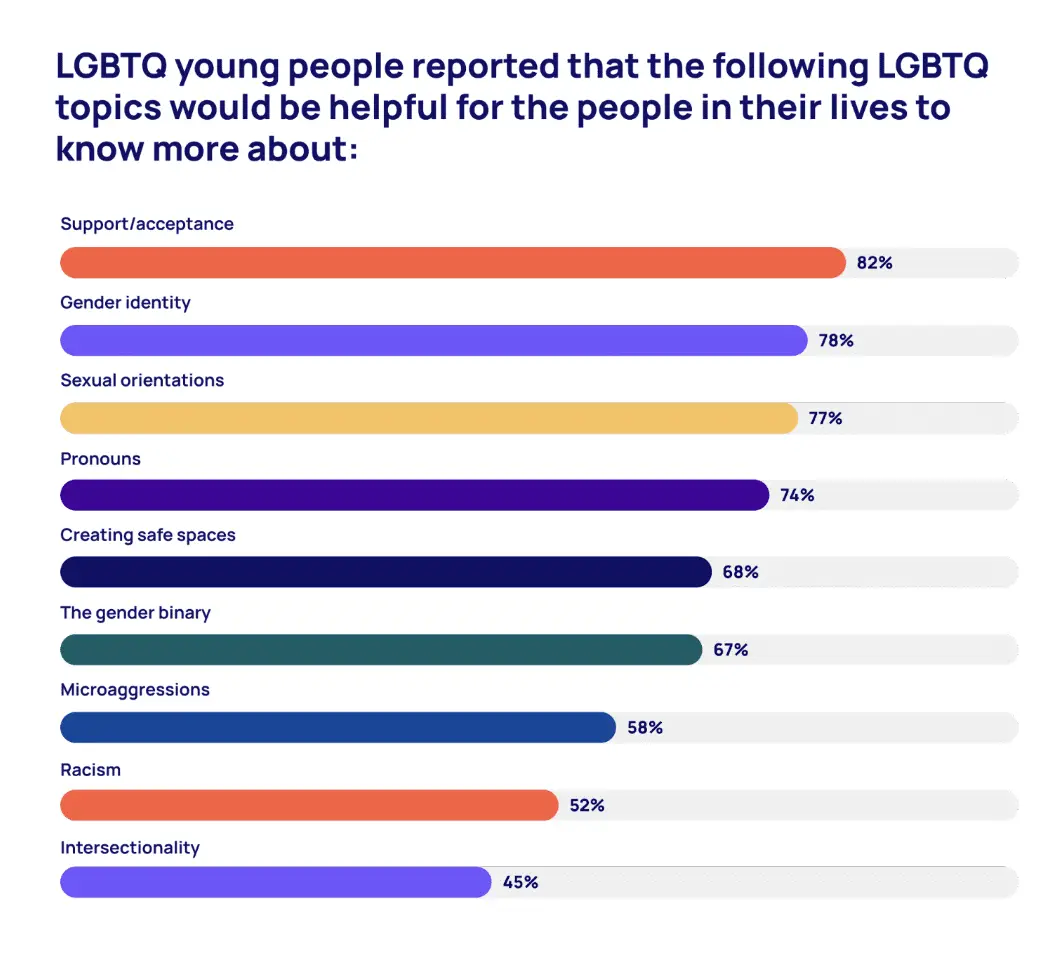
- 68% mentioned topics they wish others understood better about LGBTQ issues.
- In a new question, respondents imagined a world where LGBTQ acceptance is universal, showcasing their resilience and hope despite challenges and political adversity.

JOIN a FREE WEBINAR TRAINING with Sarah Burgamy, Psy.D
Everything You Wanted To Know about Gender-Competence But Were Afraid to Ask!
During this webinar, you will learn:
The ethical imperative of gender-inclusive mental health care
Gender identity as a global human phenomenon
The rising mental health needs of gender-questioning, gender-expansive people
Understanding the crucial mental health needs of gender-diverse children and adolescents and their caregivers
Additional Top-Line Facts & Statistics from The Trevor Project
- Suicide is the second leading cause of death among young people aged 10 to 14, and the third leading cause of death among 15-24 year olds (Centers for Disease Control and Prevention, 2022). Lesbian, gay, bisexual, transgender, queer, and questioning (LGBTQ+) young people are at significantly increased risk.
- LGBTQ+ young people are more than four times as likely to attempt suicide than their peers (Johns et al., 2019; Johns et al., 2020).
- The Trevor Project estimates that more than 1.8 million LGBTQ+ young people (ages 13-24) seriously consider suicide each year in the U.S. — and at least one attempts suicide every 45 seconds.
- The Trevor Project’s 2023 U.S. National Survey on the Mental Health of LGBTQ Young People found that 41% of LGBTQ+ young people seriously considered attempting suicide in the past year, including roughly half of transgender and nonbinary youth.
You Can Help Reverse These Latest Psychology Trends
In the face of these challenges, there is hope in the collective efforts of advocates, psychologists, and community members striving to create a more inclusive and supportive environment for LGBTQ+ individuals.
Learn More About 2024 Trends In Counseling
Gender-Competent Mental Health Training
We invite you to take a moment right now to hear from Sarah Burgamy on the importance of better understanding and being an ally for gender diverse clients. Here is a link to her free training, so that you can get started right now in better supporting diverse therapy clients you are currently working with, and the ones about to walk into your practice.
Everything You Wanted To Know about Gender Identity But Were Afraid to Ask! Or, Who Says Gender-Competent Mental Health is a Specialty? with Sarah Burgamy, Psy.D.
Be a Better LGBTQ+ Advocate
We encourage you to visit The Trevor Project to read more about important advocacy efforts, and direct ways you can support LGBTQ+ young people in your community and families. The organization does a great job of collecting data and working directly with youth. Here are some statistics they share that may be helpful to you as a psychotherapist, and of course as a concerned human.
Legislative Trends Affecting Mental Health in 2024
Here’s a look at a LGBTQ+ Legislation Heat Map created and maintained by The Trevor Project so that you can better understand the legislative climate of the state you live and/work which is likely affecting a number of your clients who identify as LGBTQ+, have LGBTQ+ family, friends, or colleagues, or serve this vulnerable population.
“The Trevor Project tracks legislation across the country that could affect LGBTQ+ young people. Below are policies being considered in 2023 as well as laws that have already been enacted, in both Map and List view. Click on a state to view policies, their status, and links to the legislation. You can also filter by bill categories and export and share data.”
Our Commitment to Diversity, Equality, and Inclusion
The Academy of Therapy Wisdom offers online therapy courses taught by a diverse faculty of experts in their field who care about your client outcomes, and your wellbeing as a therapist. Our free trainings and extended courses intersect the realms of psychotherapy, spirituality, and social change.
As a company, we are committed to elevating the voices of and providing training opportunities to marginalized mental health professionals, while also providing important diversity, equality, and inclusion training and resources to all mental health professionals so that together we may create a safer, healthier, and more inclusive world for all. Here are a few of the ways we endeavor to do that as part of our DEI commitment:
- We deliberately seek out and partner with lead teachers who are Black, Indigenous, and People of Color. Our target is a minimum of 35% of our courses led by BIPOC and LGBTQIA+ presenters.
- We seek BIPOC and LGBTQIA+ guest experts to provide course participants a broader perspective, as well as provide them exposure to the mental health community, especially those who are emerging leaders.
- We offer a variety of anti-bias courses for mental health professionals including courses on gender diversity, anti-racism, and navigating systemic trauma
If you are an expert in therapeutic practices that support creating safe spaces and better care for diverse and underserved people, and you are interested in offering a course with Academy of Therapy Wisdom, we warmly invite you to visit the section of our website dedicated to our mental health training faculty to learn more about our teachers, and to reach out to us about your interest. We look forward to hearing from you.