
Dear Friends,
For the past two years, we’ve been witnessing something unsettling in the mental health world.
It feels like our field is splitting into two very different futures at once.
Future #1: Therapy becomes more scalable, tech-enabled, and increasingly corporate.
Chatbots are offering emotional support at 3am. AI tools are writing notes. Private equity firms keep buying up therapy practices and treatment centers. Large telehealth companies are optimizing for efficiency, speed, and shareholder returns.
Not all of this is bad. I spent time this past week recording a podcast with Paul Hoard, who teaches at Seattle School of Theology and Psychology. He developed an app so students can practice their therapy skills before stepping into real sessions, without the agreeable bias of most AI apps. These tools solve real problems.
Therapy remains inaccessible for millions. Waitlists are long and costs are out of reach for many. Clinicians are burned out from documentation, insurance battles, and large caseloads. If AI can ease some of that load and help more people get care, that’s fair.
I suspect more therapists will start using AI the way accountants use software, or doctors use better diagnostic tools. It can remove friction and free up time. One reason we create the Wisepractice.io platform.
And there is another future emerging at the exact same time.
Future #2: People are starving for something more human.
Brené Brown has talked about how isolating modern life has become.
Despite all the tools we have for connection and gathering (iPhone, WhatsApp, Signal, Zoom, Uber, no one is stranded at home anymore), we are more hungry than ever for connection and meaning. So much of life has become synthetic.
Even our bodies are full of microplastics, and an NPR report yesterday described how ultra-processed foods and environmental chemicals are disrupting our gut microbiome in ways that may be fueling the rise in colon cancer, especially in younger people.
And the algorithms of social media keep us addicted for hours. At least that’s been my experience.
Over the past few months, I’ve had the privilege of sitting with extraordinary teachers, with the purpose of bringing this wisdom to you.
I spent four days filming with Hedy Schleifer and Paul Browde for their upcoming program on elderhood. I left feeling deeply moved by their warmth, humility, and hard-earned wisdom. Their presence itself felt medicinal.
I spent time with Grandmother Flordemayo, one of the 13 Indigenous Grandmothers, and was reminded that eldership is not something that magically appears on your 65th birthday like Medicare. It is cultivated through a lifetime of devotion, service, humility, and practice. Plus a lot of trial and error.
And we’ve been working with teachers like Staci Haines, who keep reminding us that healing is not merely individual. We are also living inside larger systems that shape our nervous systems, our relationships, and our sense of what’s possible.
These experiences leave me wondering, what exactly can be automated without loosing human connection?
Information? Absolutely. Scheduling? Of course. Documentation? Hopefully.
But can AI transmit wisdom earned through suffering?
Can it help us feel what it means to sit beside someone who is about to take their last breath?
Can it embody the steady nervous system of a therapist who has spent decades learning how to stay present with pain without turning away?
Can it replace the mysterious healing that happens when another regulated human nervous system sits across from us and quietly says, I’m here with you?
I don’t think so.
In fact, I suspect the opposite may happen.
The more automated therapy becomes, the more valuable deeply human clinicians will become.
Therapists who know how to create genuine connection.
Therapists who understand trauma not just as a diagnosis but as something held in our bodies, families, institutions, and communities.
Therapists committed to both study and embodiment.
Therapists who understand that healing often requires meaning, spirituality, community, grief work, and practices that cannot be reduced to an app.
If you ever doubt your edge, remember what Hedy reminded us: 93% of communication is non-verbal. How will AI ever compete with that?
This may be one of the greatest opportunities for conscious clinicians.
Not to compete with technology, but to become more fully human, to deepen your craft, to protect the soul of this profession, and to offer what machines cannot offer.
Presence. Discernment. Wisdom. Embodiment. Love. (Did I miss anything here?)
Those qualities may become increasingly rare, and at the same time increasingly needed.
Perhaps that is the strange irony of 2026.
The more therapy becomes automated, the more people will hunger for genuine humans.
With warmth,
Brian Spielmann
P.S. We’ll keep exploring these questions in upcoming conversations with teachers who remind us what deeply human healing actually looks like. Through trauma work, embodiment, relationships, spirituality, and collective care. It feels increasingly important right now. What are your thoughts on this? Share in our free Therapy Wisdom Hub. [Join the conversation here.]
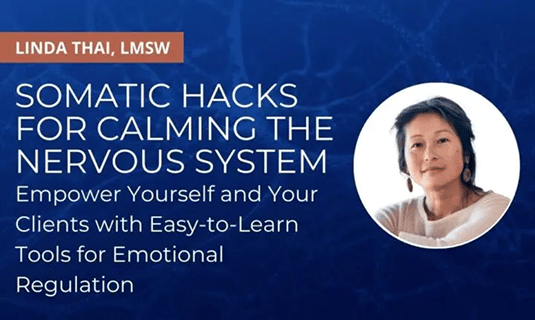
What you´ll learn:
- Vestibular Engagement for Emotional Regulation
- Using the Eyes to Hack the Stress Response System
- Subtle Sounds to Release the Peri-Trauma Response
- Effective Self-Holding and Self-Swaddling Techniques
- How and When to Apply Bilateral Stimulation
- Integration and Completing the Stress Response Cycle