
Dear Friends,
We live in a time of extraordinary prosperity and advancement, and at the same time, persistent suffering.
Our technology breakthroughs are off the chart. Our tools are faster, smarter, and more powerful than anything previous generations could imagine. And yet, despite all of this technological advancement including the brains of AI, war, racism, environmental devastation, tribalism, and deep inequity have not decreased.
We are not lacking information. We are not lacking resources. We are not even lacking solutions.
What we lack, and what we forget, is love.
Love as the basic motivation, the inspiration, the breath behind how we do anything.
Jack Kornfield, founder of Spirit Rock Meditation Center, writes about this recently with striking clarity. He points out that the roots of our collective suffering do not live primarily in broken systems or inadequate technology. They live in the human heart.
We know this intuitively. We feel it when we hear about children going hungry in Mississippi while we have overflowing grain storage in Iowa. When we have silos of food already bought by USAID rotting in storage while families starve overseas.
Something inside us recognizes that the problem is not capacity, but care.
Outer development without inner development cannot carry us forward.
Across cultures and wisdom traditions, we know that actions rooted in greed, fear, disrespect, and disconnection reliably create harm. Actions rooted in generosity, love, respect, marinated in wisdom, reliably create well-being. This is not moral theory. It is lived reality, observable in families, organizations, communities, and nations.
NASA astronaut Christina Koch spent 328 consecutive days aboard the International Space Station, the longest single spaceflight by a woman in history. After nearly eleven months of watching sunrises and sunsets sixteen times a day, orbiting our planet 5,248 times, what she came to recognize so deeply was that we are one planet.
“You don’t see borders, you don’t see religious lines, you don’t see political boundaries,” she said.“All you see is Earth and you see that we are way more alike than we are different.”
From that vantage point, the conflicts that divide countries and cultures seem almost absurd. The need to protect this fragile blue marble becomes urgent and obvious. What changes in space is not the planet. It is the heart and perspective of the person looking at it.
For those in the helping professions, this matters deeply.
Therapists sit at the intersection of inner life and outer world every day. You witness how unexamined fear and hatred hardens people. You also witness how compassion, when it is real and embodied, reorganizes a nervous system, a relationship, sometimes an entire life.
Love, in this sense, is not sentimentality. It is not positivity or avoidance or spiritual bypass.
Love is the steady capacity to stay present. To respect dignity. To act without domination. To include rather than exile.
And importantly, love is trainable.
The good news is that inner development is not abstract. There are practical ways to quiet the mind, soften reactivity, widen perspective, and strengthen care for self and others. These practices are increasingly being integrated with modern psychology, trauma-informed work, and neuroscience, not as ideology, but as skill.
This integration is already changing the culture of care. It is becoming more relational and less hierarchical. More inclusive. More attuned to self-compassion as a necessary counterweight to over-effort and burnout. More willing to meet suffering where it actually lives, in bodies, relationships, and systems.
Yes, these teachings are sometimes packaged, simplified, or commercialized. That has always been true. History suggests that wisdom survives this just fine. What matters is not the label or the lineage, but whether something genuinely helps human beings suffer less and live with greater integrity.
If love becomes common, almost invisible, woven into education, healthcare, leadership, parenting, and therapy, that is not dilution. That is success.
So perhaps the invitation is simpler than we think.
What if the work is not to defend traditions or perfect techniques, but to keep choosing actions rooted in generosity, respect, and care, again and again, in small human moments?
What if the future we are shaping depends less on what we call our methods, and more on the quality of presence we bring to one another?
It does not have to be called spirituality. It does not have to be called psychology. It does not even have to be called religion.
Let’s just call it love.
I’d love to hear from you: What does love look like in your practice? How do you cultivate it in yourself so you can offer it to others? Share your reflections with our community.
Warmly,
Brian
P.S. At Academy of Therapy Wisdom, we believe that the heart of great therapy is not just technique, but presence. That’s why we bring you teachers who embody both clinical excellence and deep humanity. If you’re looking to deepen your own practice of presence, consider joining our next LIVE course, starting next month: Integrative Therapy For Addiction And Compulsion: A Harm Reduction Approach with Andrew Tatarsky, Ph.D.
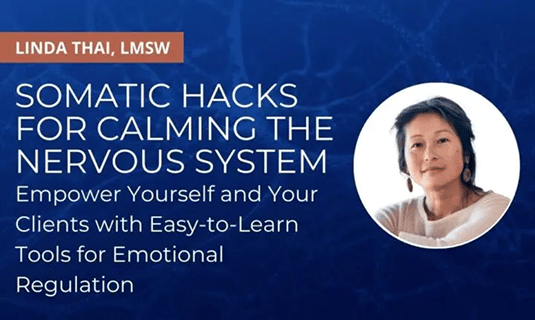
What you´ll learn:
- Vestibular Engagement for Emotional Regulation
- Using the Eyes to Hack the Stress Response System
- Subtle Sounds to Release the Peri-Trauma Response
- Effective Self-Holding and Self-Swaddling Techniques
- How and When to Apply Bilateral Stimulation
- Integration and Completing the Stress Response Cycle