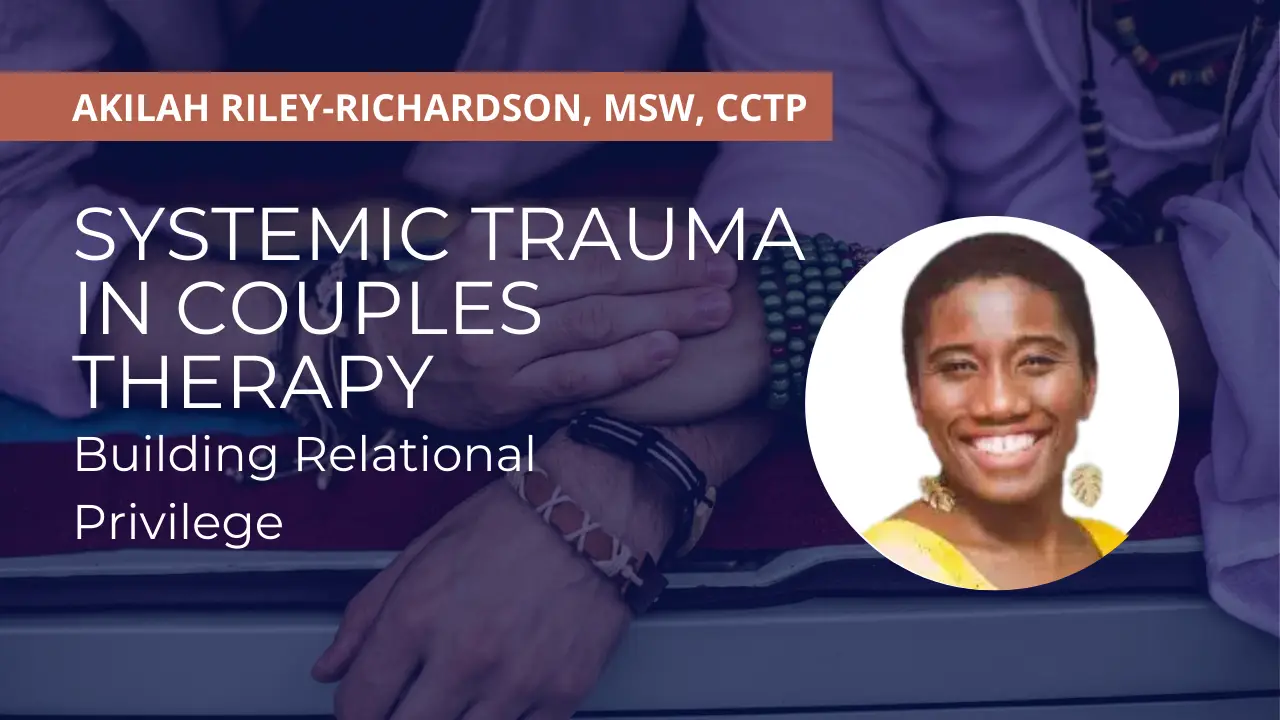
Akilah Riley-Richardson, MSW, CCTP
Hello
You have a precious opportunity with the couples you see:
You can help them grow their relational imagination — their ability to conceive of the intimacy they are worthy of.
Unfortunately, in many relationships, especially those where one or more partners has a marginalized identity, systemic trauma has made this very difficult.
From homophobia to racism to xenophobia, your clients may be impacted by marginalization… And even they might not be aware of how it is affecting their relationship.
But it does show up in intimate relationships. As hyper-aroused nervous systems, as disagreements about how to handle discrimination, as one partner feeling deeply, traumatically misunderstood.
Any of these responses to systemic trauma can deteriorate a couple’s relational imagination to the point that they feel totally stuck.
For marginalized couples and partners, intimacy is often experienced as an elusive relational privilege.
I have developed a model for assessing and repairing the impacts of systemic trauma that I call the P.R.I.D.E. method. You can use this approach with couples who are reckoning with any kind of systemic trauma or marginalization to lead them to Liberatory Connections, greater intimacy, and increased relational privilege.
We invite you to join us in a process that is designed to help you center the experiences of your clients, and help restore the sense of agency and worth in marginalized people. People of all races, genders, and sexual orientations are welcome.
FIVE On-demand TRAINING CALLS WITH AKILAH
ACCESS TO THE ACADEMY OF THERAPY WISDOM MEMBERSHIP SITE
SYSTEMIC TRAUMA IN COUPLES THERAPY TAKEHOMES
Here’s everything that’s included with Systemic Trauma in Couples Therapy
Resmaa Menakem - We Will Not Perform
adrienne maree brown - LIBERATION AND IMAGINATION: HOW WE CAN THINK DIFFERENTLY ABOUT OUR WORK
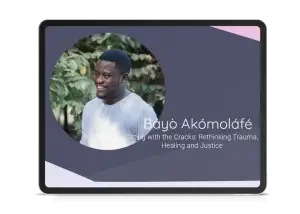
Sitting with the Cracks: Rethinking Trauma, Healing and Justice - A Conversation with Báyò Akómoláfé
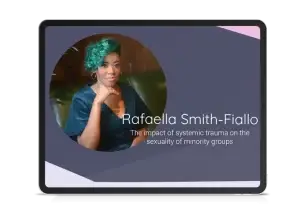
The impact of systemic trauma on the sexuality of minority groups with Rafaella Smith-Fiallo
The Neurobiology of Historical Trauma and Minority Stress - A Conversation with Juliane Taylor Shore
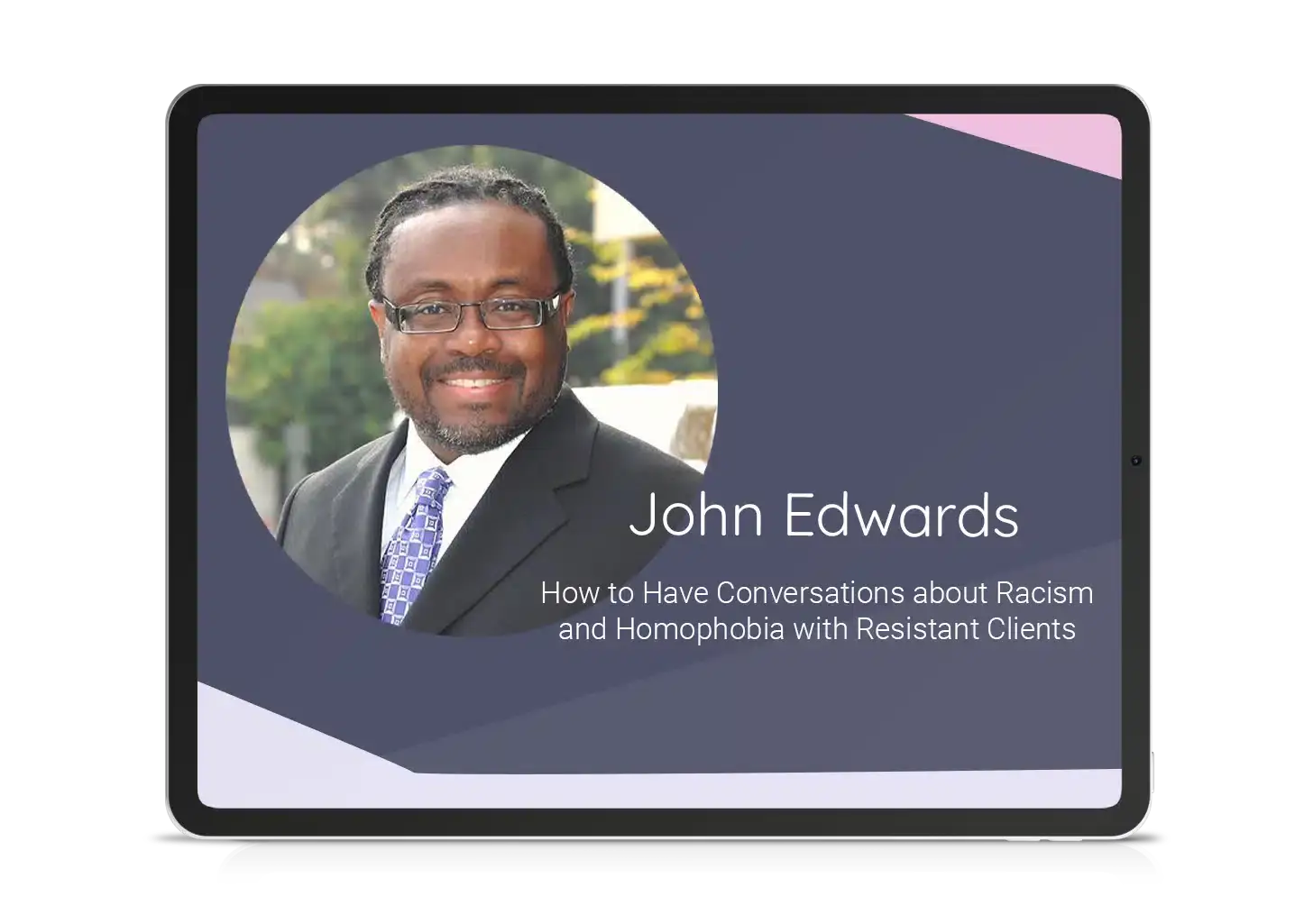
Repairing Rupture with Minoritized groups: What to do when you lose your lens with John Edwards
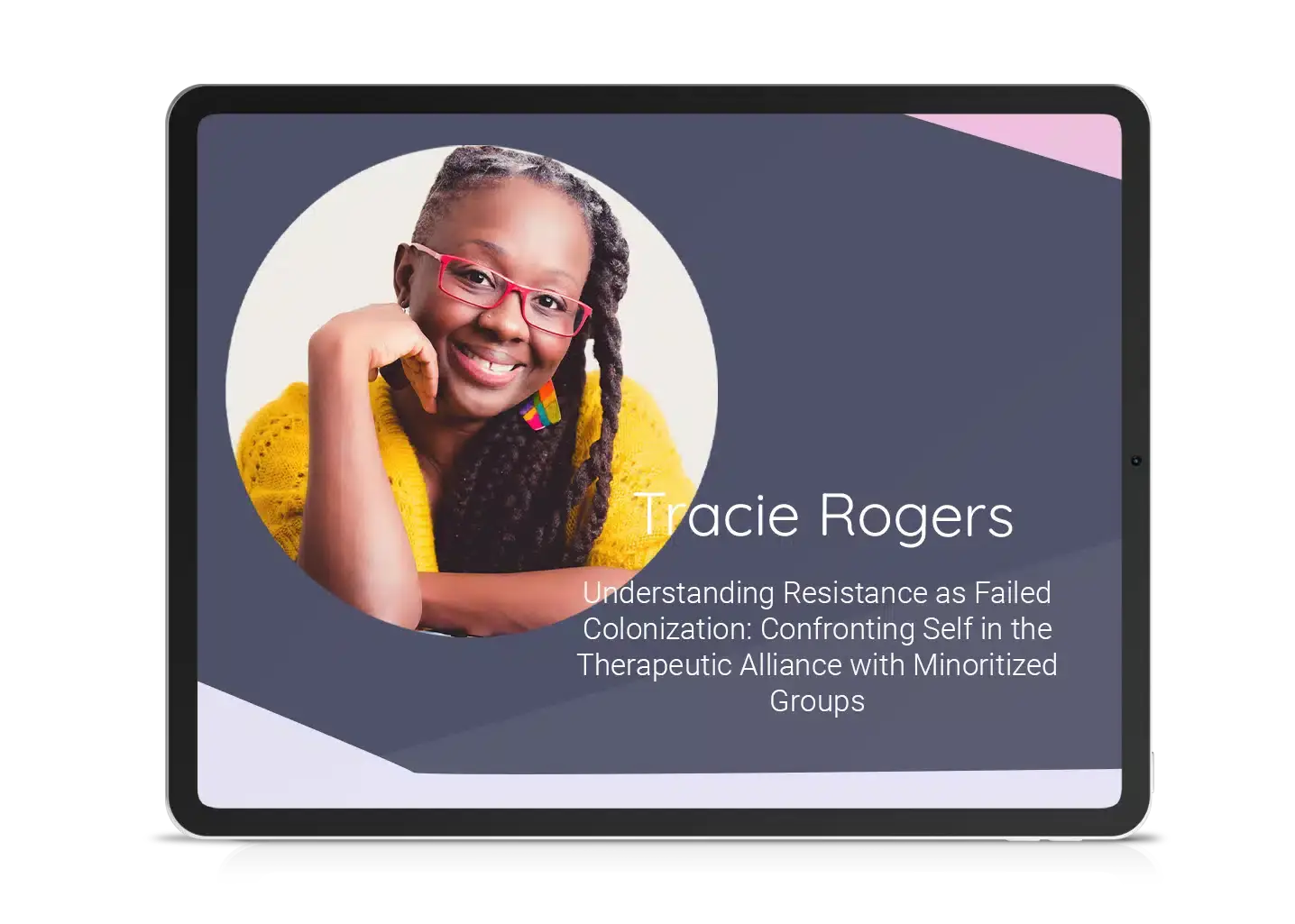
UNDERSTANDING RESISTANCE AS FAILED COLONIZATION: CONFRONTING SELF IN THE THERAPEUTIC ALLIANCE WITH MINORITIZED GROUPS WITH TRACIE ROGERS
The Narcissism of Our Field: Power, Privilege and Politics in Mental Health Education - a conversation with Stan Tatkin
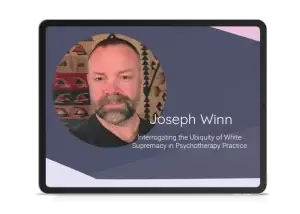
Interrogating the Pervasiveness of White Supremacy in Psychotherapy Practice with Joseph Winn
Plus, Get Access to 9 Incredible Interviews:
Understanding the Foundation of Work with Minorities, and the P.R.I.D.E. model
Therapy with marginalized couples and partnerships cannot simply mirror work done with other clients who benefit from various forms of privilege. This work requires an acknowledgment of the inequalities and the relational dynamics of marginalized couples. In this session, we will address the critical underpinnings that shape work with racial and sex minorities, and discuss the various forms and manifestations of systemic trauma that are experienced by these couples and partnerships. We will also begin to understand the critical role that the P.R.I.D.E (Pivoting, Rumbling, Imagining, Developing and Evolving) approach can play in liberatory work with marginalized people.
In this session, you will learn:
- How to practice and integrate Liberation psychology and epistemological hybridism into your work
- The various types of trauma experienced by racial and sexual minorities
- The ways in which therapists can possibly be perpetrators of “clinical marginalization” and clinical racism
- How to undo “clinical marginalization” via the P.R.I.D.E. model
- The four phases of working with marginalized couples and partnerships
- The role of emergence in working with marginalized couples and partnerships
- A reflection exercise in Epistemological Hybridism
Relational Interrogation (Part 1)
Minoritized groups are often denied life experiences that will allow them to develop safe, intimate relationships with their partners. In fact, injustice that is experienced outside of the relationship can show up in many ways within their own relationships. For marginalized couples and partners, intimacy is often experienced as an elusive privilege. In this session, Akilah will introduce and examine the concept of “Relational Privilege.” Additionally, she will discuss the six frames of Relational Interrogation used to assess the degree of relational privilege and the impact of systemic harm, which can give us some insight into the degree of relational privilege held by the couple. The first three frames will be explored thoroughly in this Session.
In this session, you will learn:
- The components of the Relational Privilege Wheel
- Managing and outing the therapist’s own relational privilege
- The idea of Relational Injustice
- How to use Frames One to Three of the Relational Interrogation framework for assessing the impact of systemic trauma on the couple’s/partners’ dynamics
- How to integrate epistemological hybridism and epistemic embracing into the assessment process
Relational Interrogation (Part 2) and Responsible Externalizing
The purpose of this session is to examine Frames Four to Six and their role in assessing Relational Privilege and the impact of Systemic Trauma on connection and intimacy. In this session, Akilah will also explore how to help couples and partners connect their microdynamics to wider systemic change, and to use this as a source of motivation for their own transformation. The concept of Responsible Externalizing as a critical tool in assisting couples to begin releasing the burden of systemic trauma on their relationships will also be discussed.
- Using Frames Four through Six of the Relational Interrogation framework to understand the impact of systemic trauma on the couple
- Co-constructing motivation with clients as an enactment of political and relational empowerment — from Micro to Macro
- Teaching Responsible Externalizing (interweaving critical consciousness and I-thou consciousness)
- How to practice “Epistemic embracing” during the assessment
Treating the Trauma and Building Liberatory Connections and Intimacy (LCI), Part 1
In this session, Akilah examines three methods of trauma work to treat the couple’s experience of systemic harm. Because systemic harm never ends, there is a need to do continuous trauma work with the couple and partners. Akilah also begins to explore three of the seven frames for Liberatory Connections and Intimacy (LCI) to help clients build healthy relationships.
In this session, you will learn:
- Using the ICN (Intergenerational Compassionate Network) in trauma work
- Integrating the SOMOS model in trauma work
- Developing Relational Healing Circles
- Defining the concepts of Supportive & Common Dyadic Coping and defining Liberatory Connections and Intimacy
- Building Relational Privilege and Liberatory Connections and Intimacy Strategies One to Three: “Identity and Interpersonal Cherishing,” “Boundaries Within and Around,” and “Decolonising the Relationship”
Building Liberatory Connections and Intimacy, Developing Relational Privilege, Part 2
In this session, Akilah will examine Strategies Four to Seven that can help marginalized couples and partners deepen their intimacy in the face of systemic oppression. She also discusses and practices the process of Relational Declarations.
In this session, you will learn:
- Tools to build healthy intimacy using Liberatory Connections and Intimacy Strategies Four to Seven: “Halting the Dance of the Stereotypes”, “Relational Imagination”, “Direct Requests” and “Building Relational Resilience”
- How to make Relational Declarations
- Relational Naming
- A reflection exercise in Epistemological Hybridism

Here’s what You’ll Learn in Systemic Trauma in Couples Therapy
Meet Your Presenter
AKILAH RILEY-RICHARDSON, MSW, CCTP
Akilah Riley-Richardson, MSW, CCTP is a dedicated therapist, educator, and researcher with several years of experience. As a Certified Clinical Trauma Professional and STAIR Method Certified clinician, Akilah specializes in relational healing, focusing on the needs of couples and individuals, both in the Caribbean and internationally. Her expertise extends to supporting sexual and racial minorities, ensuring that her practice is inclusive and culturally sensitive. Akilah’s commitment to education and advocacy has led her to consult for esteemed organizations, including NASTAD, I-TECH, CARPHA, and CVC, where she has made significant contributions to healthcare training and community support.
She has presented her work at various prestigious forums, such as the Psychotherapy Networker Symposium, Academy of Therapy Wisdom, Harvard Medical School, Chicago School of Psychology and the Black Mental Health Symposium. From 2012 to 2025, she served as a Social Work Educator at the University of the Southern Caribbean, mentoring future leaders in the field. Currently, she serves as a Research Supervisor and Examiner at the University of the West Indies Global Campus. As the founder of the Relational Healing Institute and the creator of the P.R.I.D.E. model, Akilah is passionate about advancing relational therapies. Her book, “Marginalized Couples in Therapy” reflects this passion.


Reviews
There are no reviews yet.