Dear Therapist,
Since the tragic deaths of George Floyd, Breonna Taylor, and many more, racial trauma is increasingly being recognized by the mainstream as a threat that people of color face on a daily basis.
Even the conservative Wall Street Journal recently published an article A Growing Push to Treat Racism’s Impact on Mental Health highlighting the effects of racism on the black community and their mental health.
In the context of racism and threats of violence, people of color experience threat on a daily basis in the form of “microaggressions.” As is true for battered wives or abused children or soldiers in wartime, danger is ever-present even when nothing frightening appears to be happening.
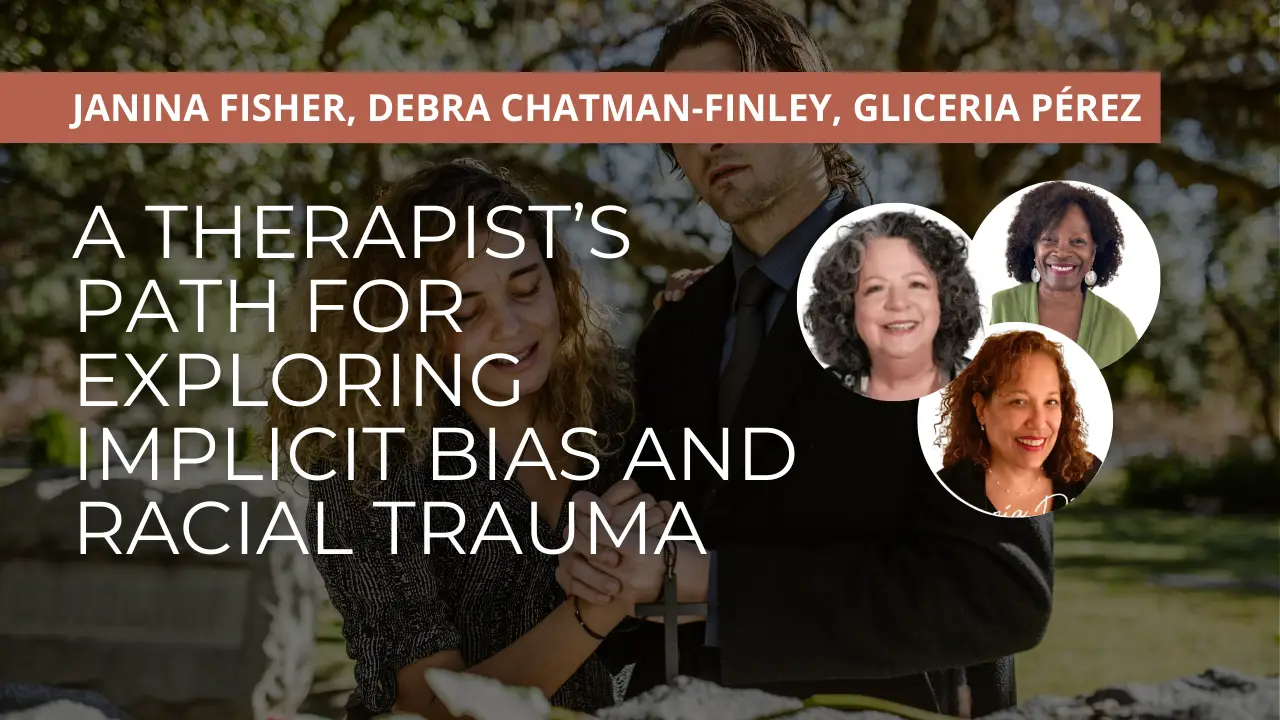
The three of us have joined together—Janina Fisher, Debra Chatman-Finley, and Gliceria Pérez—to share our perspectives as women of different colors walking through our current world. We feel that we embody the differences we plan to discuss in this program.
Over the course of three weeks, we will look at the role we play as therapists when dealing with microaggressions and racial trauma. We will ask ourselves:
How does racial trauma show up in the therapy room?
Do you find it difficult to validate or empathize with the experiences of your clients of color?
What has prevented therapists from recognizing its effects for so long?
After the traumatic death of Floyd, many people experienced an “A-ha!” moment, and these moments are when people are most open and willing to take in new information.
We want to take advantage of this openness and receptivity by creating an outlet for people to make sense of everything that’s happened in the past few months and get a better perspective on those events. This is also a safe place for all groups to vocalize their thoughts and feelings.
The goal of this course is to help everyone understand the experiences of people of color. When we see color and embrace our differences, we can work together to mend the inequalities in our world today.
We invite all races and groups to join us for this important and timely mini-course.
After this course, you’ll be adept at:
- Understanding and validating your client’s experience as a person of color
- Creating a safer place for a client of color to share experiences of racial trauma
- Recognizing the signs of racial traumatization in psychotherapy
- Understanding your own implicit bias and microaggressions.
- Helping clients by repairing moments of rupture or microaggression
Here’s Everything That’s Included In
Three 2-hour Video Sessions with Janina Fisher, Debra Chatman-Finley & Gliceria Pérez (6 hours of in-depth training)
User-Friendly Membership Site
Downloadable Replays of Each Session and Transcripts
Rewind: Cleanup Your Own Micro-Aggression
Neurobiological Effects of Racial Trauma: What it Means to Live with Threat by Janina Fisher
The Validate, Challenge, and Request Approach: A Practical Tool for Facilitating Difficult Dialogues by Kenneth V. Hardy
and An Exclusive Webinar Session With Dr. Nathalie Edmond:
Here’s What We'll Learn Together In
A Therapist’s Path for Exploring Implicit Bias and Racial Trauma
Understanding Implicit and Explicit Bias
Because implicit bias is always present, therapists must become aware of their own implicit biases in order to be effective in building trust, especially when working with clients of color. Acknowledgement of our implicit biases is a sign of health and self-awareness, not a sign of being ‘racist.’ Being curious and willing to know more about our clients’ experience of living in a world where racism is common yet rarely acknowledged builds trust.
Most white therapists have been trained to be ‘color blind’ rather than comfortable initiating discussions on race or microaggression. Rarely are they trained to understand the potential effects of their skin color or educational status on the client. In addition, anxiety about “saying the wrong thing” inhibits the therapist, while waiting for permission to talk about racial trauma inhibits the client. An important conversation may not occur unless the self of the therapist can recognize implicit bias in him- or herself and can help clients to share the experiences of implicit and explicit bias that have impacted them.
In this session, we will:
- Explore the phenomenon of implicit and explicit bias
- Re-interpret countertransference responses as a manifestation of implicit bias
- Describe how implicit racial bias can exist for both the clinician and clients of color
- Define “racial trauma” and its long lasting physical and psychological effects
Microaggression in the Clinical Setting
A microaggression is a verbal or nonverbal expression of implicit bias that evokes feelings of threat or shame in the recipient. Microaggressions are very commonly experienced by individuals of color and other oppressed social groups, but are particularly threatening in the context of racial trauma because a microaggression can be experienced as a forewarning of danger.
Microaggressions induce feelings not only of fear but also shame, dismissal, and vulnerability to intense self-doubt. Without the therapist’s understanding of the effects of microaggression, clients of color begin to question the reality of their own experiences rather than feeling validated in the therapy.
In this session, we will:
- Define and discuss examples of ‘racial microaggression’
- Differentiate three different types of racial microaggression
- Explore common ways that clinical settings can be ‘microaggressive’
- Increase our awareness of our own implicit biases and how they ‘leak out’ in clinical contexts
How The Delf Of The Therapist Can Create A Healing Space For The Client Of Honor
Because implicit bias is always present, therapists must become aware of their own implicit biases in order to be effective in building trust, especially when working with clients of color. Acknowledgement of our implicit biases is a sign of health and self-awareness, not a sign of being ‘racist.’ Being curious and willing to know more about our clients’ experience of living in a world where racism is common yet rarely acknowledged builds trust.
Most white therapists have been trained to be ‘color blind’ rather than comfortable initiating discussions on race or microaggression. Rarely are they trained to understand the potential effects of their skin color or educational status on the client. In addition, anxiety about “saying the wrong thing” inhibits the therapist, while waiting for permission to talk about racial trauma inhibits the client. An important conversation may not occur unless the self of the therapist can recognize implicit bias in him- or herself and can help clients to share the experiences of implicit and explicit bias that have impacted them.
In this session, we will:
- Discuss therapists’ implicit barriers to initiating conversation about race and racial trauma
- Explore the importance of validating client experiences of racism and microaggression
- Introduce two practical tools for self-assessing therapists’ beliefs and biases around race
- Describe clinical skills for creating a sense of safety for clients of color in the therapy session

Meet Your Presenter
Debra Chatman-Finley, LPC, NCC
a National Board-Certified Counselor in private practice in Montclair, NJ with over 20 years clinical experience. She is an Adjunct Professor at New York University, teaching Racial and Social Micro-Aggressions in Clinical Practice. She has also facilitated numerous workshops such as Micro-Aggressions: Making the Invisible Visible, and Unmasking Race With Interracial Couples. Debra has a Bachelor’s degree in Psychology and a Master’s degree in Counseling Psychology. She is a graduate and former Associate Faculty of the Multicultural Family Institute. Debra enhanced her expertise in the treatment of the traumatic effects of racial trauma on people of color through her training at the Trauma Center at the Justice Resource Institute in Boston, MA where she received her Certification in Traumatic Stress.
Gliceria Pérez, LCSW
a Master of Social Work degree from Fordham University Graduate School of Social Service. She has years of experience in the fields of mental health, trauma, domestic violence, and child abuse/neglect. For the past 14 years, Ms. Pérez has provided short-term therapy to traumatized immigrant children/adolescents and their families. Ms. Pérez is trained in Eye Movement Desensitization Reprocessing (EMDR) and completed the Certificate Program in Traumatic Stress Studies at the Trauma Center at JRI as well as the Multicultural Family Institute. Since 2011, she has been an Adjunct Faculty at New York University Silver School of Social Work. Ms. Pérez conducts workshops/presentations on parenting, trauma, microaggressions and immigration. She maintains a private practice in New Jersey.


Reviews
There are no reviews yet.