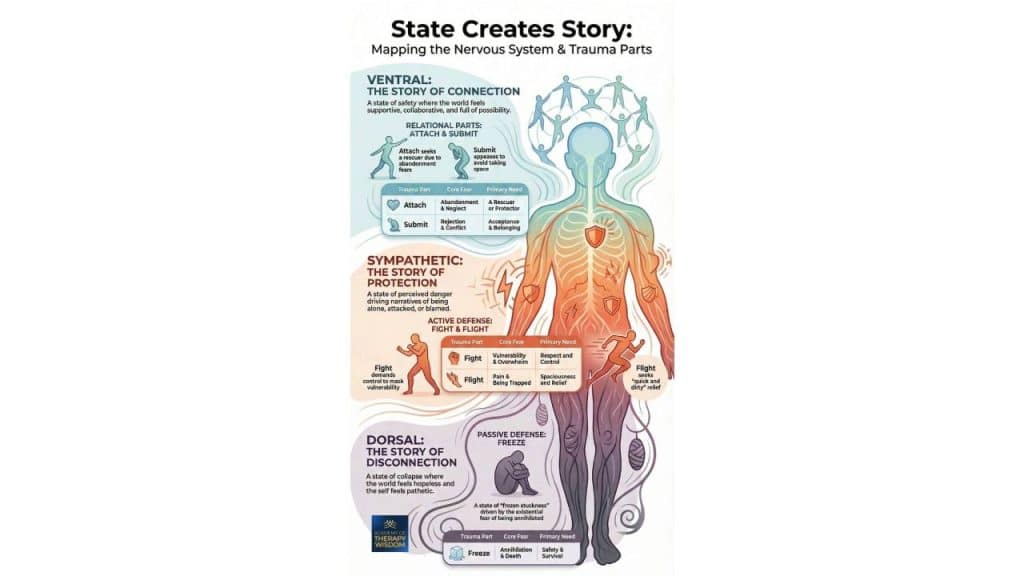


When we first start out training in Trauma-Informed Stabilization Treatment, it is important to build a strong foundation of tools that supports working with clients with trauma. The TIST therapist training with Janina Fisher begins by helping you to better understand your clients, and to understand their often puzzling and frustrating responses during counseling sessions.
A key benefit of using TIST trauma therapy techniques in your practice is that it takes the stress off of you. When you understand your clients as structurally dissociated, that they are struggling against a system of traumatized parts, and how to support them in a practical way, it becomes easier to help them and is much less stressful for you the therapist.
One invaluable tool we use in TIST trauma work is the pause.
This technique is so helpful, that Janina teaches it at the beginning of the course so that you can start using it right away. You can get a sense of this practice, and even start applying it in your next session with the help of today´s course excerpt from Helping Trauma Survivors Get Unstuck: A Fragmented Selves Approach in Therapy, Module 2: Foundational Skills for Trauma-Informed Stabilization: Differentiating Parts and Speaking Their Language.

Join Trauma Informed Stabilization Treatment Webinar by Dr. Janina Fisher
Helping Trauma Survivors Get Unstuck: A Fragmented Selves Approach in Therapy
In This NEW Janina Fisher Webinar you will learn:
How to understand perplexing clients using the TIST perspective so you can see the fragmented selves at work.
How to organize a treatment plan using the TIST model so you have an effective approach to care.
How TIST helps shift even the most stuck clients so they can finally make progress.
How to relieve your frustration and prevent burnout with more effective trauma treatment.
on April 4, 9-10am PDT / noon-1pm EDT / 5-6pm BST
Trauma-Informed Stabilization Treatment (TIST) – Level 1 with Janina Fisher (excerpt)
Janina shares…
The pause between the trigger and the response is where the healing happens. And this was sent to me by a former client of mine just today, and I thought it was really wonderful. So often clients, and she has a very good example, this is a client with DID, a long long history of anorexia, suicidality, self-harm. And so often, she and other clients have expressed this deep desire, “I don’t wanna be triggered. I’m tired of the triggering. If I work at this, can you tell me I won’t be triggered?” And I have to say triggering is part of life. Triggers don’t disappear from our lives, but we can learn how to relate to triggering differently. And so today, I’m going to teach you how to help clients put that pause in.
Now, I have found that it doesn’t help to ask them to pause between the trigger and the response, because they can’t do it and they feel that they failed, or they’re angry at me for asking of them something they can’t do. And so we’re going to in such a way that that pause has to happen. It has to become more and more familiar to the client.
And how do we get there?
Language of Parts in Trauma Therapy
We get there through the use of the language of parts. Because when my client is triggered, when my client has an impulse, and I say notice that part that has the impulse. Notice what part got triggered. That mindful awareness creates the pause.
We know from the brain scan research that when we are mindful, the medial prefrontal cortex, this part of the brain right above your forehead or right behind your forehead, becomes more active. That’s what’s associated with meditation, increased activity in the medial prefrontal cortex, and currently reduced activity in the amygdala, the tiny little structure buried deep in the brain that scans for threat and reacts to danger.
So when we activate the medial prefrontal cortex, we help the client create that pause.
How Janina Fisher Uses “The Pause” in Her Sessions
My job [as a therapist] is to help the client notice mindfully, not just intellectually, notice mindfully each part as it arises in the course of the conversation, in the course of daily life.
So the client says, “I’ve been really sad this week.” And I say, “Oh, a part of you is really sad, and she’s been very, very there this week.” And the client might say, “Yeah, well, you know, it’s the holidays, and the holiday suck.”
So now the client isn’t putting the pause in. So I’ve gotta put the pause in. So I say, “Yes, so this part is triggered by the holidays, as I’m sure many parts of you are.” “Yeah, I hate the holidays, I hate the holidays. I hate the fact that nobody gives to me and I have to give to everybody else.” And I say, “Oh, I hear the voice of a part that feels burdened by what feels like this tremendous, weighty responsibility to buy gifts.” And she says, “And I always overbuy because I’m always worried that people are not gonna like what I got. So then I get something else.” And I say, “Oh, is that the same part or is that a different part?” And then there’s more pausing because clients have to think. Is that the same?
This is actually a conversation I just had with a client a couple of days ago.
And so I said, “So the part that feels burdened by all this doing, is that the part that says, ‘Oh I don’t have enough presence for so-and-so. I don’t have enough presence for so-and-so.’?” And she said no. Actually, the part that says, “I don’t have enough presence for this person or I got the wrong thing for that person,” that part is just trying to please everybody. And she says, “But you know, does anybody ever thank me?” And I say, “Oh so that part wants to be recognized that she’s really given so much thought to what would please people.”
And then Annie had another pause and she said, “Yeah, I spent my entire childhood trying to figure out how to please people so maybe they wouldn’t hurt me.” And I said, “Oh, so this part is still trying to please people.” And I said, “Is that part still trying to please people who are unpleasable?” And she said, “Yes, my in-laws.” And she said, “They’ve never thanked me. They’ve never really responded. They don’t send gifts to us or our children.” And I said, “Maybe, maybe you could tell that part to cross them off the list.” And she said, “I never thought of that.” She said, “That part has been trying to… I’ve been married 30 years and that part is still trying to please them. And even my husband can’t please them.”
So again, we’re noticing part by part by part. And the pause is coming naturally because when I say, “Is that the same part or a different part?” There has to be a pause or that question can’t be answered.
How the Brain Responds to this TIST Therapy Technique
So the other thing that we’re doing is we’re keeping the prefrontal cortex online, firing, active, curious. And we know that that is crucial for resolving trauma. So very, very important, this language of parts. And we really have to think of it as if we’re teaching the client a second language, which means immersion… we have to get that repetition in order to learn fluency.
So I think of it as the therapist taking on the role of the simultaneous translator. When the client says I, I say part. The client says I again, I say part. The client is speaking the language of I, which is the first language of most of our clients. We’re translating what they say into the language of parts.
Very, very, very important piece of this work, particularly I’m remembering now some of the patients at the state hospital where we did the most extensive pilot study of this approach. They were all clients who regularly, on a weekly basis, harmed themselves, harmed others, or tried to commit suicide. So we couldn’t afford to go about this slowly. We had to do an immersion class in parts language so that they could learn to say “My suicidal part is on the rampage again. My anorexic part is not letting me eat this week.” And we had to be absolutely consistent because people’s lives were at stake.
A Simple Study Guide for TIST Therapy Parts Language
So here’s a very, very simple sort of a study guide with some of the most common expressions and wording for parts language, so that you can memorize those, and then you will find your fluency increase.
- Notice that sadness as a communication from some part.
- Notice the shame as a communication from some part of you.
- Notice the anger.
- Notice the suicidal ideation.
- Notice that impulse to drink as a communication from some part.
And then we want to increase curiosity about these parts… ask questions like:
- Does that part feel older or younger?
- Is that part more emotional or more impulsive?
- Would it be okay to hang out with that part?
- Is there an image that goes with that part…?
- What happens to that sadness when you name it as the feeling of a part?
- What happens to the shame when you name it as his shame, her shame, their shame?
- When you have that thought that it’s going to be okay, what happens to the sad part?
- When you’re best friends or your partner reminds you that they’re there, what happens to the sad part?
- When you come to therapy, what happens to the sad part? Does it get sadder or less sad?
- At what time of day does the sad part usually show up?
There are so many questions we can ask. The idea is we’re not searching for answers. We’re searching for curiosity because we wanna light up this part of the brain. That’s what creates the pause, right? We light up this part of the brain, and the client goes, “Oh.” And that’s the pause…”
Dive deeper into these and more practices to support yourself and your trauma clients with Janine Fisher´s Trauma-Informed Trauma Treatment (TIST) courses. Start Here: Helping Trauma Survivors Get Unstuck: A Fragmented Selves Approach in Therapy with Janine Fisher – TIST LEVEL 1 for Trauma Therapists